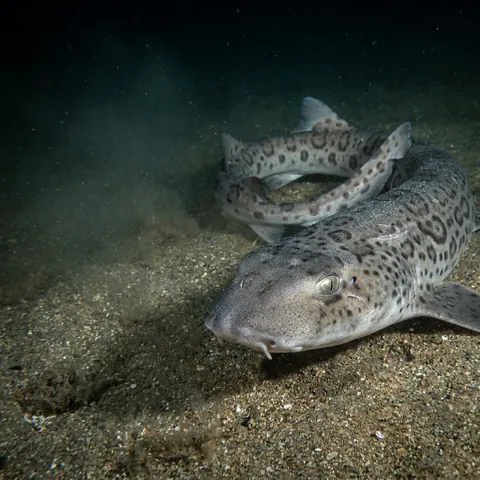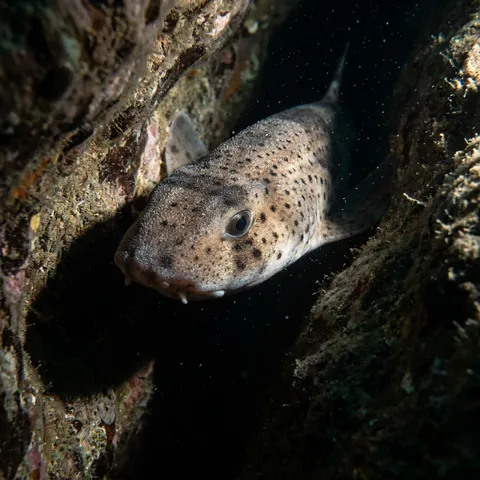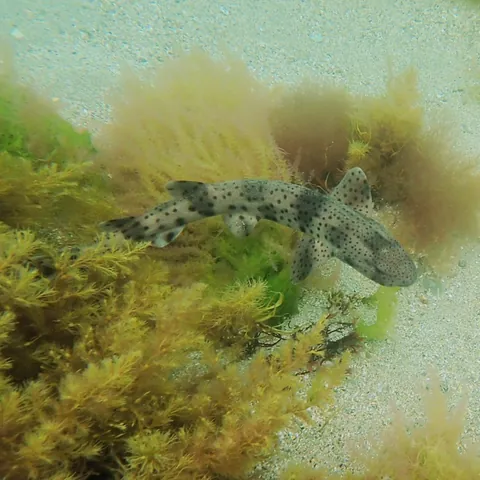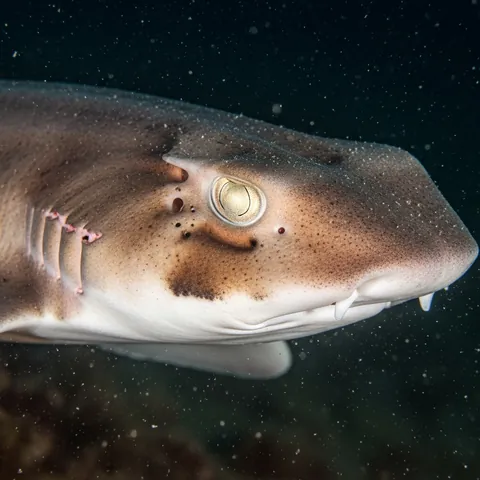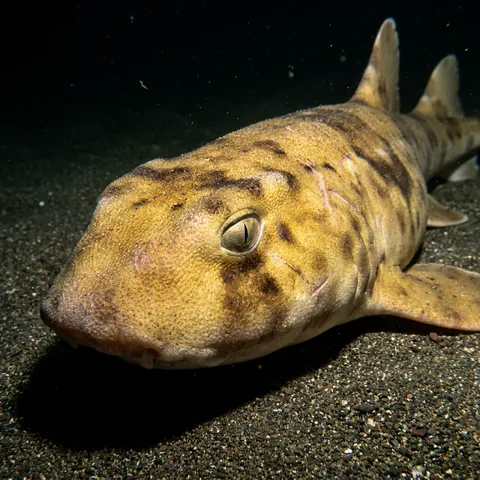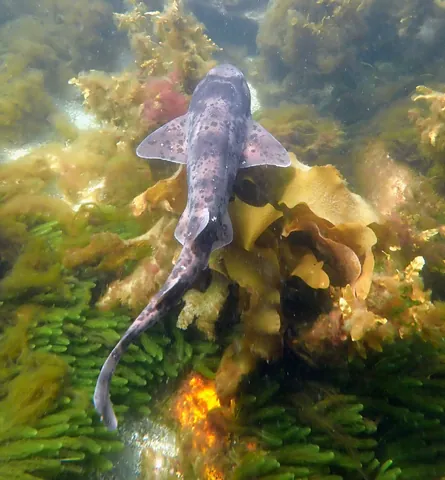
Draughtboard Shark
Cephaloscyllium laticeps
Poroderma africanum
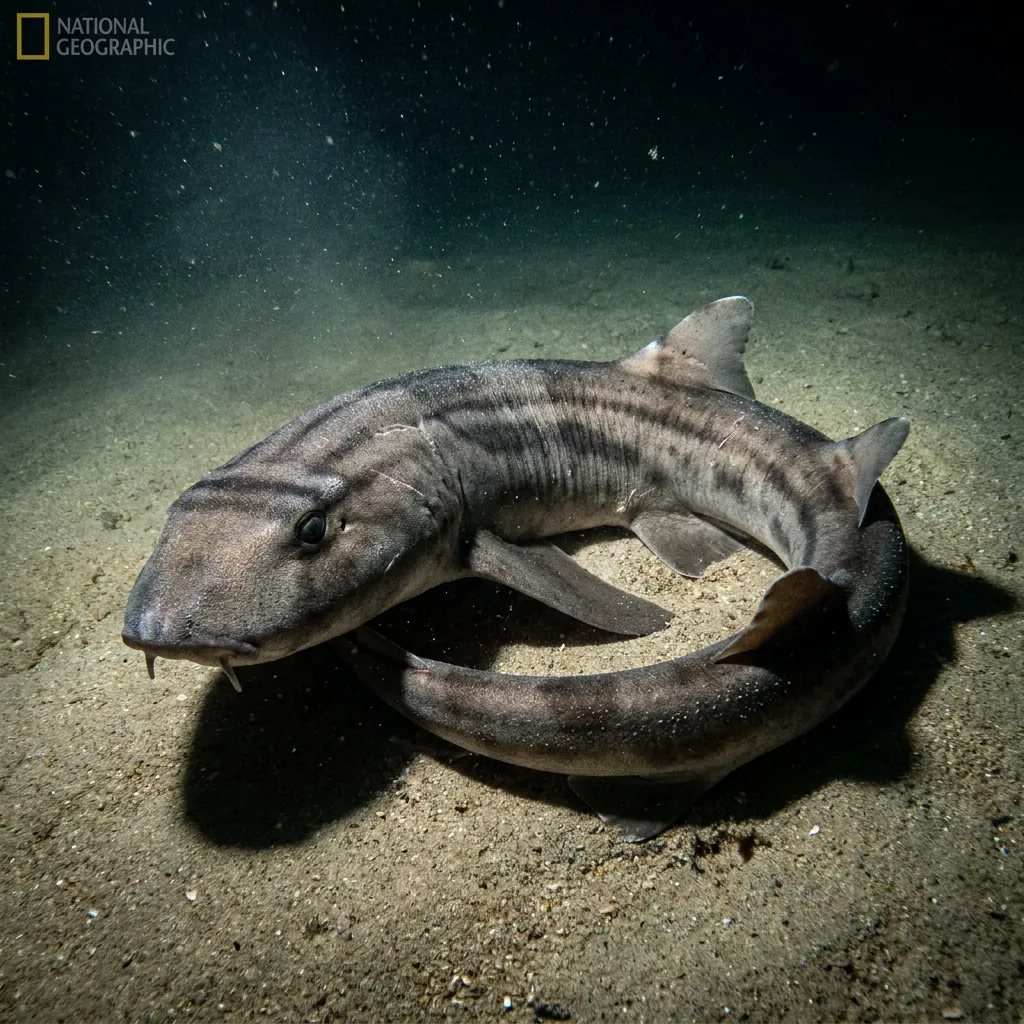
A slow-moving bottom shark of South Africa's cool inshore reefs, the pyjama shark grows up to 101 cm long and spends its days tucked into caves and kelp.
Also known as: striped catshark, striped dogfish, pyjama catshark
It can be confused with the leopard catshark, which shares its build and cave-dwelling habits. Look at the barbel in front of each nostril: on the pyjama shark it is noticeably thicker and falls short of the mouth.
This shark has a short, flattened head with a narrow, rounded snout. In front of each nostril sits a three-lobed flap of skin, its centre lobe drawn out into a stout barbel. The eyes are oval and set high on the head, above a thick ridge. Its broad mouth is arched, with short grooves at the corners, and the upper teeth stay visible even when the mouth is closed. The body is flattened side to side and tapers toward the tail, with two dorsal fins set far back, the first much larger than the second, and large, broad pectoral fins.
The pyjama shark lives only off South Africa, mainly around the Western Cape, from Table Bay to north of East London. It stays close to the bottom on rocky reefs and in kelp beds, usually in shallow water within 5 metres of the surface, though in places like Algoa Bay it has been found much deeper, down to around 100 metres.
This shark is a slow swimmer that rests by day in caves, crevices, or kelp, often alongside others, and comes out to hunt at night. It eats a wide range of small prey, including fish, hagfish, small sharks and rays, crustaceans, shellfish, worms, and squid or octopus, and will also scavenge dead fish. When it catches an octopus or cuttlefish, it grips a tentacle and twists it off. When threatened, it curls into a circle with its tail covering its head. Larger sharks, including the broadnose sevengill shark, prey on it.
Pyjama sharks have been seen working together, with three individuals attacking a single octopus at once and twisting off its tentacles.
Describe what you saw and we name it, then keep every species you find in your Oceandex.