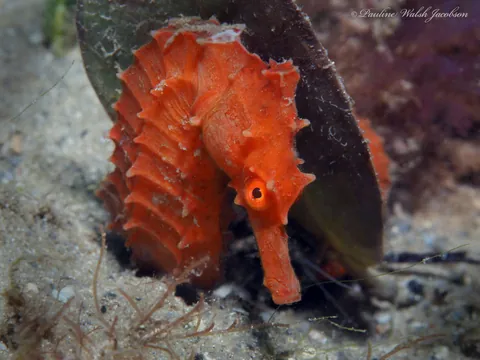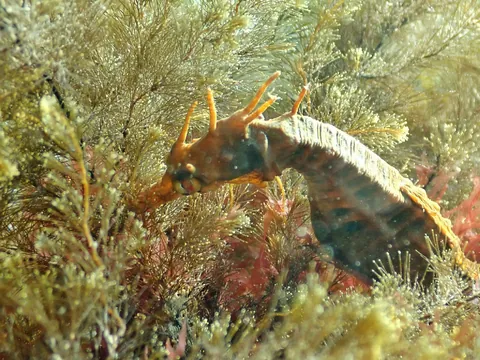
Bigbelly Seahorse
Hippocampus abdominalis
Hippocampus erectus
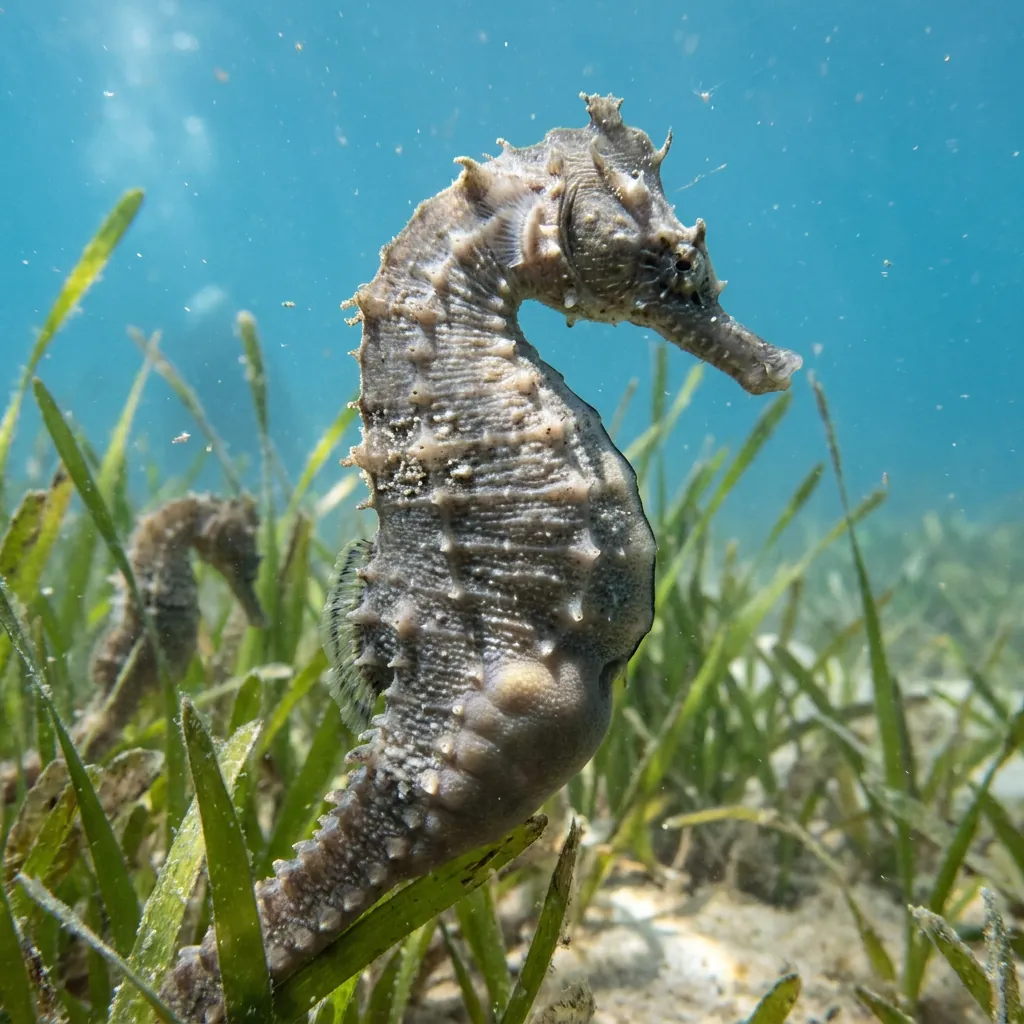
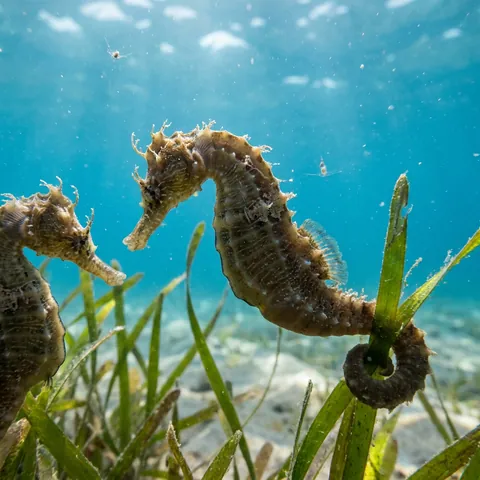
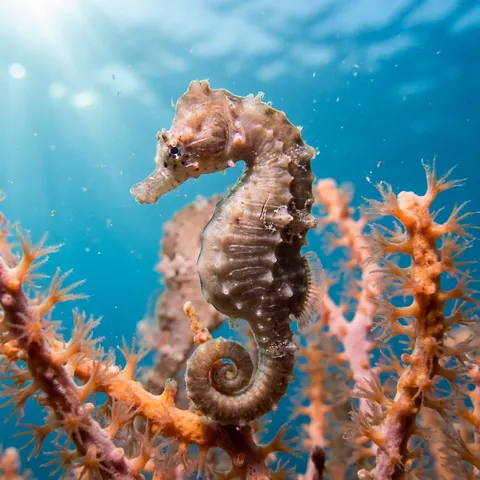
The northern seahorse swims upright with a horse-like head and a body built more like armour than a fish's. It lives along the Atlantic coast, drifting among seagrass and floating weed rather than chasing prey across open water.
Also known as: lined seahorse, spotted sea horse
Seahorse species can be hard to tell apart at a glance. The crown-like coronet on top of the head is the most reliable feature to check, since its shape and spines differ from one seahorse species to the next.
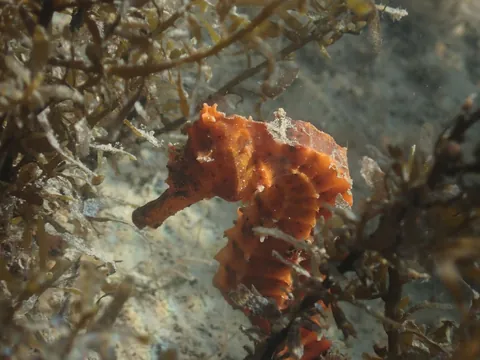
Its body is stiff and bony, made of a series of armour-like plates, and it holds itself upright in the water. Colour ranges widely between black, grey, brown, green, orange, red and yellow, usually paler on the front of the body, and can shift with its surroundings or mood. Males carry a pouch on the belly and have a longer, gripping tail than females. A crown-like bony ridge, called a coronet, sits on top of the head.
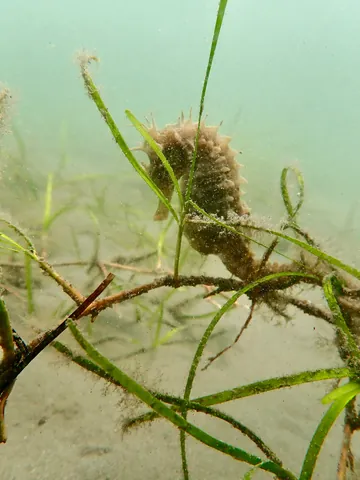
It lives along the Atlantic coast from around Nova Scotia south to Venezuela, including the Caribbean and Gulf coasts, at depths down to 73 m. It shelters among seagrass beds, sponges, mangroves and drifting mats of floating seaweed, with adults often gripping a stem or branch with their tail while young seahorses stay nearer the surface.
The northern seahorse is a weak swimmer, moving slowly in an upright posture by fanning its small back and side fins rather than powering through the water. It does not travel far, though it moves into deeper water during winter. Pairs stay together as mates and perform a greeting display together each morning.
It hunts tiny crustaceans, molluscs and drifting plankton, using colour change to blend into its surroundings while it waits. Once prey drifts close, it snaps its head forward and draws the prey in through its long, tube-like snout.
Courtship runs over several days, with paired males and females performing displays and both sometimes turning pale. The female then deposits her eggs into the male's belly pouch, where they are fertilised and carried until he releases the young.
The northern seahorse is listed as vulnerable. Its numbers are under pressure from habitat loss, pollution and coastal building, along with being caught, both by accident and on purpose, for the aquarium trade and traditional medicine.
Its excellent camouflage does not make up for weak swimming: studies show crabs, rays, seabirds, sharks, tuna and even dolphinfish still catch it once it drifts into view.
Describe what you saw and we name it, then keep every species you find in your Oceandex.