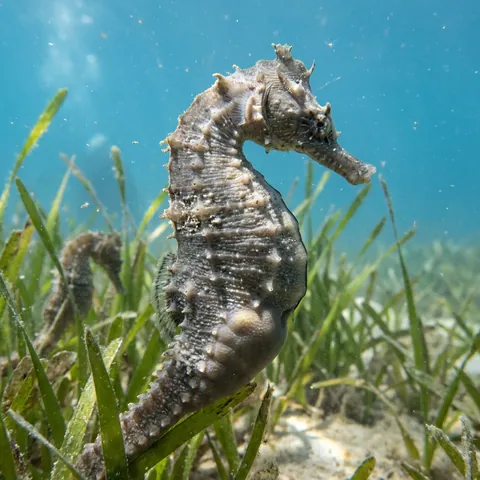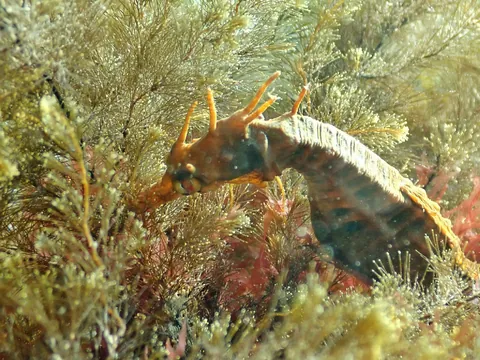
Bigbelly Seahorse
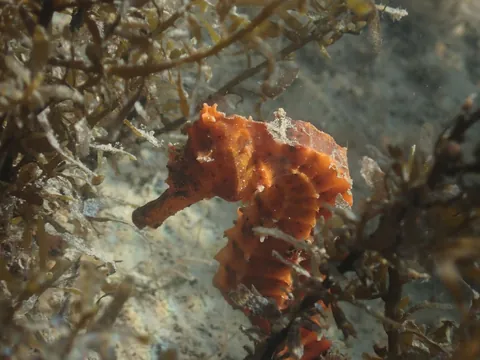
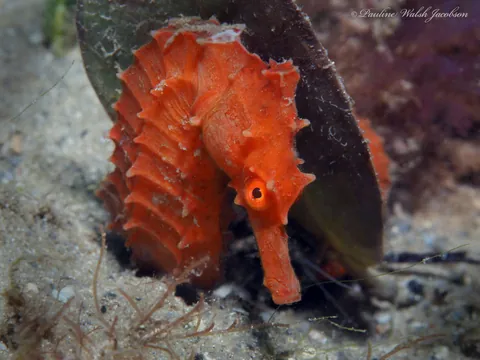
Hippocampus abdominalis
Hippocampus guttulatus
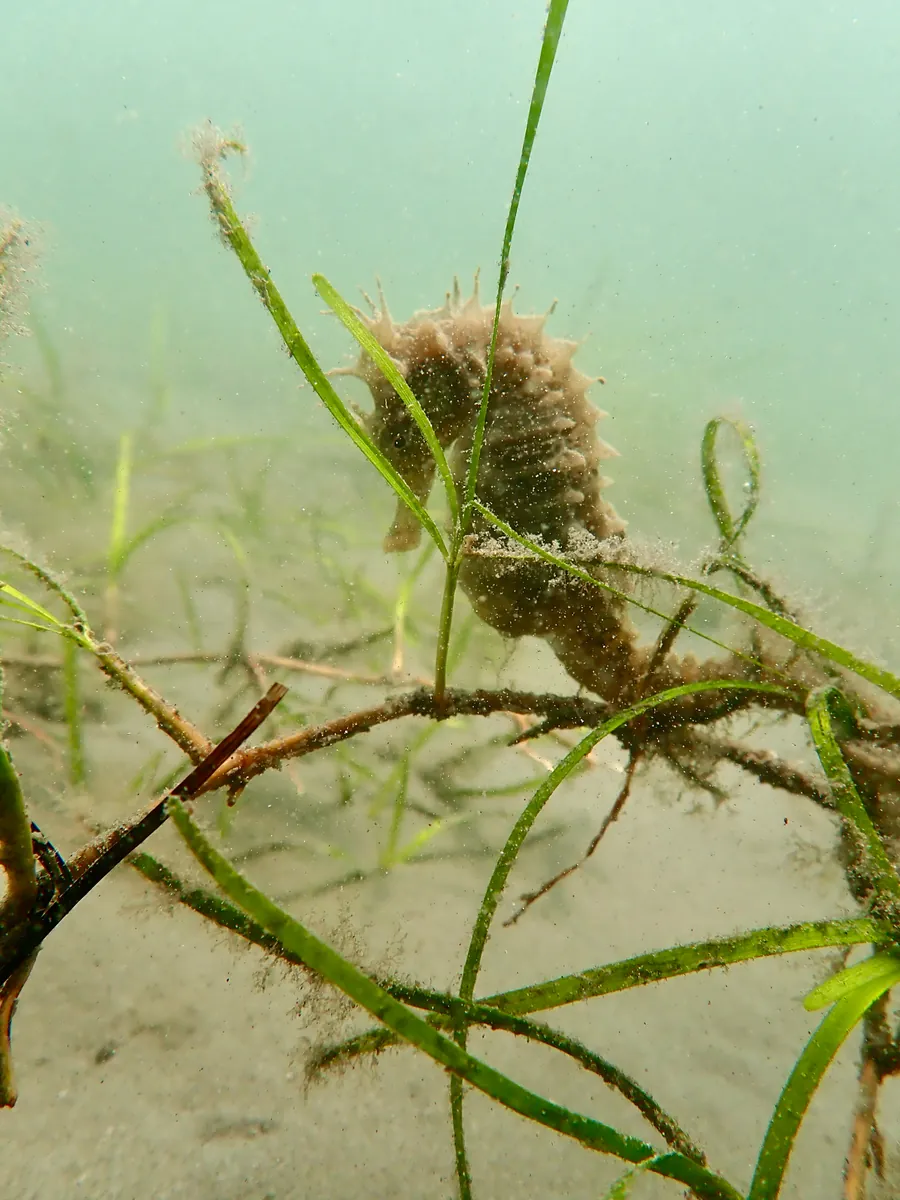
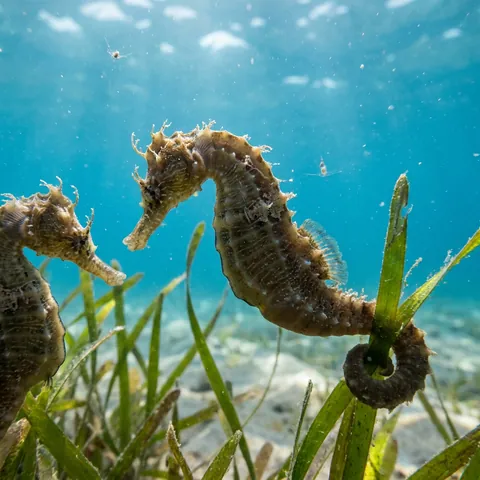
The long-snouted seahorse drifts upright through seagrass meadows, holding onto stems with its curled tail. Its delicate shape and slow, careful movements make it one of the most sought-after sights for divers along Europe's coasts.
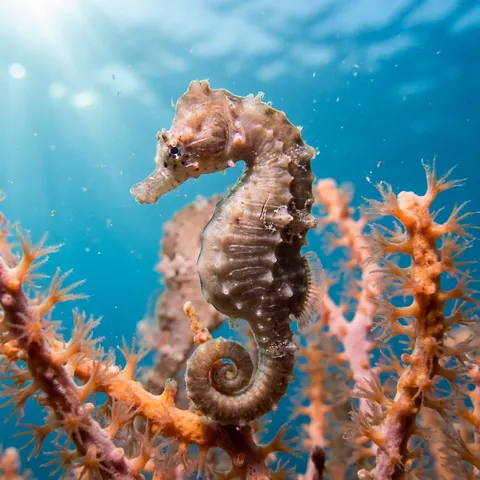
It is often confused with the short-snouted seahorse. The giveaway is the snout itself: this species' snout is long and thin, while the short-snouted seahorse has a noticeably stubby one.
This seahorse has a slender body, a long thin snout, and a tail that curls around plants for grip. Its head and back often carry a mane of long skin filaments, and a small crown of rounded knobs sits on top of its head. Colour ranges from dark green to brown or yellow, usually with small white spots that can join into wavy lines along the body.
It lives in the temperate eastern Atlantic, from the south coast of the UK down to Morocco and the Canary Islands, Azores, and Madeira, and through the Mediterranean Sea. It stays in shallow coastal water from 1 to 20 metres deep, favouring seagrass meadows, mixed sandy bottoms, and rocky ground with algae.
It hunts small crustaceans, larvae, fish eggs, and other tiny drifting animals, swimming upright rather than lying flat like most fish. It can quickly shift its colour to match nearby plants, which helps it hide from predators. Adults tend to stay within a small home patch and may move into deeper water during winter.
As with other seahorses, the male carries the fertilised eggs in a pouch on his belly, where a network of blood vessels feeds the developing young, much like a placenta. Fully formed young, called fry, are released from the pouch to fend for themselves. It is unclear whether this species pairs with the same mate each season.
This species is listed as Near Threatened. Limited data exists on its numbers and on how much trade for traditional medicine and the aquarium market affects it, and it is controlled under CITES Appendix II. Early maturity, fast growth, and several breeding cycles per season give it some capacity to recover, but protected habitat still covers only part of its range, and coastal building and human activity affect much of where it lives.
Once an adult settles into a spot, it may stay within the same small patch of seagrass for years, barely moving from day to day.
Describe what you saw and we name it, then keep every species you find in your Oceandex.