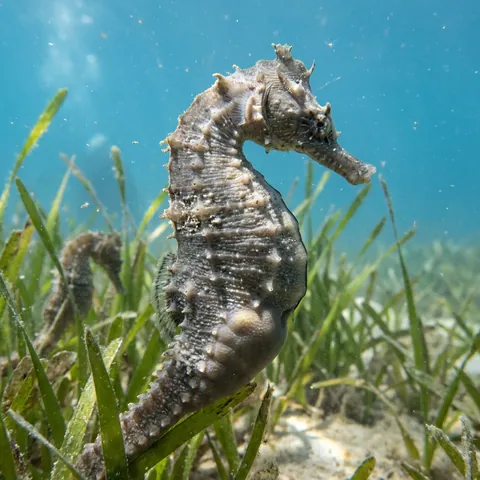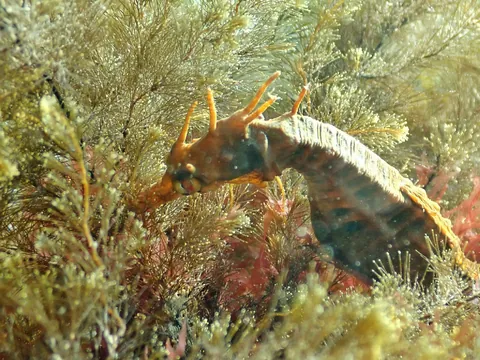
Bigbelly Seahorse
Hippocampus abdominalis
Hippocampus ingens
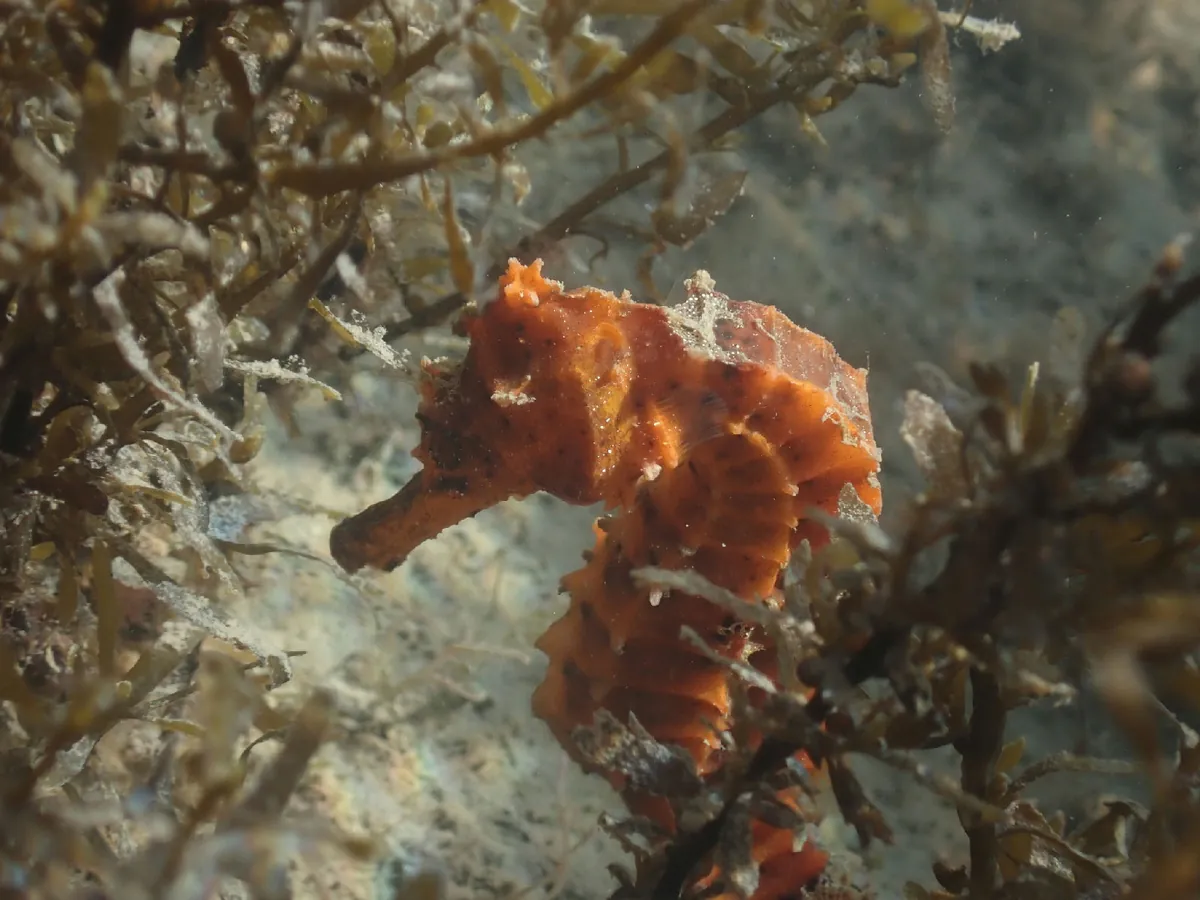
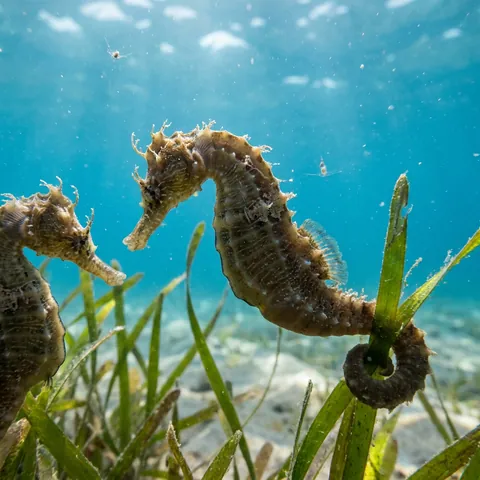
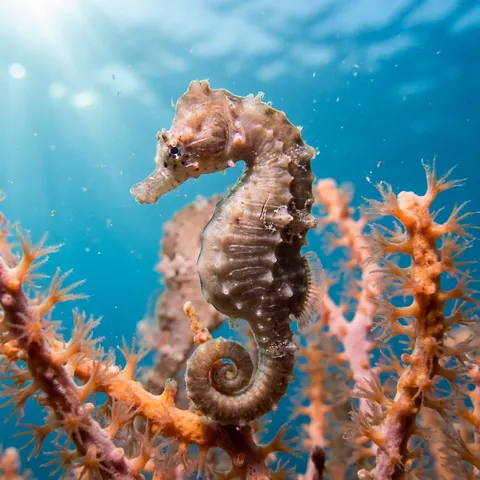
The giant seahorse is one of the largest seahorse species in the world, reaching up to 30 cm tall. Divers usually spot it holding still, tail wrapped around a branch of coral or gorgonian sea fan.
Also known as: pacific seahorse
Its large size, among the biggest of any seahorse species, is the simplest confirmation, since most other seahorses never come close to this size.
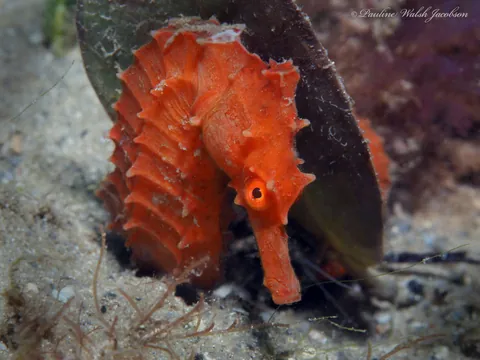
Colour varies widely, from green, brown, and maroon to grey and yellow. Like all seahorses, it has skin rather than scales, no teeth, a tail that curls around branches for anchoring, and eyes that can move independently of each other. Males carry a raised ridge, called a keel, along the belly that females lack.
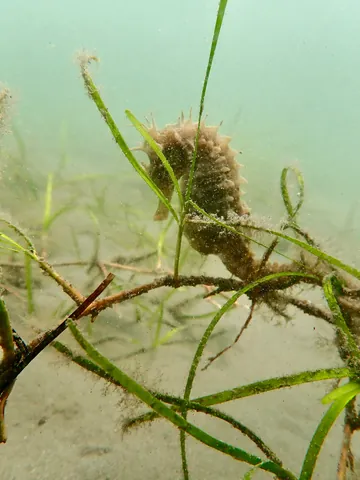
This seahorse lives along the Pacific coast from Baja California to Chile, including a population around the Galapagos Islands. It is active at night and shelters in mangroves, seagrass meadows, rocky and coral reefs, sponges, and kelp, usually between about 3 and 18 m deep.
It feeds on small bottom-dwelling animals such as mysids, other small crustaceans, and plankton. As an ambush predator, it stays camouflaged and still until prey drifts close, then sucks it in whole, since it has no teeth to chew with.
As with all seahorses, the female places her eggs into a pouch on the male's belly, where he fertilises and seals them in. When the eggs are ready, the male goes into labour and pushes the young out of the pouch one at a time. The young are fully independent from birth and receive no further care.
The giant seahorse is listed as Vulnerable. It is heavily targeted for traditional medicine, the aquarium trade, and dried curios, and also suffers from habitat loss and being caught as bycatch in fishing nets.
This is one of only six seahorse species singled out by CITES as facing the greatest threat from unsustainable harvest and trade worldwide.
Describe what you saw and we name it, then keep every species you find in your Oceandex.