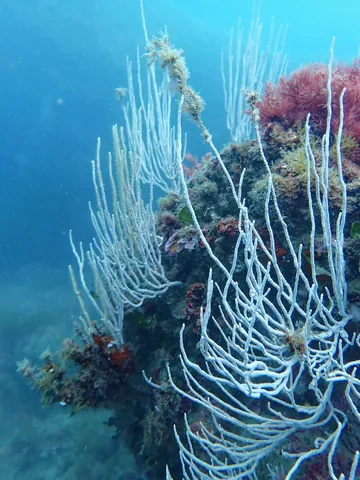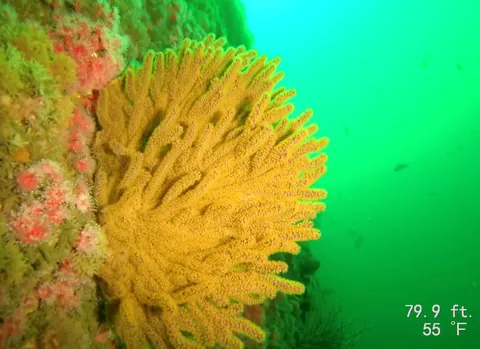
California Golden Gorgonian
Muricea californica
Plexaura homomalla
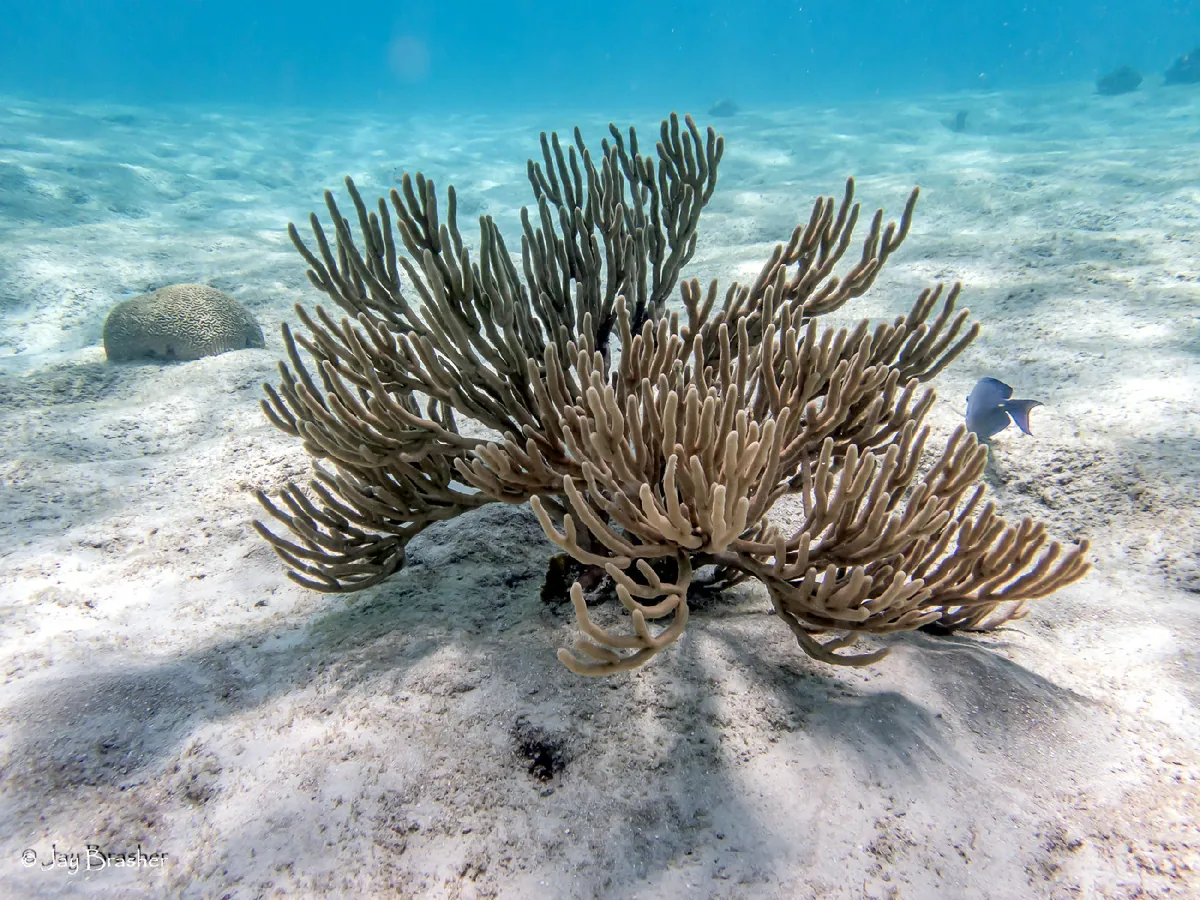
A stiff, bushy gorgonian that looks plain until you learn what is inside it. Its tissue holds more prostaglandin than any other animal known.
Also known as: Caribbean sea whip, black sea rod, black sea plume, sea rod, sea whip, gorgonian
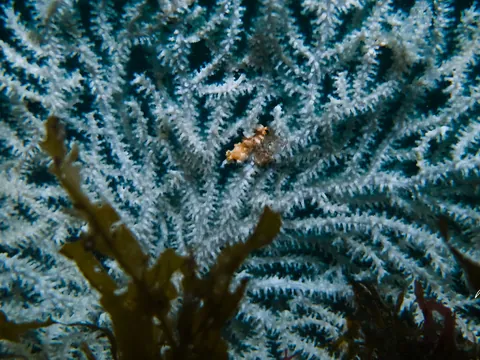
A dark, stiff, upright bush rather than a flat fan, with pale cream polyps against near-black branches. If the branches look black once the polyps pull in, this is almost certainly it.
A bushy colony of upright branches, shaped a little like a candelabra and about 35 cm tall. The skeleton and the branches are dark brown to black. The open polyps are cream, yellow or pale brown, so a feeding colony looks dusted with pale fuzz. Shallow colonies are squat, with thick branches. Deeper ones grow taller, with slender ones.
Caribbean reefs from Florida south to Venezuela, including the Bahamas and the Gulf of Mexico. It grows from just below the surface down to about 55 m, and it is one of the most common soft corals on shallow Caribbean reef tops.
It grows upright and stiff instead of spreading into a flat fan. That way it holds its ground in the surge without having to face one direction. The polyps feed on plankton and are usually open all day.
Plankton and fine bits of organic matter, plus sugars from the algae that live in its tissue.
Colonies are male or female and spawn into the water. The larva settles on hard reef rock. Broken branches can also take hold again and keep growing.
Not assessed by the IUCN, and still common across the Caribbean. It copes with warming and damage better than the hard corals around it.
Prostaglandin A makes up two to three percent of this coral by weight, about a million times the level in most animals. Drug firms harvested it from Caribbean reefs in the 1960s, until labs learned to make it in the 1970s.
Describe what you saw and we name it, then keep every species you find in your Oceandex.