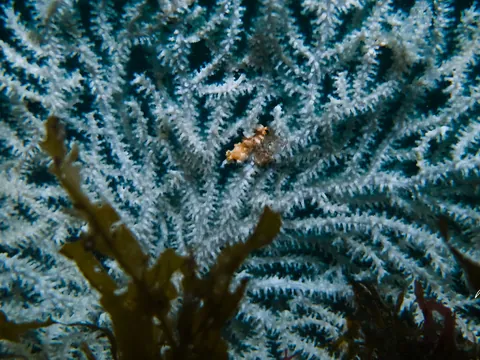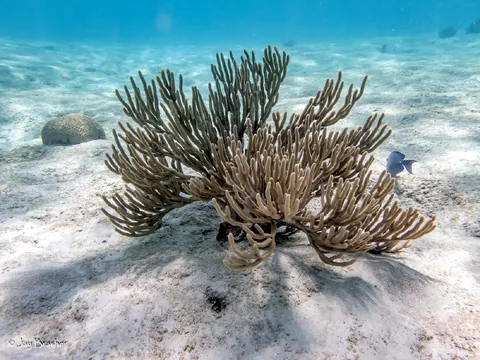
Black Sea Rod
Plexaura homomalla
Eunicella singularis
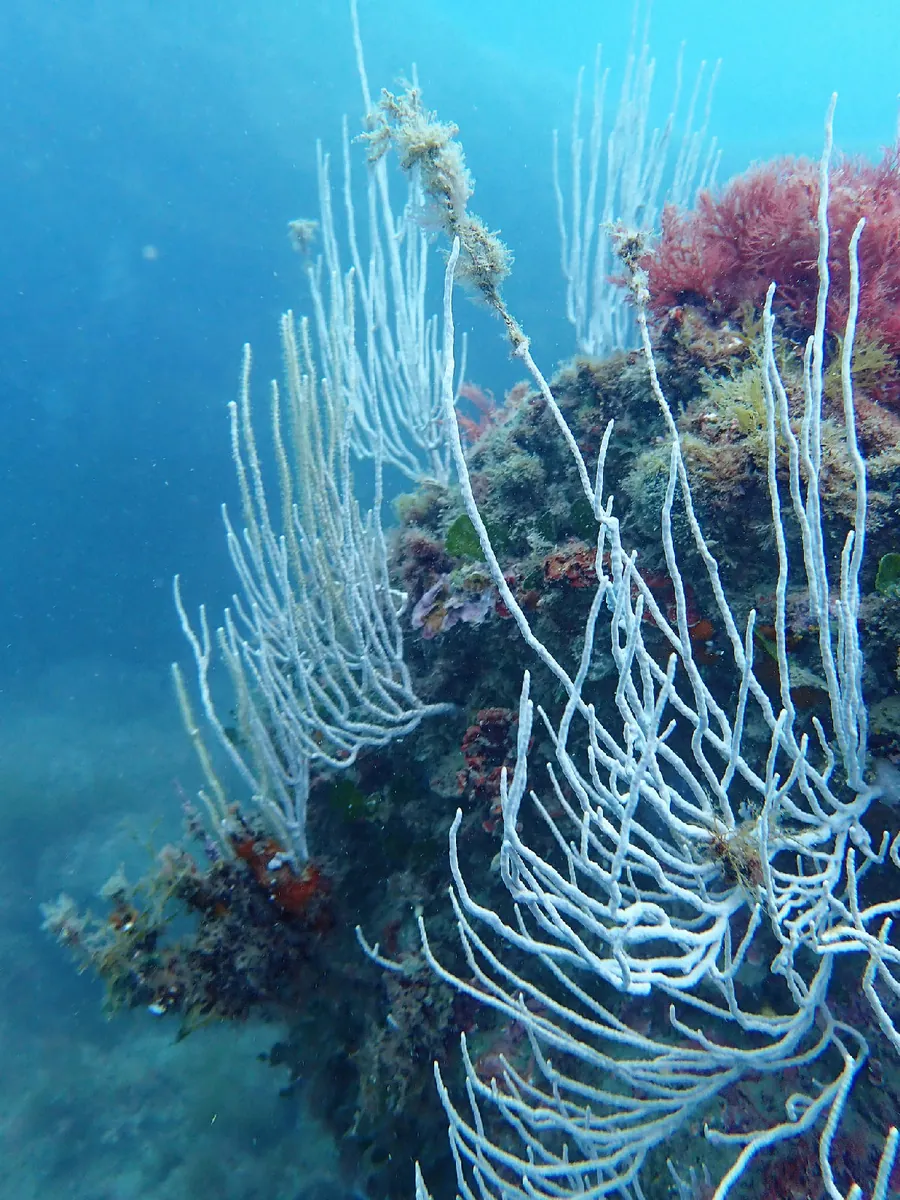
The pale, thinly branched gorgonian that covers sunlit Mediterranean slopes just below the shallows. Where the red gorgonian wants shade, this one wants light.
Also known as: white gorgonian, white sea fan, white sea whip, gorgonian, sea fan
Chalk-white, sparse branches on a sunny Mediterranean slope, with olive-tinted polyps. The white skeleton and the bright, shallow spot set it apart from the red and yellow gorgonians on shaded walls.
A whitish colony up to about 70 cm tall and wide, with few branches, often in a loose plane. The branches look chalk white. The polyps are see-through, with a yellow-brown or olive tint from the algae inside them.
The western Mediterranean and the Adriatic, between about 10 and 60 m. It likes gently sloping rock, often half covered in sand, in bright spots rather than the shaded walls that other Mediterranean gorgonians prefer.
It grows in loose stands rather than thick forests, and feeds with its polyps out. It is the only common Mediterranean gorgonian with algae in its tissue. Those algae add to what the polyps catch, and they tie it to shallow, sunny ground.
Plankton caught by the polyps, plus sugars from the algae in its tissue.
Eggs are fertilised on the surface of the colony. The larvae grow there and then drop off to settle close by.
Near Threatened on the IUCN Red List for the Mediterranean. Heatwave deaths and physical damage are the main pressures.
Look closely at the polyps: that olive tint is living algae. It is the only common Mediterranean gorgonian that makes its own food from light, which is why it does well in bright shallows where its red cousins cannot.
Describe what you saw and we name it, then keep every species you find in your Oceandex.