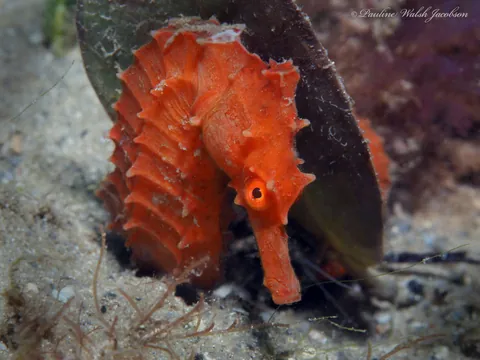
Bigbelly Seahorse
Hippocampus abdominalis
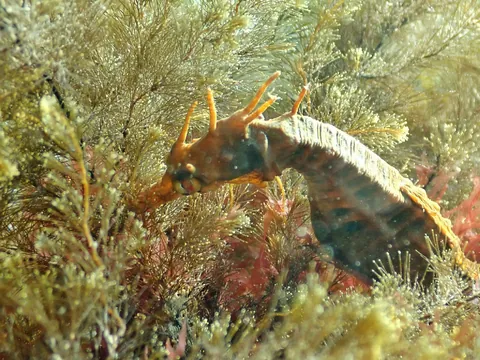
Hippocampus histrix

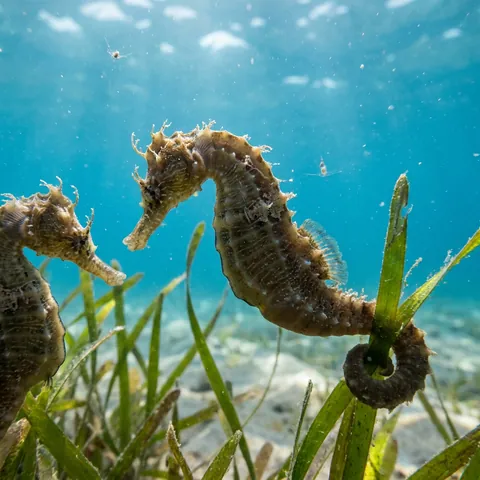
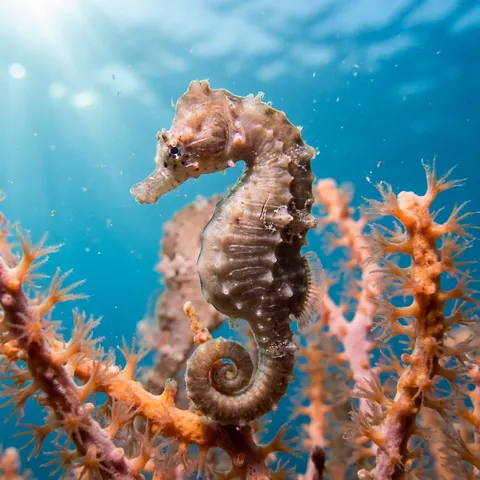
The spiny seahorse is a slow, well-armoured seahorse of the Indo-Pacific, with sharp spines covering its whole body. It is rarely seen, and it lives in deeper water than many other seahorses.
Also known as: hippocampus histrix, long-snouted seahorse, longspine seahorse, seahorse, thorny seahorse
Several other seahorse species share these reefs, but few carry spines this long. Check the coronet on the head, described above - on this species its spines are unusually long and needle-sharp, unlike the smoother-crowned seahorses nearby.
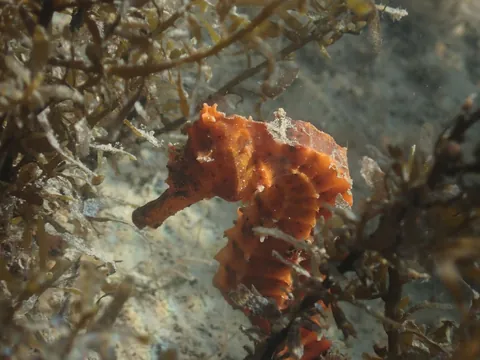
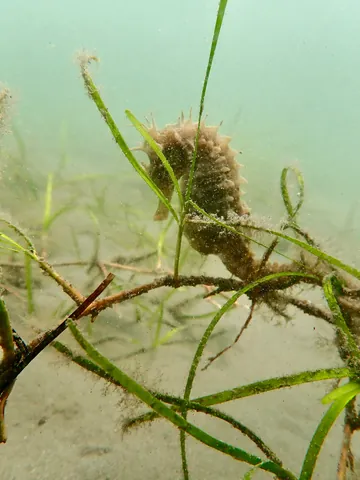
This seahorse has a slim, long body covered from head to tail in sharp, dark-tipped thorns of an even size along the tail. Long spines also cover the head, especially on the forehead, cheeks, snout, and above the eyes. A raised, crown-like part on the head, called a coronet, carries several very long, sharp spines. The snout is long and thin, usually marked with one or more thin white lines. Body colour can vary a lot, from grey, cream, yellow, green, red, or brown, plain or patterned, to match its surroundings.
The spiny seahorse is spread across the Indo-Pacific but rarely seen, including on Australia's Great Barrier Reef and Timor Sea, and at sites in Indonesia, Papua New Guinea, New Caledonia, and Japan. It lives in fairly deep water, usually from about 15 to 40 metres, on sponges, weedy rocky reefs, and soft corals, but most often in seagrass beds.
The spiny seahorse eats small crustaceans and other tiny floating animals. Like other seahorses, it breeds in an unusual way: the female puts her eggs into a pouch on the male's belly, and he carries and protects the young until they are born fully formed.
harmless to humans
This species has declined significantly over the past ten to fifteen years. People catch it on purpose for traditional medicine and the aquarium trade, and it is also caught by accident in shrimp fishing nets. The seagrass beds it depends on are shrinking too, damaged by pollution, sediment, coastal building, and dredging.
Describe what you saw and we name it, then keep every species you find in your Oceandex.