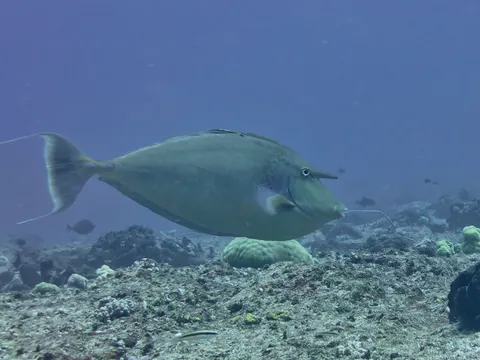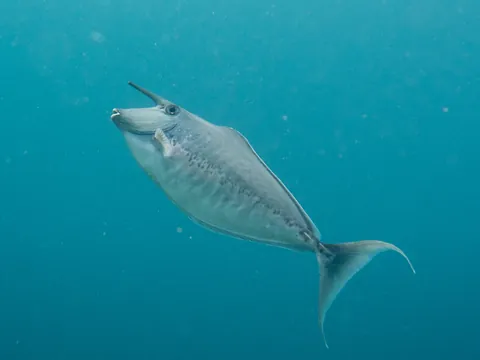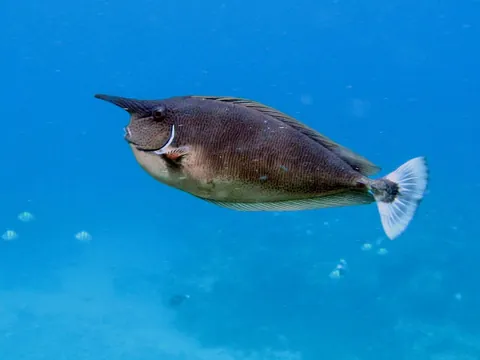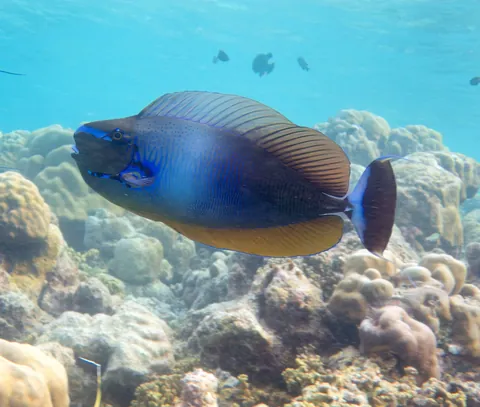
Bignose unicornfish
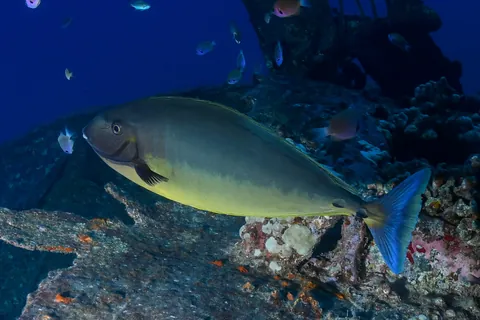
Naso vlamingii
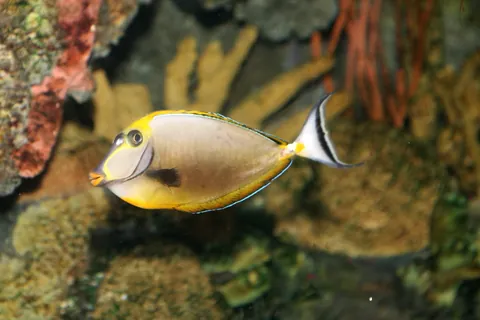
Naso lituratus
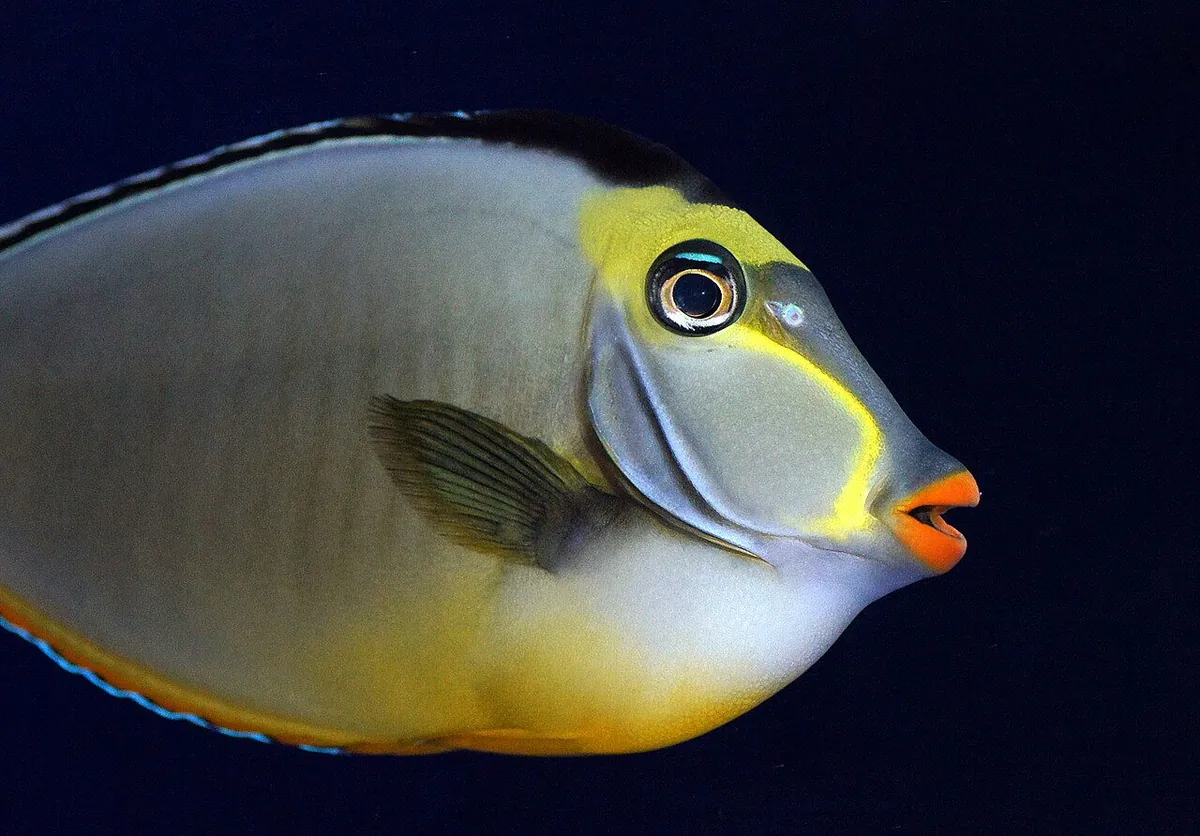
The orangespine unicornfish is a large member of the surgeonfish family. Despite the name it carries no horn on its forehead; the striking part is the tail base, which holds two bright orange blades. It grazes leafy brown seaweeds, mainly Sargassum and Dictyota. It reaches 46 cm. Divers usually see adults in small groups, sometimes in pairs, and now and then in a big gathering.
Also known as: clown tang, masked unicornfish, striped unicornfish, unicornfish, smooth headed unicornfish, masked unicornfish, poll unicornfish, orangespine unicornfish, poll headed unicornfish, stripe-face unicornfish, pacific orange-spine unicorn, orange spine surgeonfish, clown tang, smooth-head unicornfish, naso trang, surgeonfish, striped-faced unicornfish, redlip surgeonfish, orange-spine unicornfish, orangesine unicornfish, orangespine unicornfish, lipstick surgeonfish, pacific orange-spine unicornfish, black-finned unicornfish, clown surgeonfish, clown unicornfish, stripe-faced unicorn-fish, orange-spine unicornfish, stripe-face unicornfish, pacific orange-spine unicorn, smooth-headed unicornfish, stripe-faced unicorn fish, orange-spine unicorn, pacific orangespine unicornfish, smooth-head unicornfish, striped-faced unicornfish, striped unicornfish
Easy to lump in with other unicornfish, which also carry forward-hooking spines at the tail base. The giveaway is what's missing: despite the name, no horn grows on this species' forehead. Confirm with the orange lips against the black face mask, already described, rather than searching for a horn that isn't there.
The body is brownish grey, deep and flattened from side to side. The face carries a black mask, and the lips are bright orange. Behind the head the nape is yellow, and the dorsal fin along the back carries a broad black band. The clearest feature is at the tail base: two bright orange spines that hook forward, one on each side. In life the fish holds them flat against the body and swings them out when it needs to.
It lives on coral reefs in the eastern Indian Ocean and the western Pacific, reaching the Great Barrier Reef and Hawaii. It uses areas of coral, rock and rubble on both lagoon and seaward reefs, and it does best where the water is well oxygenated and the current runs strongly, with plenty of wild algae to graze. Young fish keep to shallow rocky reefs, sometimes in small mixed groups with other young surgeonfishes. The species has been recorded down to 90 m, but most divers meet it between 5 m and 30 m.
This fish was first described in 1801 by the naturalist Johann Reinhold Forster, who named it Acanthurus lituratus after seeing one near Tahiti. It was later moved into Naso, the only genus in its own branch of the surgeonfish family tree.
Describe what you saw and we name it, then keep every species you find in your Oceandex.