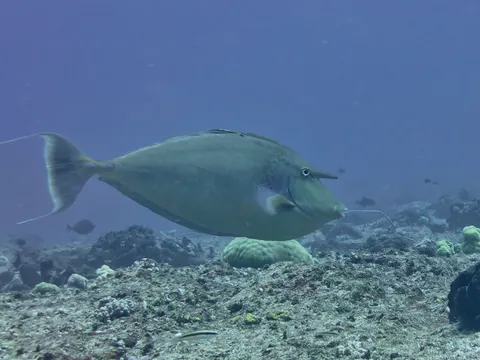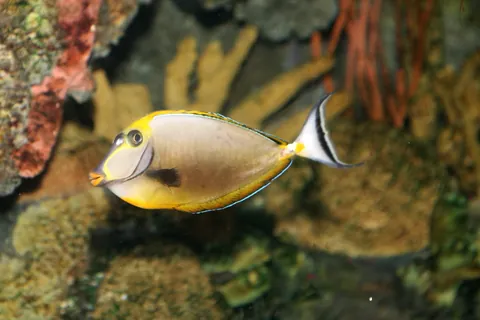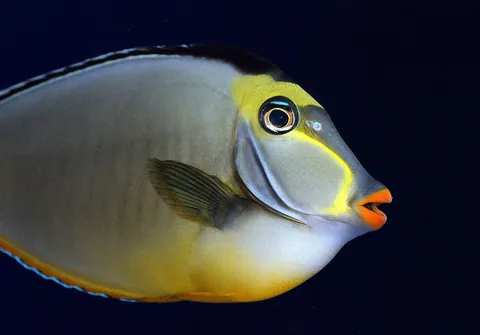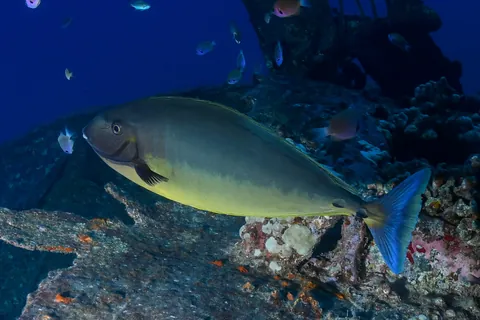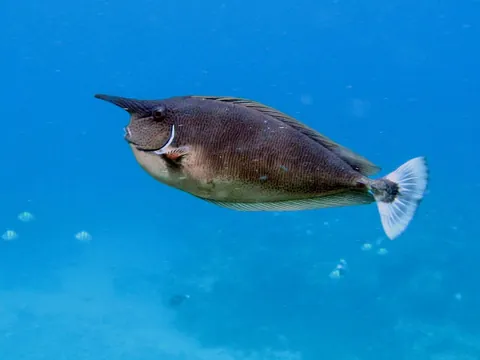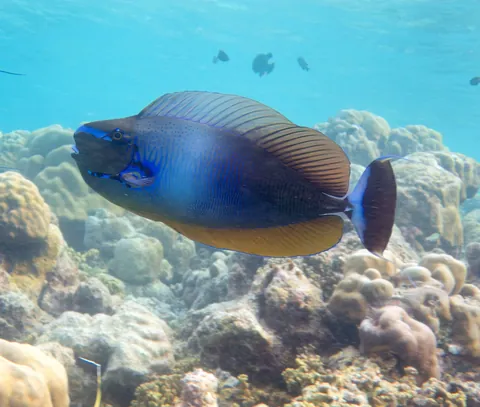
Bignose unicornfish
Naso vlamingii
Naso brachycentron
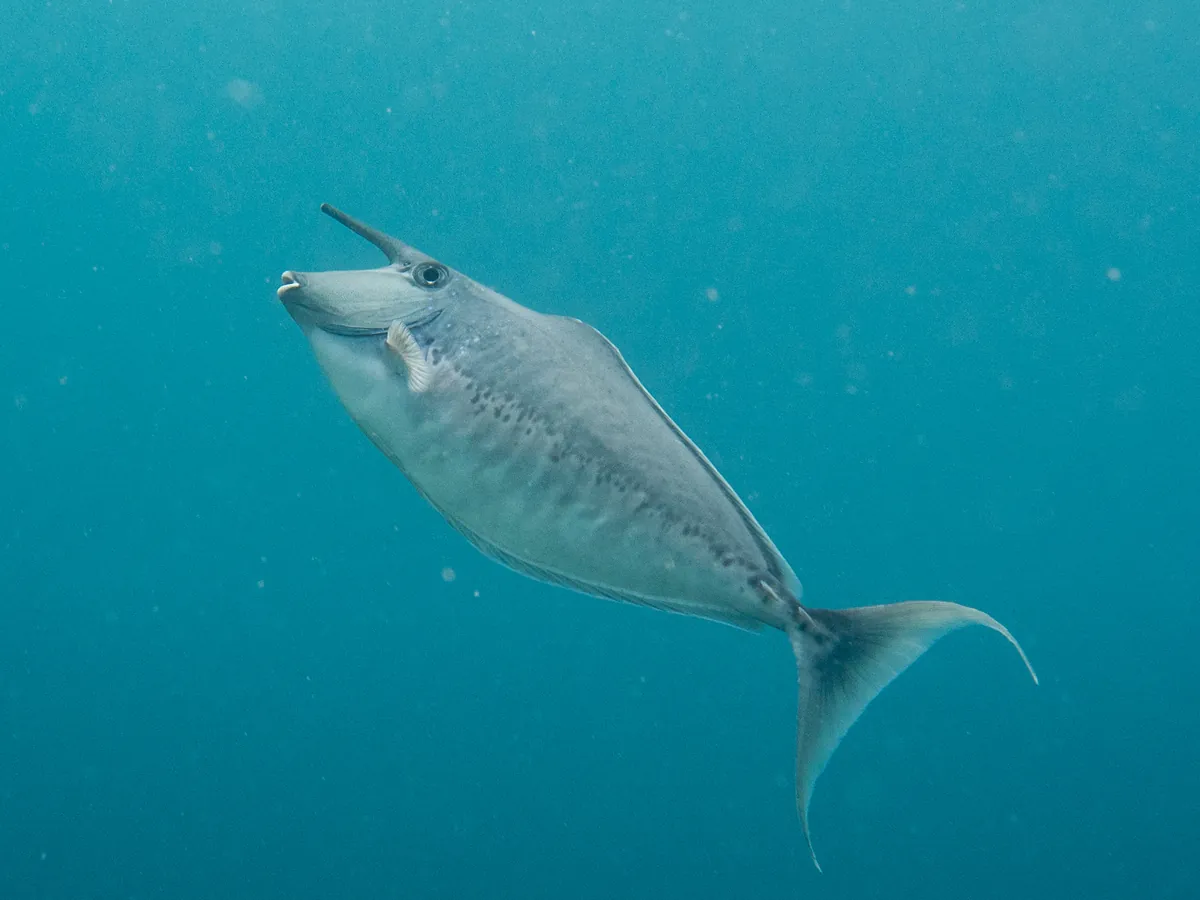
The humpback unicornfish carries its name in its profile: a pronounced hump rises from its back, giving this reef grazer an unmistakable silhouette even before you spot its horn.
Also known as: ringtailed unicornfish, ringtailed unicornfish, humpback unicorn, unicornfish, surgeonfish, humpback unicorn
It can be confused with other large unicornfish that also carry a forehead horn, but the stepped, humped profile of the back is the clearest giveaway; combined with a tail fin that lacks any pale edge, it rules out species like the whitemargin unicornfish.
This is a large unicornfish, reaching up to 90 cm. Past a certain size, a hump develops on the back, making the profile dip inward between the eyes and the rear of the dorsal fin (the fin along its back). The snout slopes steeply down to the mouth. Adult males grow a long, tapering, horn-like bony bump in front of the eyes that can extend past the mouth, while females carry only a small bump in the same spot. A pair of bony plates on each side of the tail base form blade-like keels. The head and upper body are grey, fading to paler yellowish or whitish on the lower body, with the two tones meeting in an irregular line. Small pale, dark-edged spots often appear behind the eyes, and larger males may show faint dark bars on the lower flanks. The tail fin has no pale margin.
This species lives across the Indian and western Pacific Oceans, on seaward reef slopes and rocky shores in deeper coastal water, usually between 8 and 30 m and most often around 15 to 20 m, in warm water of 25 to 28°C. It is seen alone or in small groups.
Only adult males grow the long forehead horn this species is known for; females carry just a small bump in its place.
Describe what you saw and we name it, then keep every species you find in your Oceandex.