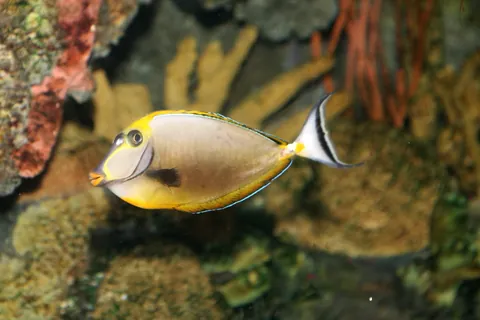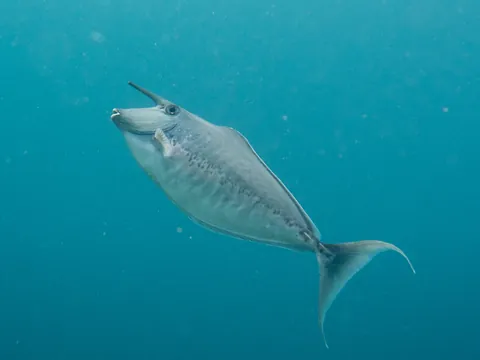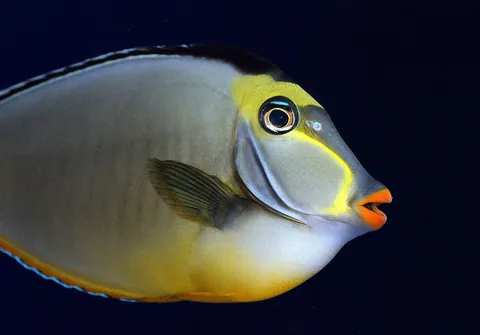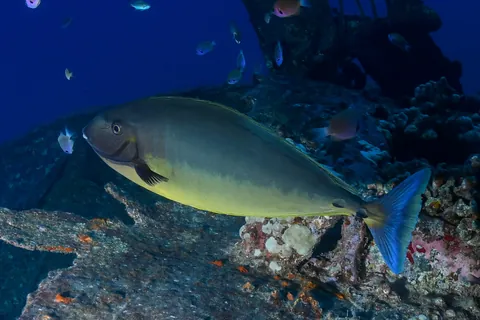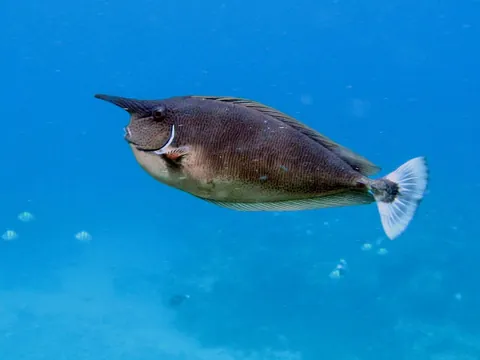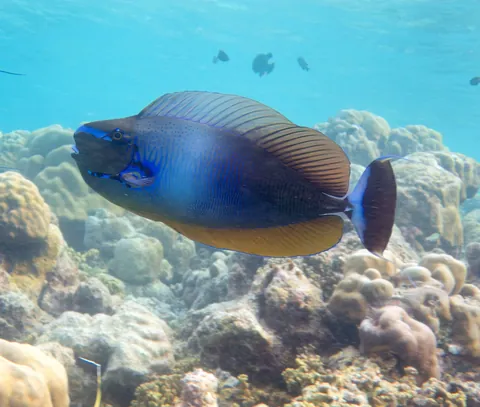
Bignose unicornfish
Naso vlamingii
Naso unicornis
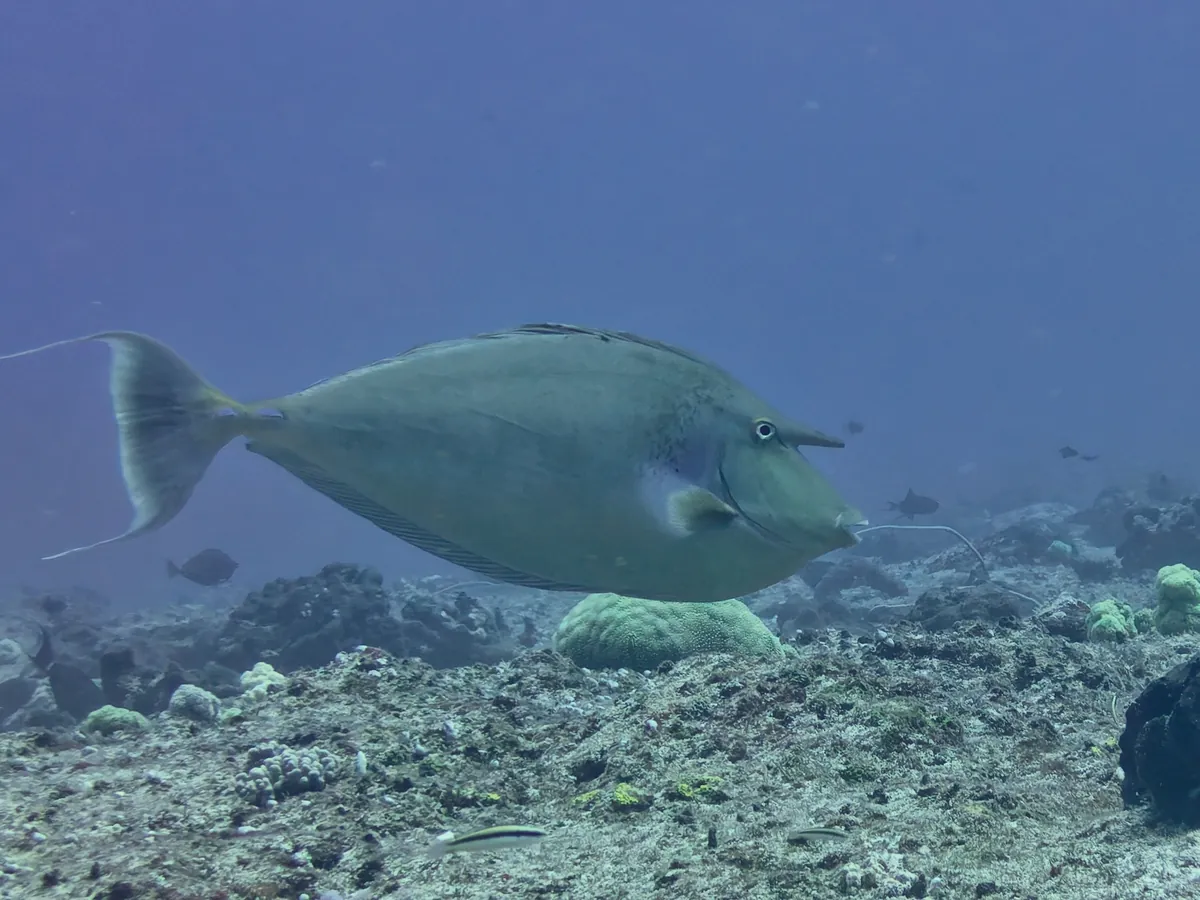
The bluespine unicornfish is a large, blue-grey surgeonfish of Indo-Pacific reefs. Adults carry a bony horn on the forehead, which is how the group got its name. It grows to about 70 cm, and divers often meet it at around 50 cm. Instead of normal scales it has tough, leathery skin. You may see one alone, in a small group, or mixed into a larger crowd of other reef fish.
Also known as: naso unicornis, blue-spine unicorn, bluespine unicorn, brown unicornfish, humphead unicornfish, long-snouted unicornfish, longhorn unicornfish, longnose unicornfish, surgeonfish, unicorn tang, unicornfish
Look at the base of the tail. Two bright blue plates sit on each side, each carrying a forward-curving spine like a small blade. That pair of blue marks is fixed and easy to see from a few metres away. On adults, add the short horn on the forehead: it juts forward at eye level but stops short of the mouth, which separates it from unicornfish with longer horns.
The body is blueish-grey and fairly deep, with a straight forehead that slopes down to the snout at about 45 degrees. Adults have a short bony horn on the forehead. It points forwards at about eye level but does not reach past the mouth. Small fish have no horn at all; it starts as a bump once the fish is roughly 12 cm long. On each side of the tail base there are two blue plates, each with a forward-curving, knife-like spine. Males have much bigger tail spines than females, and slightly longer horns and tail streamers.
This is a near-shore fish of the tropical Indo-Pacific, and it is very common there. Look for it in reef channels, moats and shallow lagoons, and on seaward reefs where the surge is strong. It seems to like spots with waves and moving water. Juveniles stay close to shore, in sheltered bays and harbours. Adults range from the shallows to the edge of deeper water, but usually stay in the top few metres of the reef. The species has been recorded from 1 to 180 m, and it lives in warm water of roughly 26 to 29 degrees Celsius.
The bluespine unicornfish is a plant eater and feeds during the day. It crops coarse, leafy brown and red seaweeds, such as Sargassum. Few reef fish will eat these tough, fleshy seaweeds, so this species does important work in keeping them from taking over a reef.
reports of ciguatera poisoning
It is listed as Least Concern. In Hawaii the fishery is managed: commercial fishers need a permit for kala, as the fish is called there, and anglers may take no more than four fish per person per day. The commercial catch is also capped by an annual limit.
On Hawaiian reefs this fish eats the invasive seaweed Gracilaria salicornia, which smothers corals in dense mats. But its help comes with a catch. The seaweed can regrow from broken pieces, and the fragments that pass out in the fish's droppings are still alive and can start new mats.
Describe what you saw and we name it, then keep every species you find in your Oceandex.