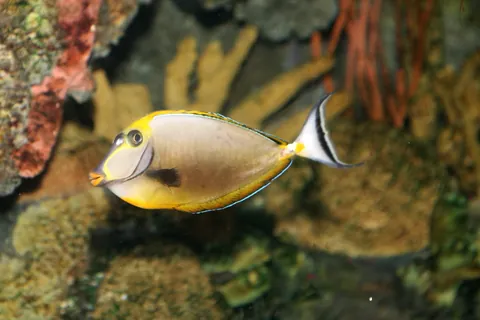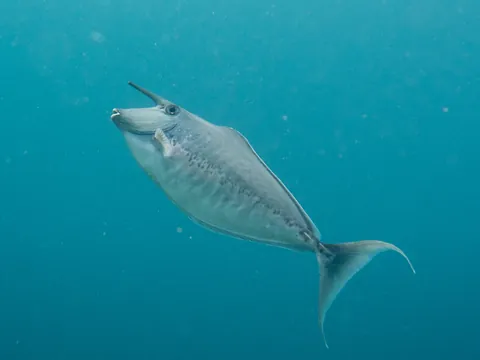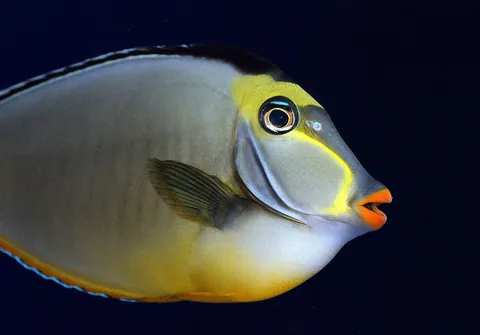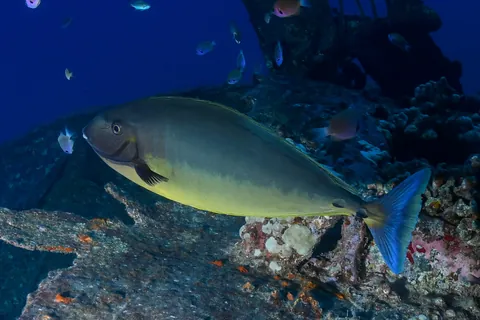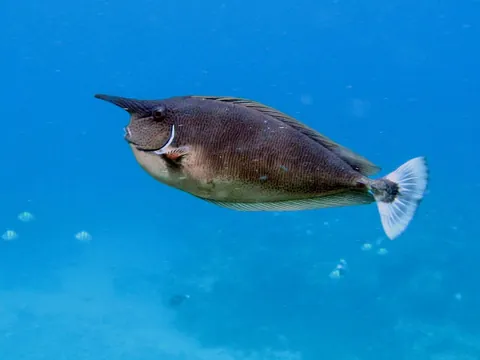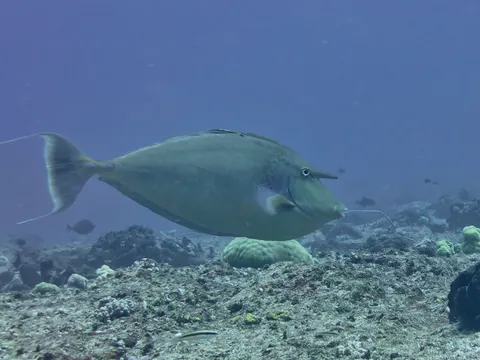
Bluespine unicornfish
Naso unicornis
Naso vlamingii
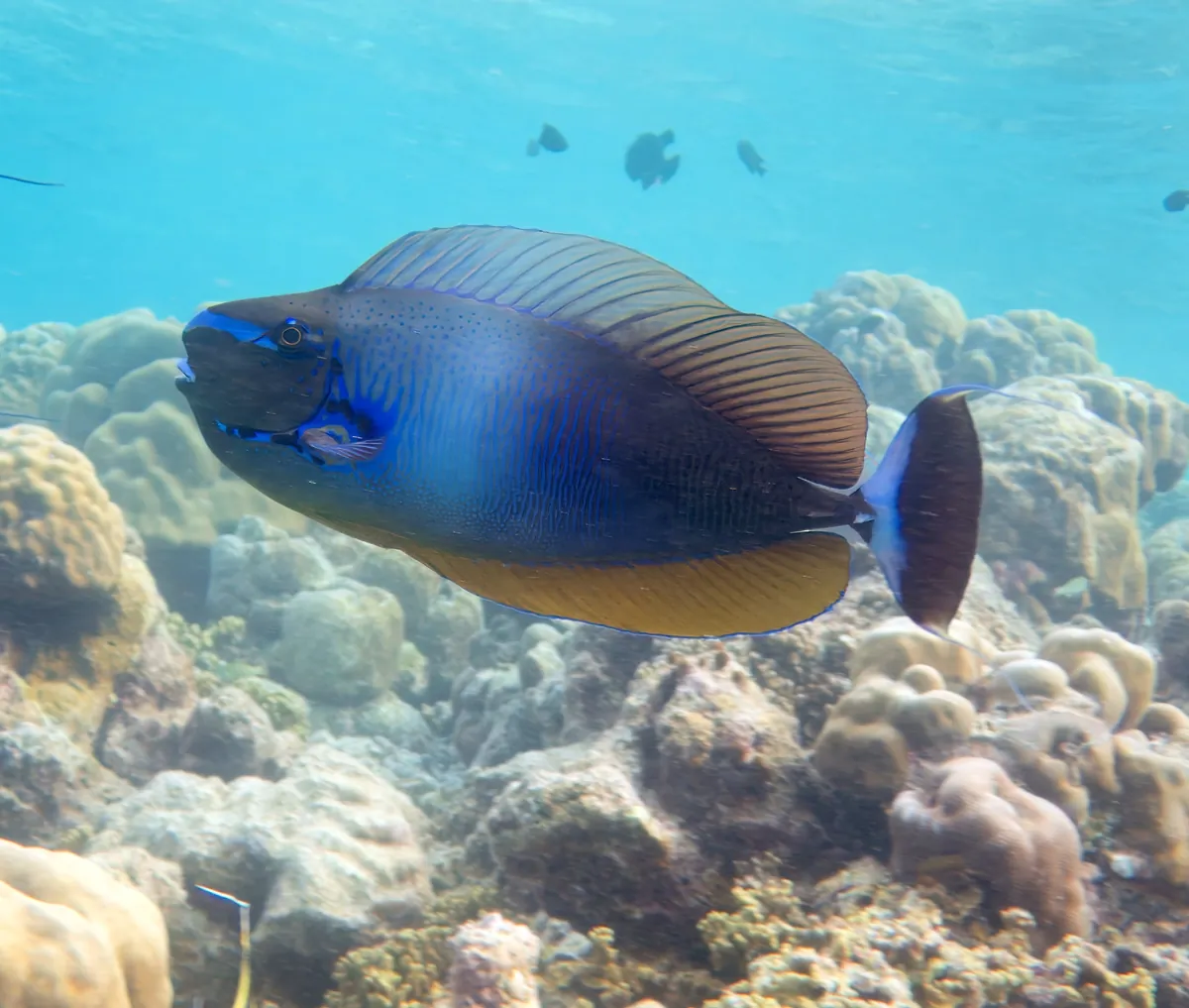
A big-bodied unicornfish that can flash brilliant blue markings on and off, using them like a signal light when it wants to be noticed.
Also known as: bignose unicorn, scibbled unicornfish, vlaming's unicornfish, scibbled unicornfish, vlaming's unicorn fish, bignose unicorfish, unicornfish, zebra unicornfish, surgeonfish, bignose unicorn, bignose unicornfish, bignose unicornfish, bignose unicorn, big-nose unicornfish, scribbled unicornfish, vlaming's unicornfish
This species can be confused with other unicornfishes that share the bump on the forehead, but the settling feature is a wide blue band running from the eye forward to the base of that bump.
This is a deep-bodied fish with a tall dorsal fin and an obvious bulbous bump growing from the head above the snout. Adults grow long, trailing filaments from the tips of the tail fin. Its overall colour is greyish-brown to reddish-brown, scattered with small dark blue spots on the head and upper body that join into stripes lower down the flanks. The lips are blue, and the tail fin is blue at the base, grey in the middle, and blue along the outer edges of the lobes and filaments. It can quickly change how intense its colours look.
This unicornfish lives in deep lagoons and on seaward reefs across the Indo-Pacific, in water between about 24 and 28°C, often gathering in schools around the upper edges of deep slopes and drop-offs.
It feeds mainly on zooplankton, forming loose schools in midwater off steep slopes during the day, though it is also often seen alone or in pairs. It can turn its blue markings up to a brilliant glow or fade them down, which it appears to use during courtship and around cleaning stations. It has even been seen swimming at night among schools of hunting barracuda and trevally, feeding on the waste these predators leave behind.
It has been seen following hunting barracuda and trevally at night to feed on their faecal matter.
Describe what you saw and we name it, then keep every species you find in your Oceandex.