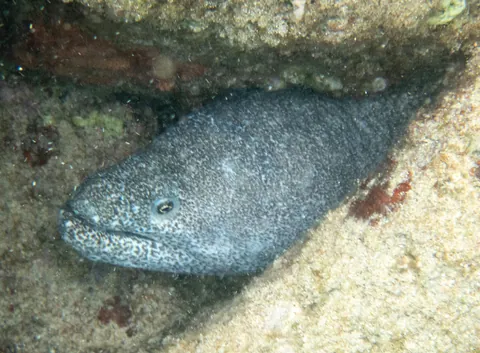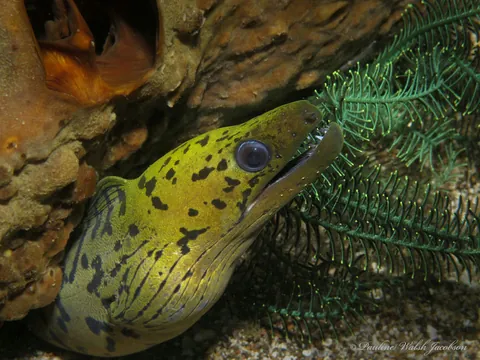
Fimbriated moray
Gymnothorax fimbriatus
Muraena helena
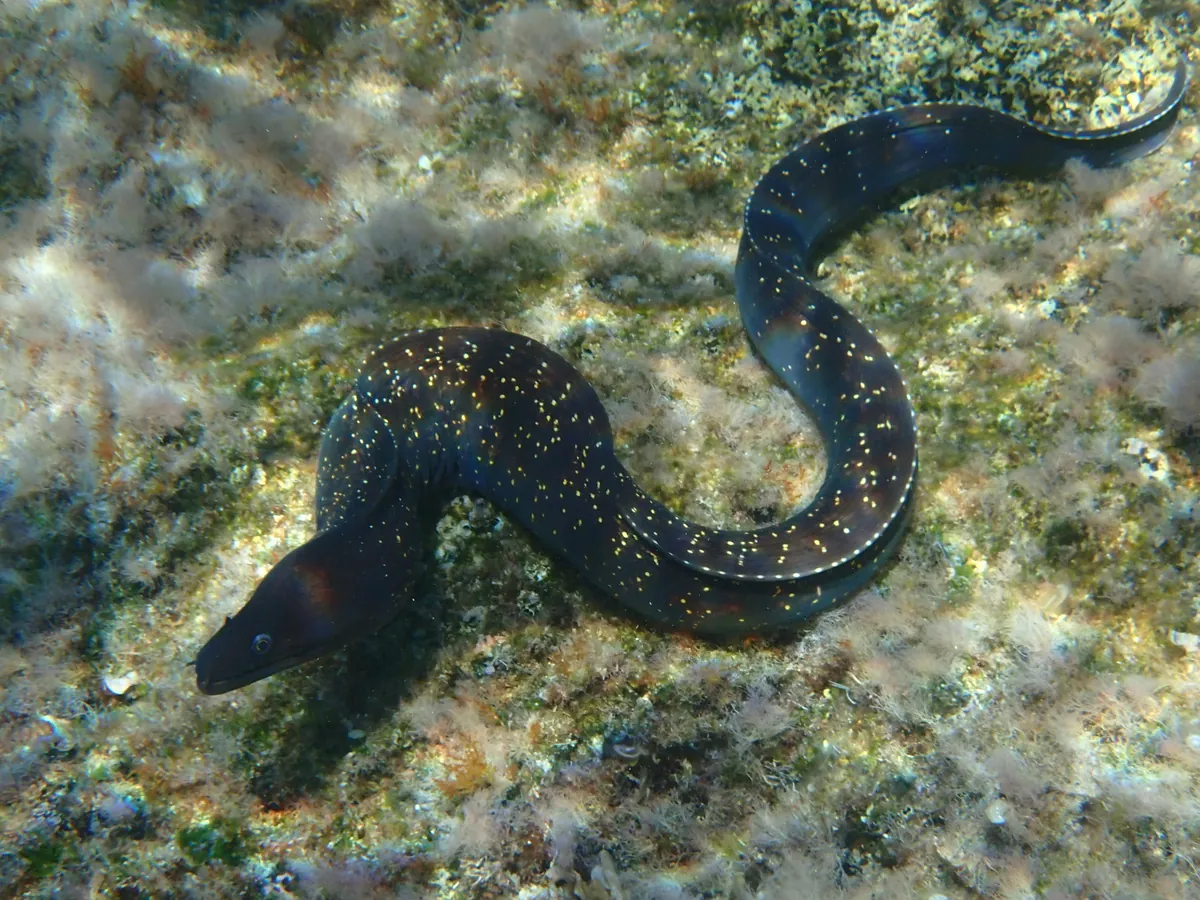
Tucked into a crevice with just its head showing, the Mediterranean moray is easy to overlook until it opens its mouth, lined with long, sharp teeth. By day it lies hidden in rock; by night, it hunts.
Also known as: murry, roman eel
This moray's fin runs as one smooth ribbon from behind the head to the tail, with no separate pectoral fins breaking the line, a useful feature for telling it apart from other eel-like fish on the reef.
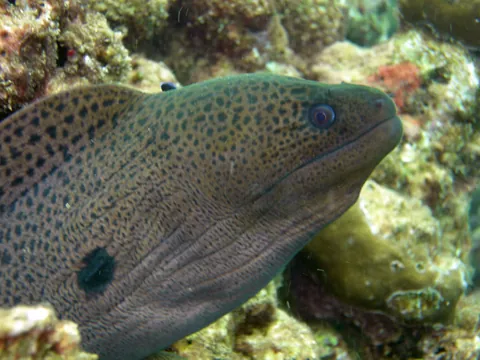
This eel-like fish has a long, slimy, scaleless body coloured dark grey to dark brown, marked with fine dark spots. Its dorsal fin starts just behind the head and runs all the way to the tail, joining with the anal fin, and there are no pectoral fins. The mouth is long and powerful, reaching back past the gills, and armed with long, sharp-pointed teeth.
It lives along the eastern Atlantic coast from the British Isles to Senegal, around the Canary Islands and Azores, and throughout the Mediterranean Sea. It favours rocky bottoms and is a solitary, territorial species that spends most of the day hidden in rock crevices and clefts, becoming more active at night.
Adults spawn in the warmer months, releasing about 60,000 eggs into open water, where fertilisation happens outside the body. The eggs hatch into small, transparent, free-floating larvae called leptocephali. The act of mating itself has never been observed in the wild.
Despite its shy, hidden lifestyle, the Mediterranean moray has a bite strong and sharp enough to be dangerous to humans if provoked.
Describe what you saw and we name it, then keep every species you find in your Oceandex.