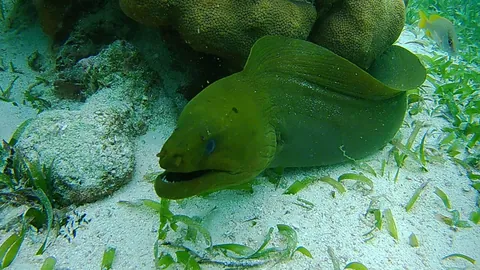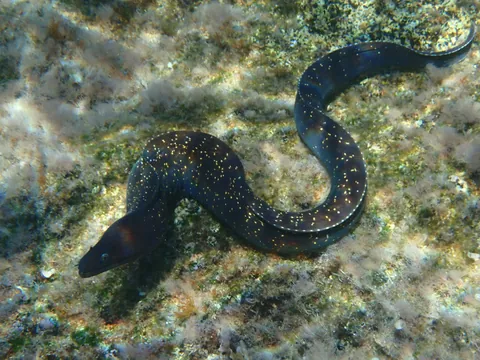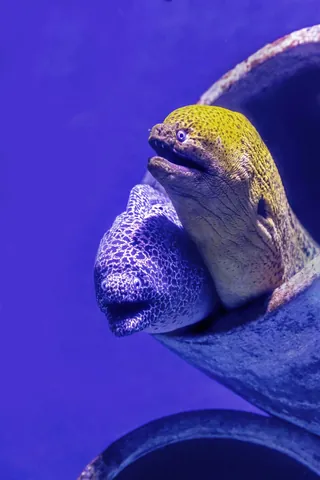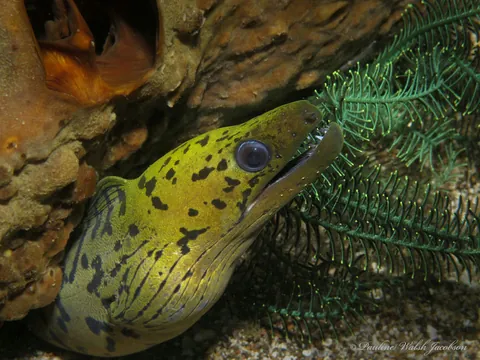
Fimbriated moray
Gymnothorax fimbriatus
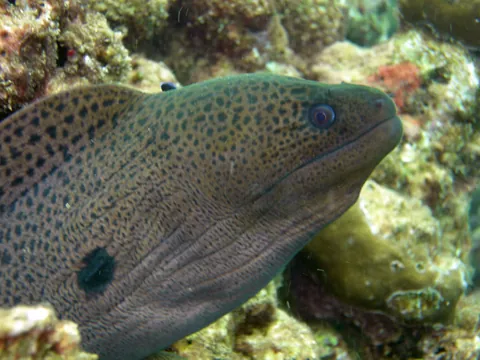
Gymnothorax favagineus
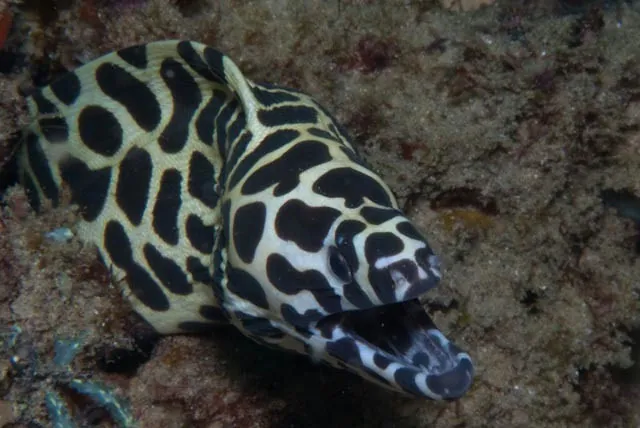
The laced moray is one of the two largest morays of the Indo-Pacific. It can reach 3 m, although the animals usually encountered are much smaller.
Also known as: gymnothorax favagineus, honeycomb moray, honeycomb moray eel, leopard moray, tessellated moray, tessellate moray, tessellated eel, tessellated reef-eel, black-blotched moray, black-blotched reef-eel, blackspotted moray, black-spotted moray, reticulated moray, reticulate moray, giraffe eel, coral eel
Look for large black blotches with pale honeycomb-like spaces between them. The spotted moray eel is whiter, with smaller and rounder spots, and the fimbriated moray is much smaller (under a metre) with a greenish-yellow head dotted with black.
The body is long and serpentine, white to yellowish with black blotches; the pale spaces between them form a honeycomb pattern. The spots vary between individuals and with their surroundings: morays on clear-water reefs have fewer black spots than those living in turbid water.
It is found from the Red Sea and the East African coast east to Papua New Guinea, north to southern Japan and south to Australia. It lives on reef flats and outer reef slopes, sheltering by day in crevices at about 1 to 50 m.
It leaves its shelter at night to hunt actively along the reef. It is often found in holes together with cleaner wrasses or cleaner shrimps. Large adults can be aggressive.
It feeds mainly on small fish and cephalopods.
Its many English names - honeycomb, leopard and tessellated moray - all come from its spotted pattern.
Describe what you saw and we name it, then keep every species you find in your Oceandex.