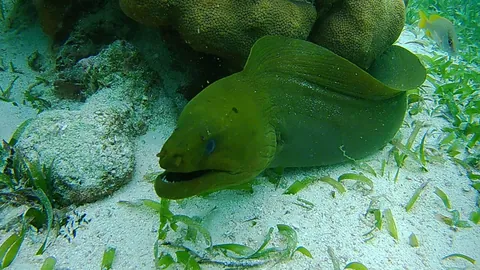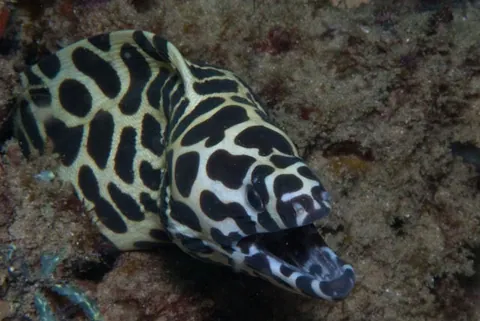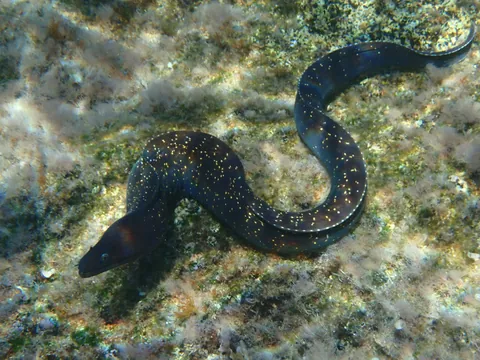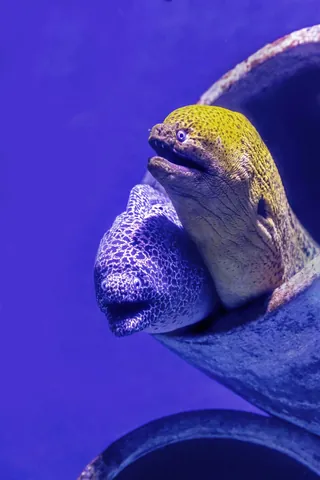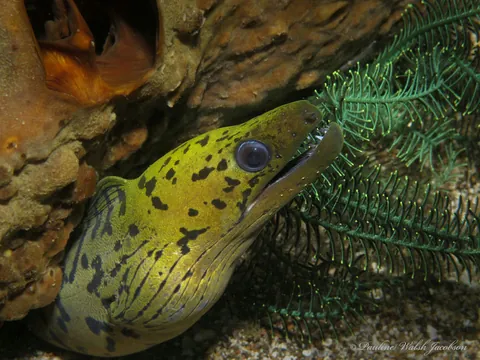
Fimbriated moray
Gymnothorax fimbriatus
Gymnothorax javanicus
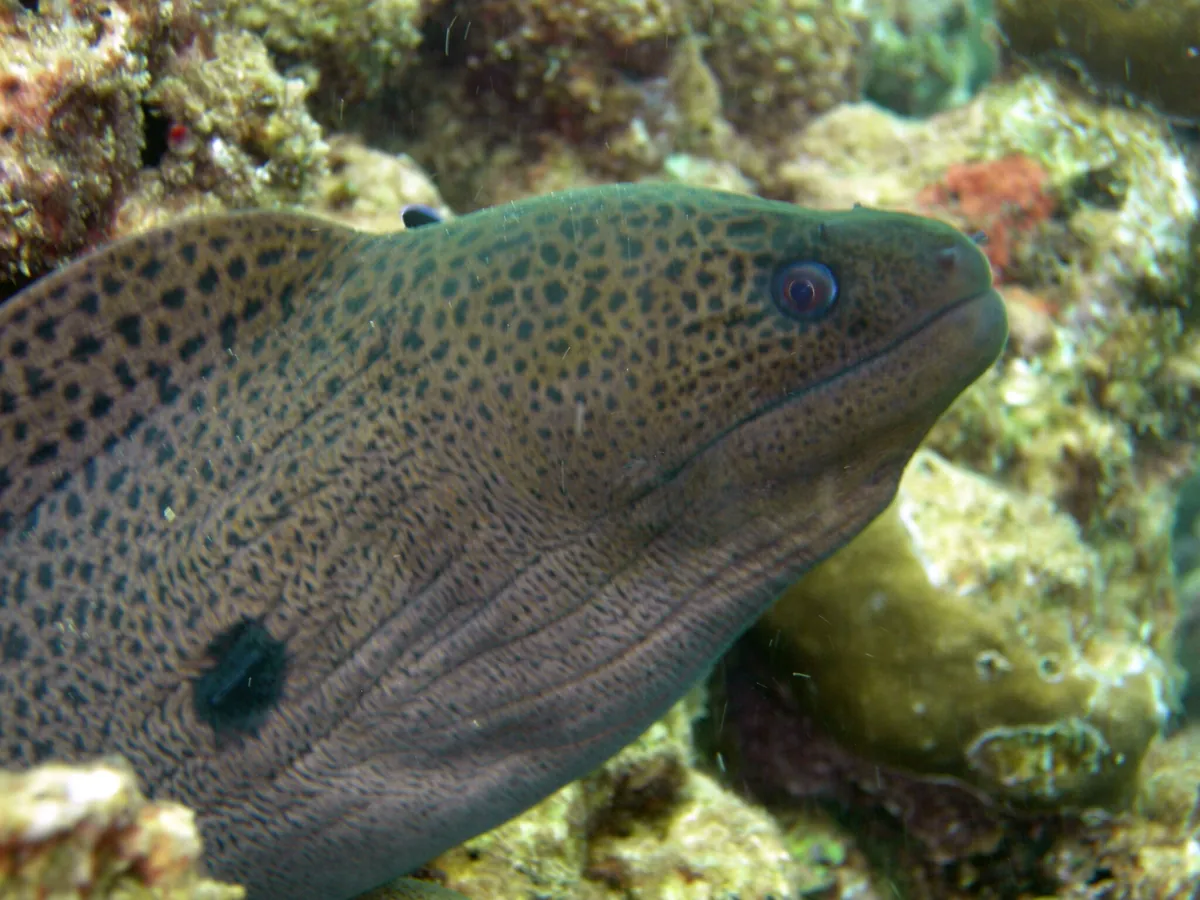
The giant moray is the heavyweight of the Indo-Pacific reef eels. It reaches a little over 3 m and can weigh up to 30 kg, so a big one filling a hole in the reef is a genuinely large animal. Most of the day it stays wedged in a crevice with only the head showing, mouth opening and closing as it breathes. It is not usually aggressive, but it will bite if it is cornered, threatened, or if there is food in the water.
Also known as: gymnothorax javanicus, blackpearl moray, java moray eel, moray eel, tropical moray eel
Look at the gill opening. A giant moray has a solid black patch around it, which sits clearly against the brown head and holds at viewing distance. Then check the body pattern: fine dark speckling near the head that grows into large, run-together leopard blotches further back. Small tan eels with big round black spots are the young of the same species.
The body is long and eel-like, and thick through the middle in big adults, with the fin along the back starting ahead of the gill opening. The colour is brown. Adults are covered in fine black specks that grow and run together into large leopard-like blotches behind the head, and there is a solid black patch around the gill opening. Juveniles look different: tan with a scatter of large black spots. The jaws hold rows of sharp teeth, but they are not unusually long.
This moray lives right across the Indo-Pacific, from the East African coast and the Red Sea east to the far Pacific islands and Hawaii, north to southern Japan and south to New Caledonia and Fiji. It uses lagoons and the outer slopes of coral reefs, and it is a common sight along deep drop-offs and slopes. By day it shelters in crevices in the reef, at depths down to 50 m. Juveniles are shyer and live on intertidal reef flats, the shallow ground that is exposed at low tide.
It hunts at night, working its way through the reef after fish and, less often, crustaceans. In the Red Sea it has been recorded eating lionfish. Studies of its brain show the part that handles vision is very small, which suggests it finds prey mainly by smell rather than by sight. It also hunts together with the roving coral grouper. The two work well as a pair: the eel pushes prey out of the reef where the grouper can take it, and the grouper drives prey down into the reef where the eel is waiting. Cleaner wrasses are often seen with it, working inside its open mouth.
reports of ciguatera poisoning
By weight this is the biggest moray eel in the world. Another moray, the slender giant moray, grows longer, but no moray is heavier than this one.
Describe what you saw and we name it, then keep every species you find in your Oceandex.