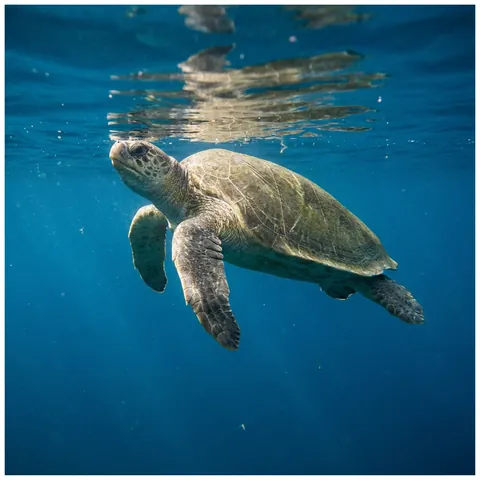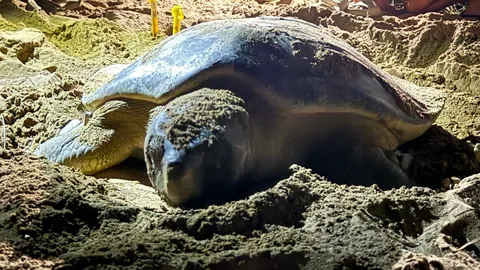
Flatback Sea Turtle
Natator depressus
Dermochelys coriacea
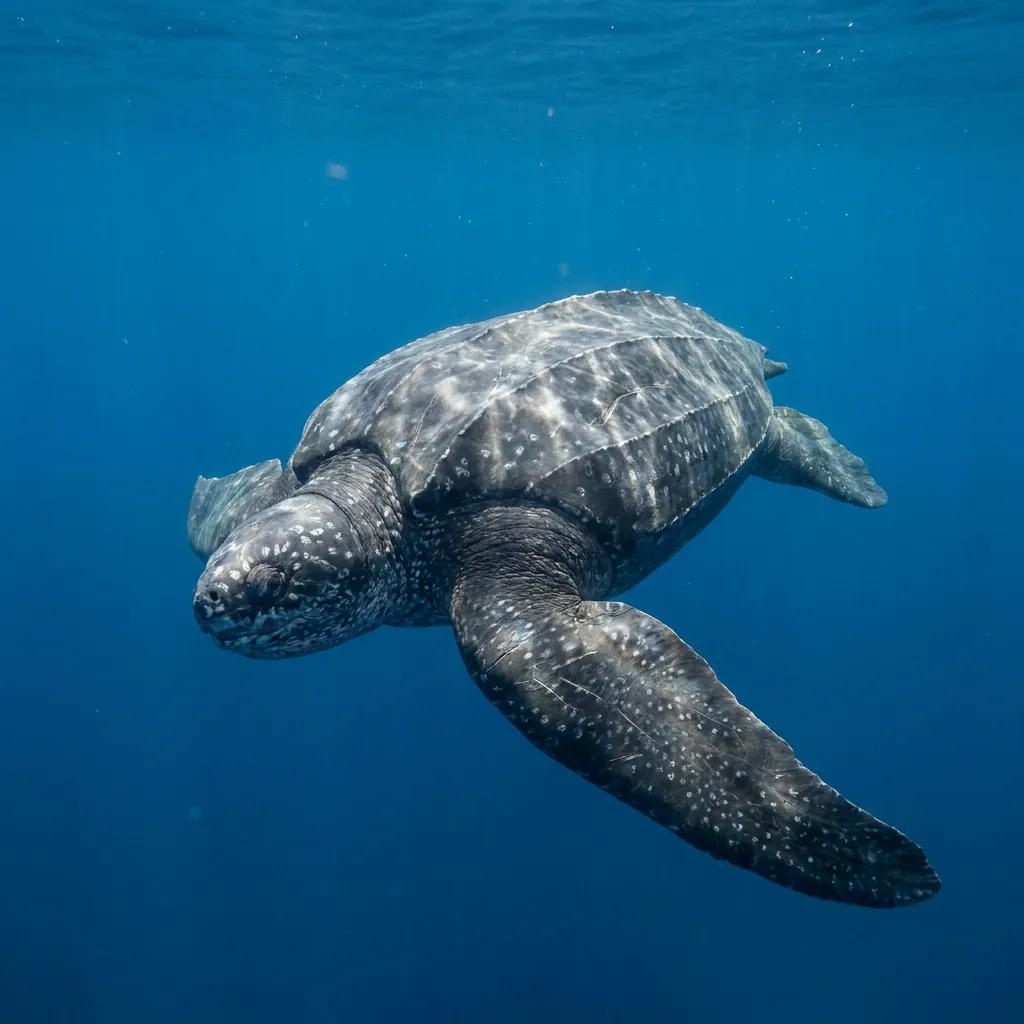
The largest turtle alive, this ocean giant has no hard shell at all. It can reach 256.5 cm in length and weigh as much as 650 kg.
Also known as: coffin-back, dermochelys coriacea, leather-back turtle, leatherback
This is the only sea turtle without a hard, bony shell. Every other sea turtle has a shell made of fused plates; this one's back is soft, leathery skin over oily flesh, which is enough on its own to tell it apart underwater.
It has a large, teardrop-shaped body, the most streamlined of any sea turtle. Instead of a bony, plated shell, its back is covered in oily flesh and flexible, leather-like skin, which gives the species its name. A pair of large front flippers, the biggest in proportion to body size of any sea turtle, powers it through the water. Neither pair of flippers has claws.
It has the widest range of any sea turtle, found in tropical, subtropical, and even Arctic waters worldwide. It lives mainly in the open ocean rather than around reefs, following its jellyfish prey through the water. It has been recorded diving to depths of 1,250 m, though it usually stays above 200 m.
It stays active almost constantly, spending as little as 0.1% of the day resting. This nonstop swimming generates body heat. Combined with a layer of insulating fat, that heat lets it keep its core body temperature far above that of the surrounding water, by as much as 18°C in some recorded individuals.
Adults feed almost entirely on jellyfish, along with other soft-bodied animals such as siphonophores, salps, and squid. An adult can eat about 73% of its own body weight in a single day. Floating plastic bags are often mistaken for jellyfish, and roughly a third of adults have been found with plastic in their stomachs.
Mating happens at sea, and males never come back to land once they enter the water. Females nest on beaches, sometimes up to 10 times in one season, more often than any other sea turtle. Multiple males typically mate with a single female. Eggs hatch after about 60 to 70 days, and the temperature inside the nest determines whether the hatchlings are male or female.
harmless to humans (endangered — do not disturb, especially when nesting)
Global nesting numbers have fallen sharply, from an estimated 115,000 females nesting per year around 1980 to between 26,000 and 43,000 today. The biggest driver of this decline is accidental capture in pelagic fishing gear such as longlines, which set vast numbers of hooks in the Atlantic Ocean alone every day.
This turtle's scientific name, Dermochelys coriacea, literally means 'leathery skin-turtle'. It was first described in 1761 from a specimen given to the University of Padua by Pope Clement XIII.
Describe what you saw and we name it, then keep every species you find in your Oceandex.