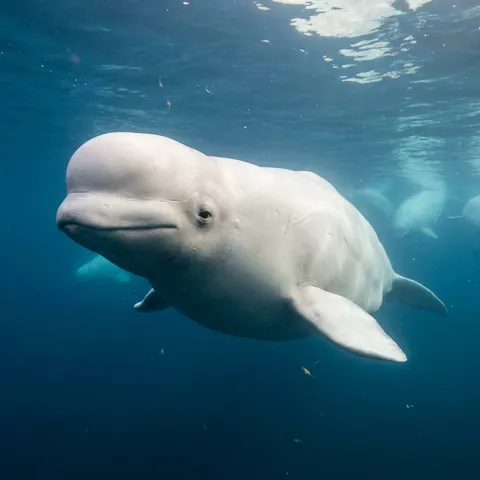
Beluga Whale
Delphinapterus leucas
Orcinus orca
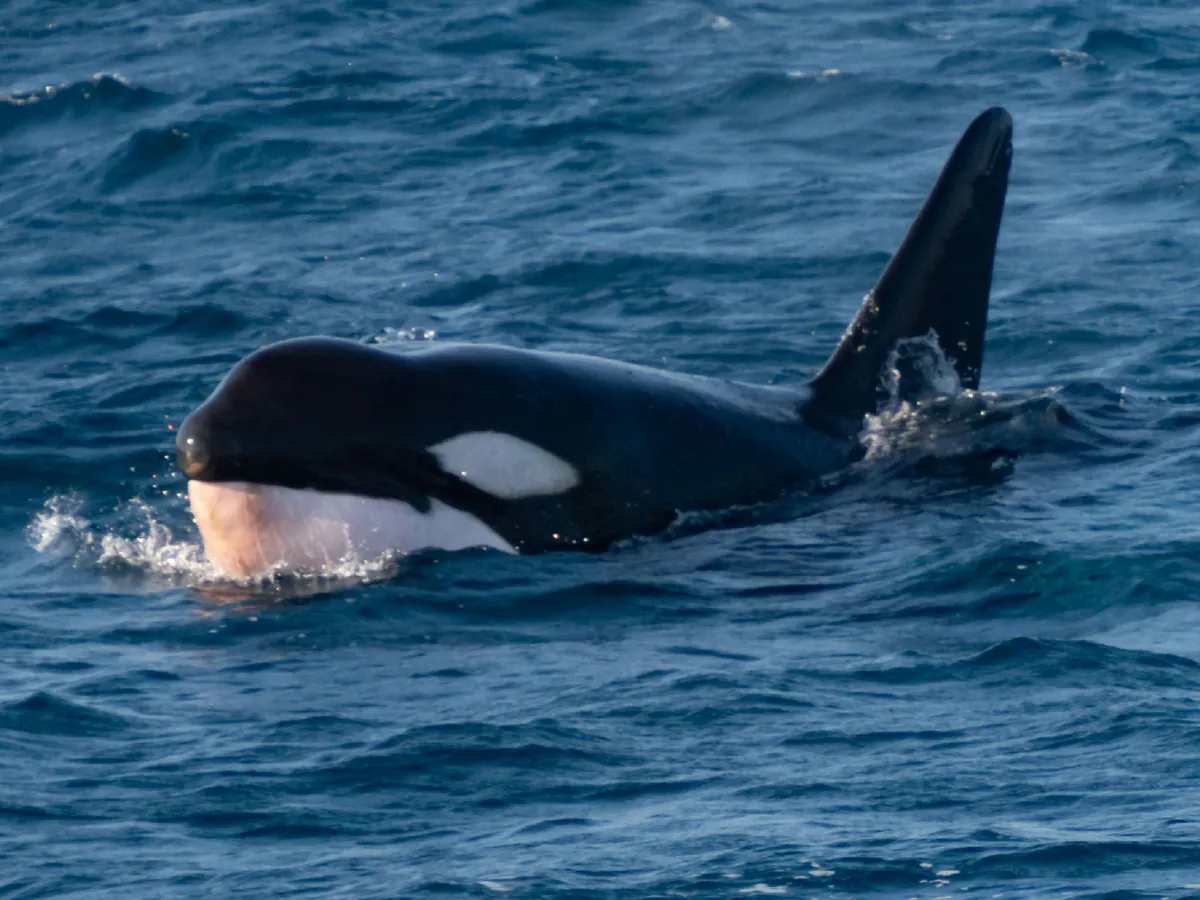
The orca, or killer whale, is the largest member of the dolphin family and an apex predator (an animal with no natural predators of its own) found in every ocean. Its bold black-and-white pattern makes it one of the most recognisable animals in the sea.
Also known as: epaulard, killer whale, orca, orca (killer whale), orcinus orca
From a distance, a young orca can be mistaken for a false killer whale or a Risso's dolphin, but adults are rarely confused with anything else. The single clearest mark is the bold white oval patch behind each eye, which neither of those species has.
Orcas are mostly black with sharply defined white patches. The entire lower jaw is white, and this colour runs back along the underside toward the genital area, widening and narrowing along the way and extending into white patches on the flanks near the tail. The underside of the tail fluke (the flat tail fin) is also white, and each eye sits inside an oval white patch. Males are larger than females, typically reaching 6 to 8 m and over 6 tonnes, while females usually reach 5 to 7 m and 3 to 4 tonnes; the largest recorded animals reach up to 9.8 m and 10 tonnes.
Orcas live in every ocean, from the tropics to the edge of the polar pack ice, though they are most common at higher latitudes and along coastlines rather than in the open ocean. They can dive to at least 2,652 m, but spend most of their time hunting in shallower water.
Orcas are highly social and active at the surface, breaching, tail-slapping, and spyhopping, where a whale lifts its head above the water to look around. They live in tight family groups built around related females, and closely related family groups travel together for years. They communicate using clicks, whistles, and pulsed calls, relying heavily on sound for navigation and hunting.
Orcas are apex predators that hunt in coordinated groups, sometimes compared to wolf packs. Depending on the population, they may take fish, squid, marine mammals, seabirds, or sea turtles, with some groups specialising heavily in a single prey type, such as salmon or herring.
harmless to humans in the wild (an apex predator — treat with respect)
The IUCN lists the orca as Data Deficient.
Some orcas have been seen carrying dead salmon balanced on their heads like hats, a behaviour with no known purpose.
Describe what you saw and we name it, then keep every species you find in your Oceandex.