Beluga Whale
Delphinapterus leucas
Megaptera novaeangliae
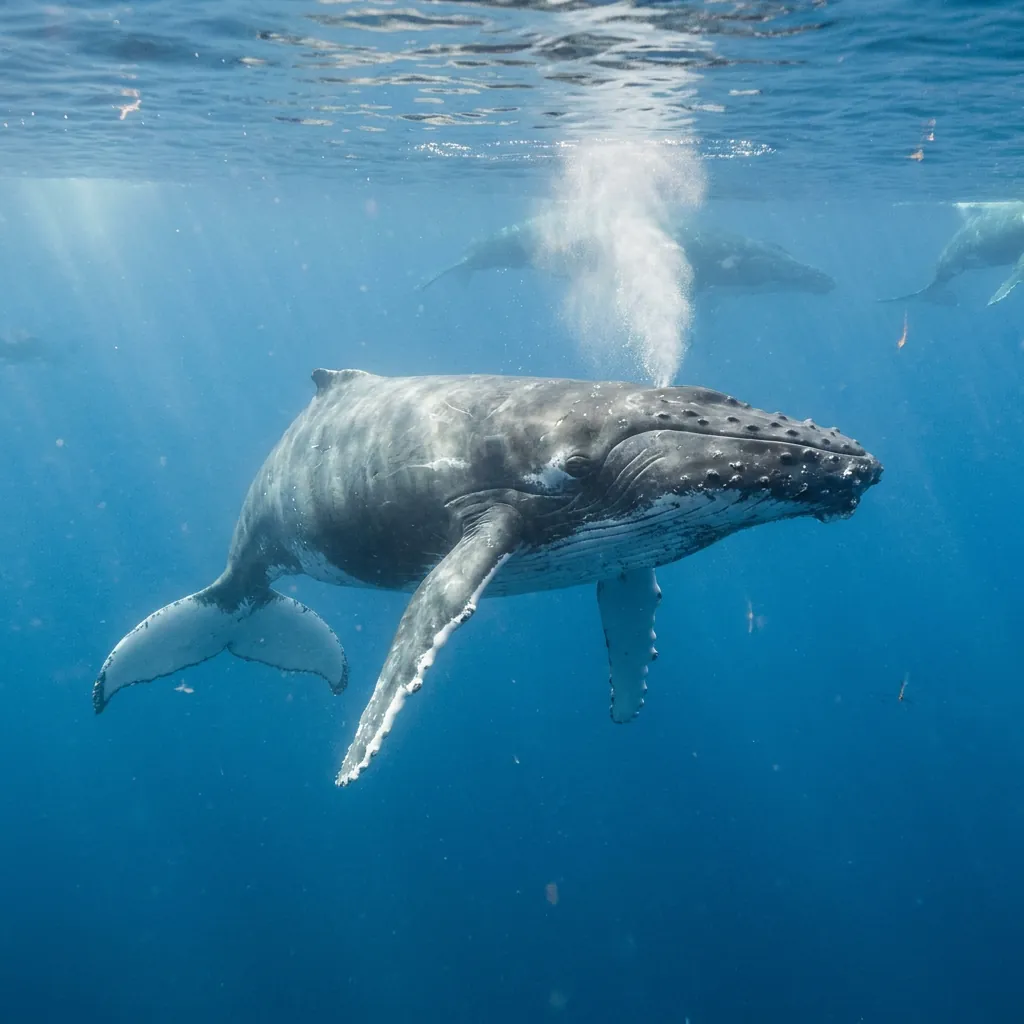
The humpback whale is one of the ocean's great travellers, crossing entire oceans between icy feeding grounds and warm breeding waters. It can grow to nearly 19 m long, making a chance encounter underwater unforgettable.
Also known as: buckelwal, bunch whale, hump whale, megaptera novaeangliae
Divers sometimes confuse a distant humpback with other large whales, such as fin or blue whales. The flippers described above settle it: on a humpback they are far longer relative to the body than on any other whale.
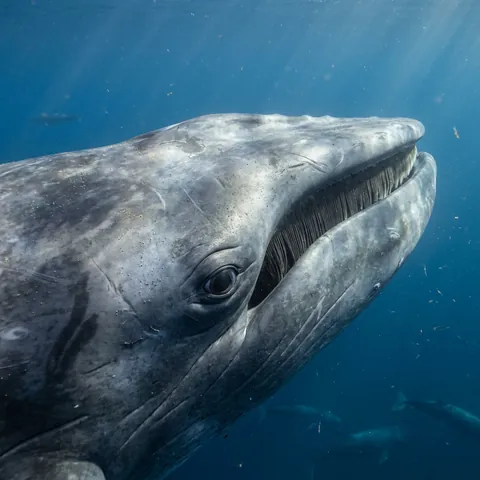
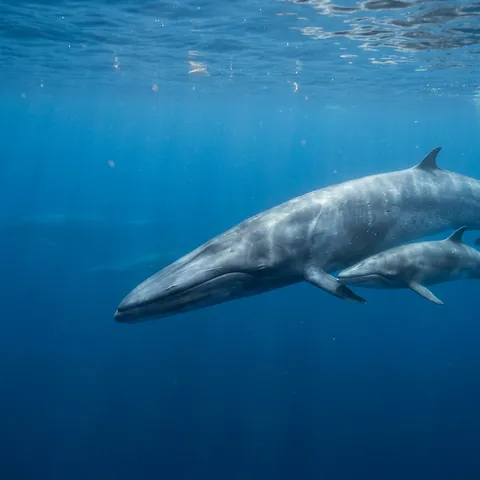
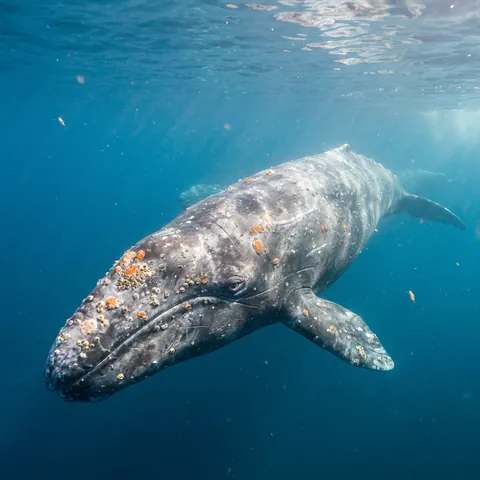
This is a bulky whale with a thin, narrow snout and a small, stubby dorsal fin set far back on the body. The fin shape varies a lot between individuals, from barely a bump to a longer, curved fin. Its most striking feature is its flippers: proportionally the longest of any whale, reaching about a third of its total body length. A row of 14 to 35 deep grooves runs along the throat, from the tip of the lower jaw back toward the belly. Inside the upper jaw sit 540 to 800 black baleen plates, the comb-like plates it uses to filter food instead of teeth. The whale's back is generally black. The underside shows a mix of black and white that varies between individuals; whales from the southern hemisphere tend to show more white than those from the north. It can reach about 18.9 m in length and weigh up to 35 tonnes.
Humpbacks range through oceans worldwide, avoiding only the far Arctic, parts of the equator, and a few enclosed seas. They favour coastal waters over continental shelves, spending summer feeding in cold, productive seas near the poles and winter breeding in warmer water closer to the equator. Divers most often meet them along migration routes or on breeding grounds, where they can be seen resting near the surface. They have been recorded diving to as much as 616 m, though most of their time is spent much shallower.
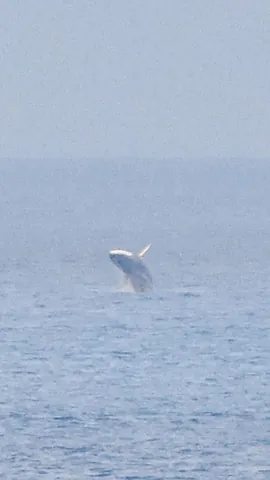
Humpbacks are unusually active at the surface, breaching clear of the water, slapping the tail fluke (lobtailing), and swinging the tail sideways onto the surface in a peduncle throw. These displays may help with communication or shedding parasites. Outside of mother-calf pairs, groups usually stay together for just days or weeks, though larger gatherings form to feed or when males compete over a female. The long flippers give the whale unusually fine control, letting it turn and manoeuvre independently of its tail.
Humpback whales are generalist feeders, taking krill, copepods, other plankton, and small schooling fish such as herring, capelin, and sand lances. They are gulp feeders: they take a huge mouthful of water and prey, then push the water back out through the baleen plates, trapping food behind. Large numbers of whales sometimes gather where prey is dense, feeding together in the same patch of water.
Mating takes place in winter, when females come into season and males reach peak hormone levels. Both sexes mate with multiple partners in a season. Males, known as escorts, follow females and compete for the position closest to her, fighting off rival males that trail behind. Pregnancy lasts about 11.5 months, and females typically give birth every two years.
harmless to humans
The IUCN lists the humpback whale as Least Concern.
Its scientific name, Megaptera novaeangliae, literally means 'giant-winged New Englander': Megaptera for its huge flippers, and novaeangliae because 18th-century naturalists first named the species after seeing the whales regularly off the coast of New England.
Describe what you saw and we name it, then keep every species you find in your Oceandex.