Flatback Sea Turtle
Natator depressus
Eretmochelys imbricata
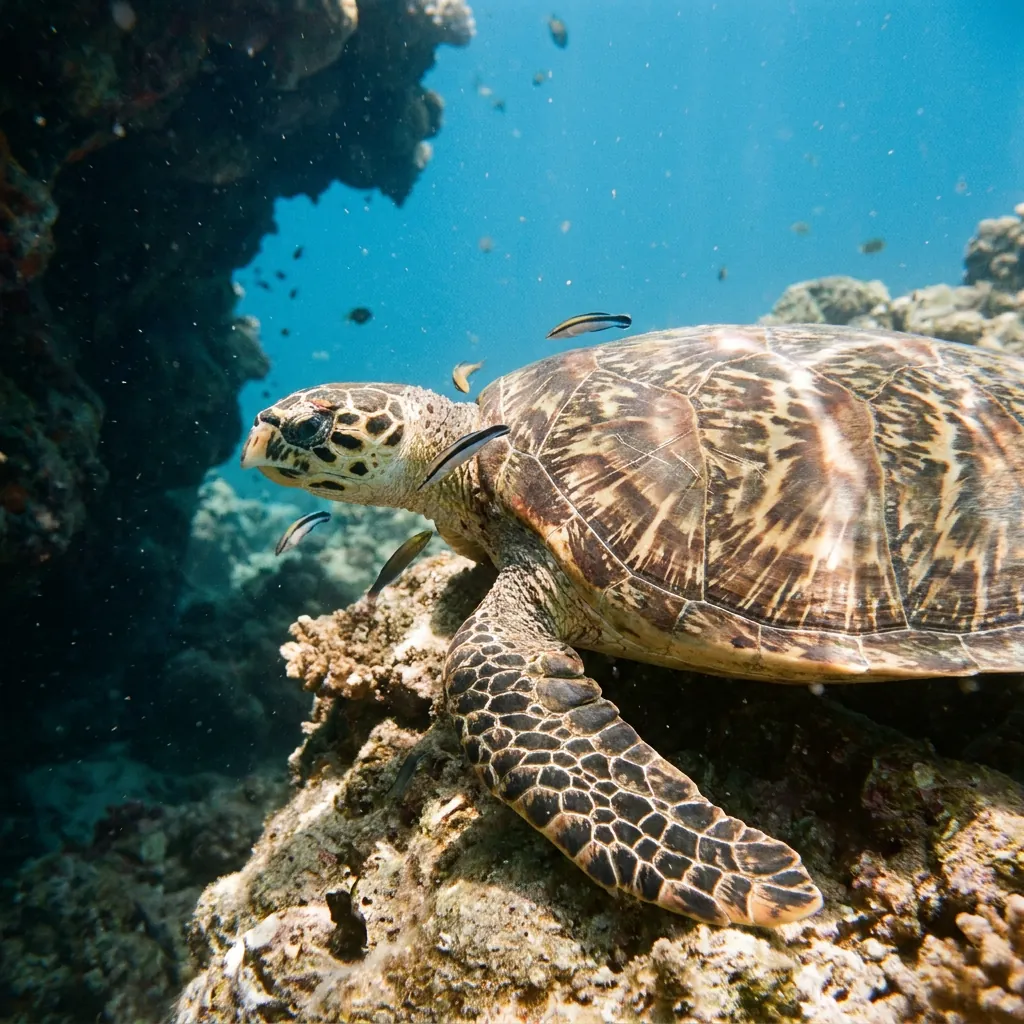
The hawksbill is a small, reef-loving sea turtle and the only living member of its genus - the most tropical of all sea turtles, and the one divers most often meet on coral reefs. Adults reach about 90 cm, commonly around 80 cm, and up to 120 kg, and have been recorded down to 300 m.
Also known as: eretmochelys imbricata, hawk's-bill turtle, hawksbill, hawksbill sea turtle
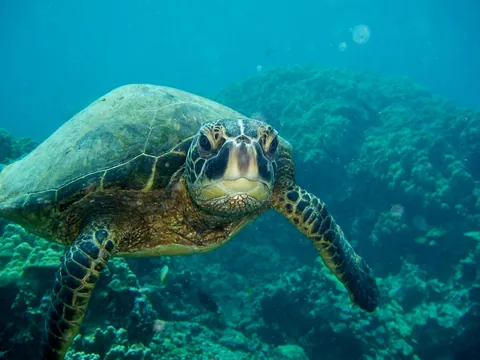
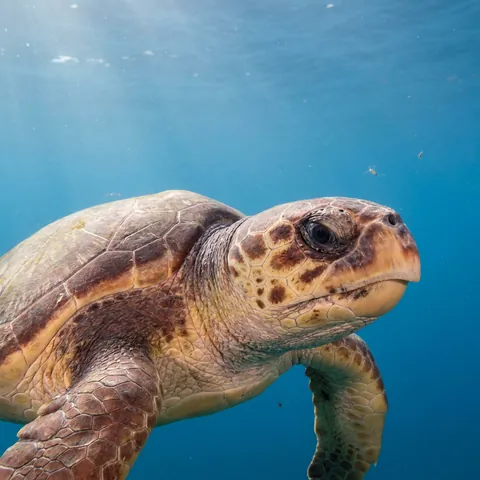
Several sea turtles share the same flattened, flippered body. Two features set the hawksbill apart: a sharp, curved beak instead of a rounded one, and shell plates that overlap with jagged, saw-like edges rather than lying flush.
Like other sea turtles it has a flattened body, a hard shell, and limbs shaped like paddles for swimming. Its shell colour can shift slightly with water temperature.
Hawksbills live in tropical seas across the Atlantic, Indian, and Pacific Oceans. Adults are creatures of the coral reef and by day are often found resting under ledges and inside caves. They also use shallow bays, inlets, lagoons, and mangrove-lined estuaries, crossing open water between them. Young turtles spend their first years out at sea before settling on a reef.
Adults live alone and meet only to breed, but they are strong travellers, moving long distances between feeding reefs and breeding grounds. Once settled on a feeding area, a turtle tends to stay loyal to it, though it may shift to a similar nearby reef. On the reef, you will usually see one poking its beak into cracks between rocks and corals. Its hard shell means that, apart from humans, only large sharks and a few other big predators can trouble an adult.
Sponges are the main food, and the turtle is fussy, taking only certain kinds and ignoring others. It also eats algae, seagrass, jellyfish, corals, molluscs, sea urchins, small fish, and crustaceans, and even mangrove fruits and seeds. Many of the sponges it chooses are toxic to other animals.
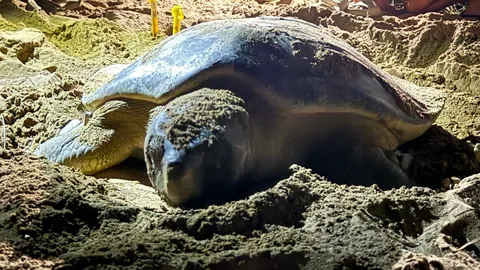
Adults gather to mate in quiet lagoons off remote nesting beaches, with the season depending on the region. At night the female hauls herself up the beach, digs a nest hole with her rear flippers, lays her eggs, and covers them before returning to the sea. Hatchlings also emerge at night and head for the water, guided by moonlight on the sea surface - which is why lights on the beach can confuse them.
harmless to humans (critically endangered — never disturb or buy shell products)
The hawksbill is Critically Endangered, mainly because of hunting and fishing by people. Its shell was long harvested for the ornamental tortoiseshell trade, and it still fetches high prices on the international market. Trade in the turtles and in anything made from them is now regulated under CITES, the Convention on International Trade in Endangered Species.
The hawksbill is one of the few animals that can safely eat the Portuguese man o' war, a jellyfish-like animal with a dangerous sting. It closes its eyes while feeding on the tentacles, since its armoured head cannot be pierced by the sting.
Describe what you saw and we name it, then keep every species you find in your Oceandex.