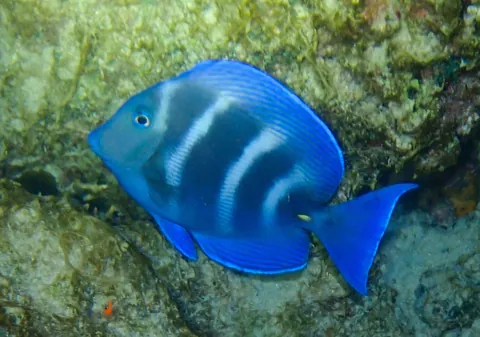
Atlantic Blue Tang
Acanthurus coeruleus
Acanthurus pyroferus
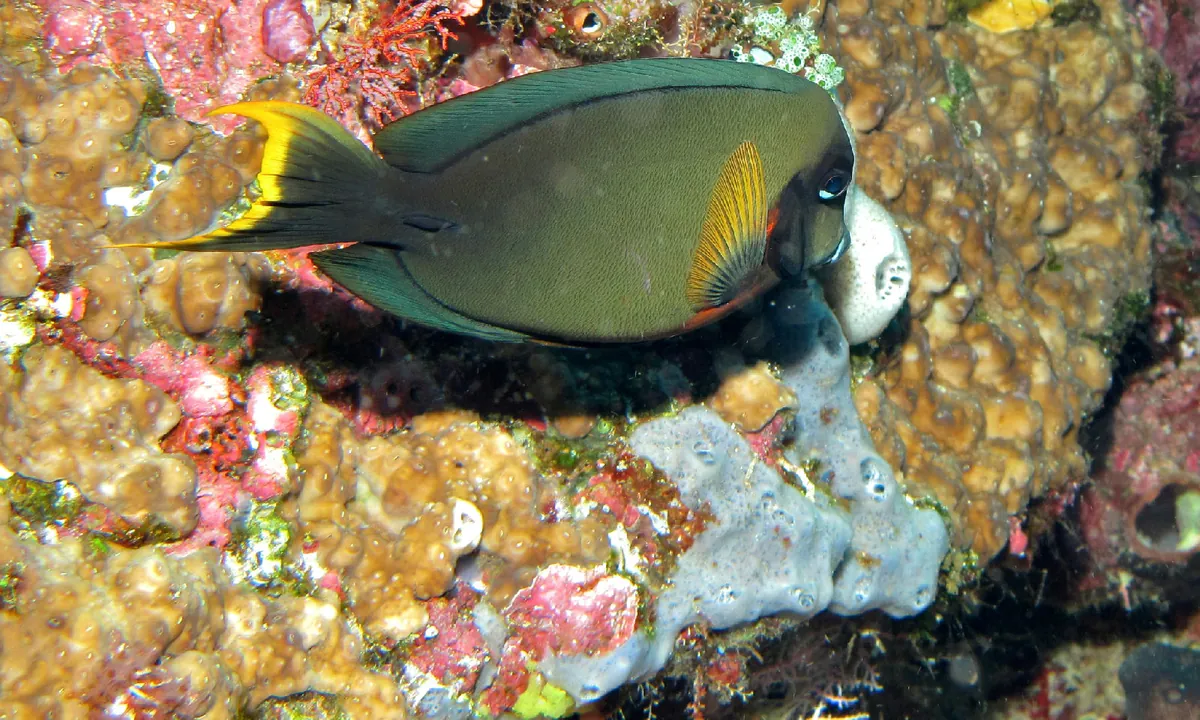
As a juvenile, this surgeonfish disguises itself as a small pygmy angelfish to avoid predators, then grows into a plain brownish adult. It reaches up to 29 cm.
Also known as: mimic surgeonfish, orange-gilled surgeonfish, pacific mimic surgeon, yellowspot surgeon, chocolate surgeonfish, powderblue surgeonfish, orange-gilled surgeonfish, mimic surgeonfish, pacific mimic surgeon, chocolate surgeonfish, yellowspot surgeon, chocolate surgeonfish, mimic surgeon, mimic tang
As a juvenile, this fish can look almost identical to the pygmy angelfish it copies. The giveaway comes with growth: once it reaches adult size the mimicry fades into the plain brown body with the orange pectoral patch and white mouth band described above, a look no pygmy angelfish ever grows into.
The adult body is yellowish brown with a white band around the mouth and a darker band running from the chin up to the gill cover, plus an orange patch at the base of the pectoral fin. The tail fin has a pale rear edge and is rounded in juveniles.
It lives on lagoon and seaward reefs across the Indo-Pacific, favoring areas of mixed coral, rock, or sand at the base of reefs and ledges, at depths of 4 to 60 m. Adults are usually seen alone.
It grazes on algae and detritus (dead organic matter) on the reef. As juveniles it copies the color pattern of a local pygmy angelfish species, switching which one it mimics depending on which angelfish lives in that area. Juveniles have grooves in their tail spines that may once have carried venom, but adults appear to have lost this ability.
Its scientific name, pyroferus, means 'firebearer', a reference to the patch of orange color behind its gills.
Describe what you saw and we name it, then keep every species you find in your Oceandex.