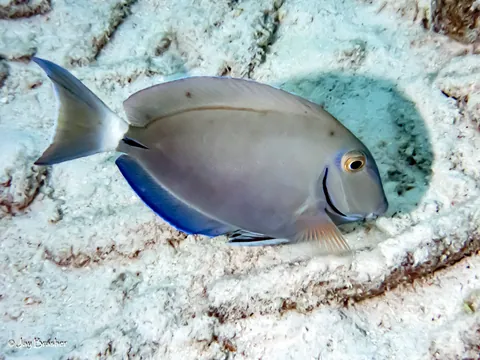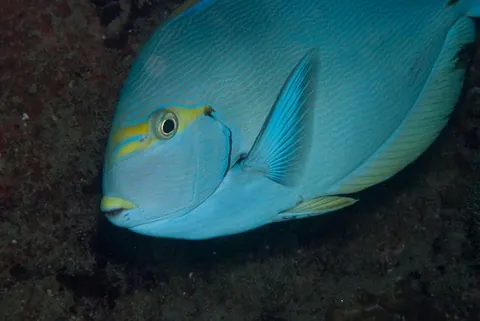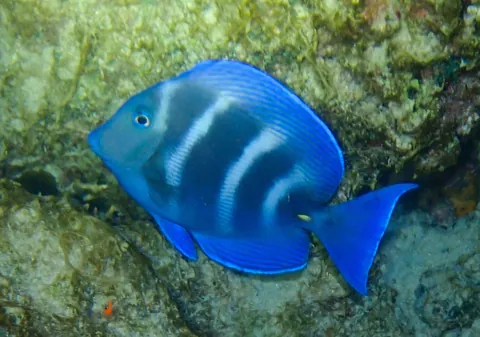
Atlantic Blue Tang
Acanthurus coeruleus
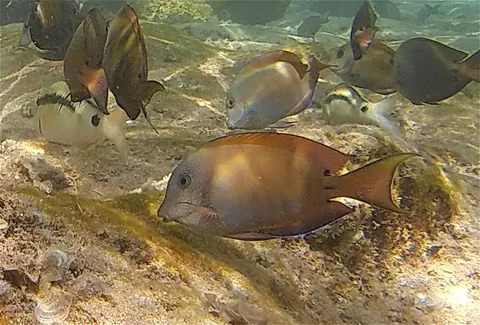
Acanthurus chirurgus
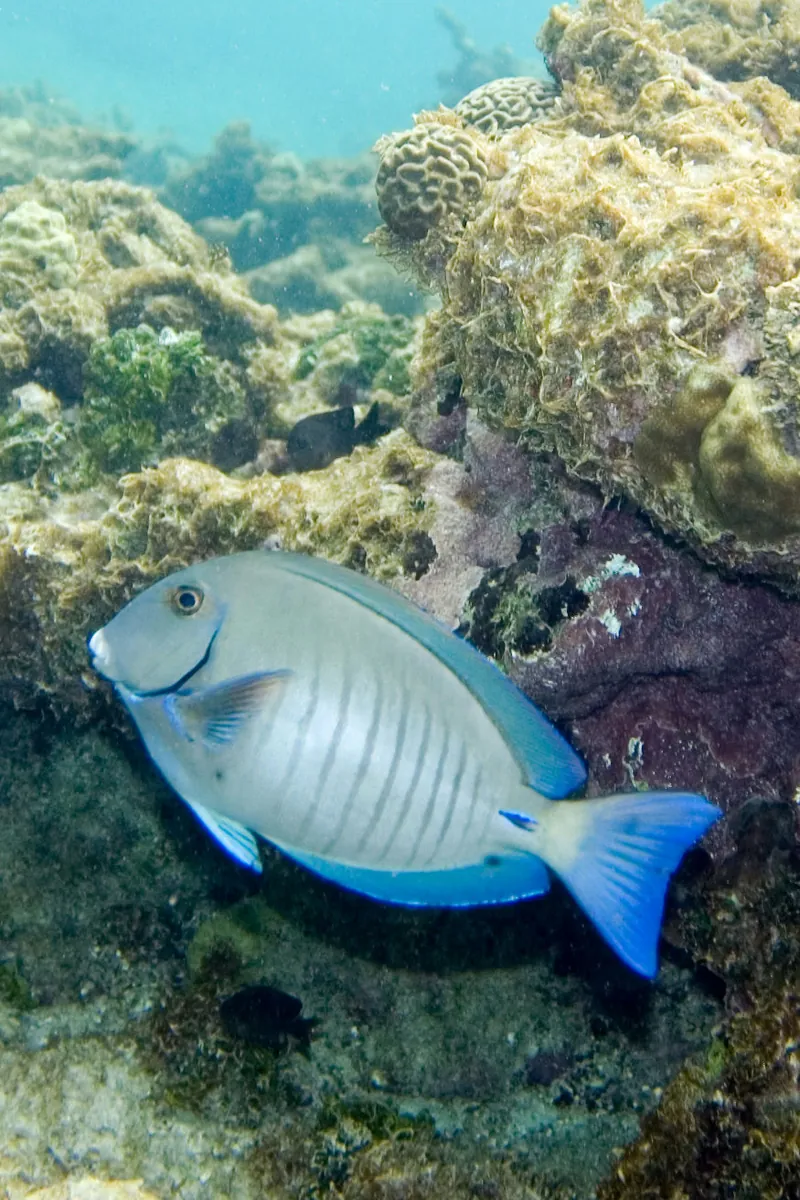
The doctorfish takes its name from a hidden weapon: a sharp, scalpel-like spine folded against its tail. Grazing quietly over the reef, it looks harmless, but it can defend itself with a fast flick of the tail.
Also known as: doctorfish tang
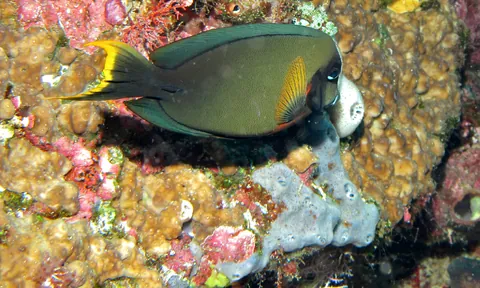
Doctorfish can be confused with other Atlantic surgeonfish of similar shape and colour. Look for the faint blue ring around the spine at the base of the tail, combined with the row of narrow vertical bars along the body; other similar species lack this exact ring-and-bar combination.
This is an oval, flattened fish that reaches up to 39 cm in length and 5.1 kg in weight. Its body colour ranges from blue-grey to dark brown, crossed by 10 to 12 narrow vertical bars that are always present but often faint. The edges of the tail, dorsal, and anal fins are blue, and a faint blue ring circles the base of the tail. On each side of the tail base sits a sharp, blade-like spine, the feature that gives the species its name.
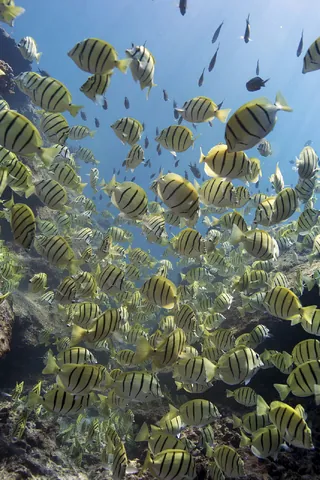
Doctorfish live over rocky outcrops and coral reefs in shallow water, from close to the surface down to about 25 m, most commonly in the upper 15 m. They range along the western Atlantic coast, from the northeastern United States down to Brazil, and gather in loose, open groups over the reef.
During the day, doctorfish graze steadily on algae and organic debris growing on rock and reef. Their teeth are shaped for scraping this growth from hard surfaces, and because they swallow food whole, a gizzard-like organ in the gut grinds it down with swallowed grains of sand. Spawning happens in the evening, in group events, releasing tiny floating eggs that hatch within a day.
Doctorfish feed mainly on algae scraped from rock and reef, swallowing sand along with it to help grind the food internally. Juveniles will also set up cleaning stations together with other surgeonfish and damselfish, where they pick dead skin and parasites off green turtles, inspecting and nipping mostly at the turtles' flippers.
Juvenile doctorfish act as cleaners for green turtles, inspecting and picking dead skin and parasites mostly from the turtles' flippers.
Describe what you saw and we name it, then keep every species you find in your Oceandex.