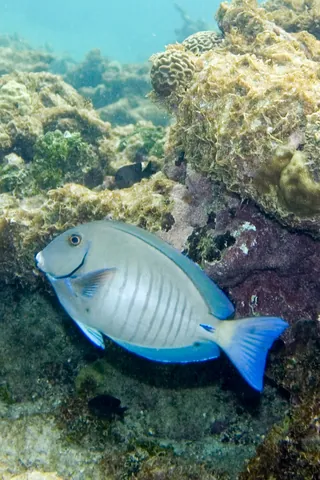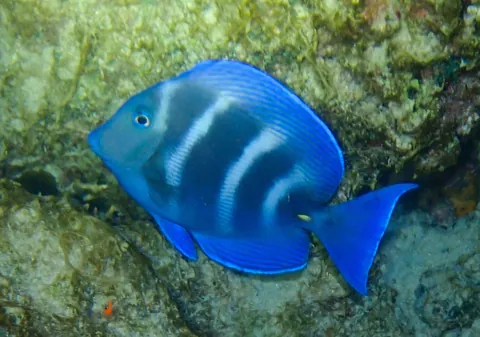
Atlantic Blue Tang
Acanthurus coeruleus
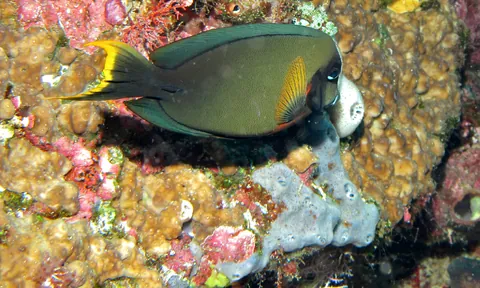
Acanthurus mata
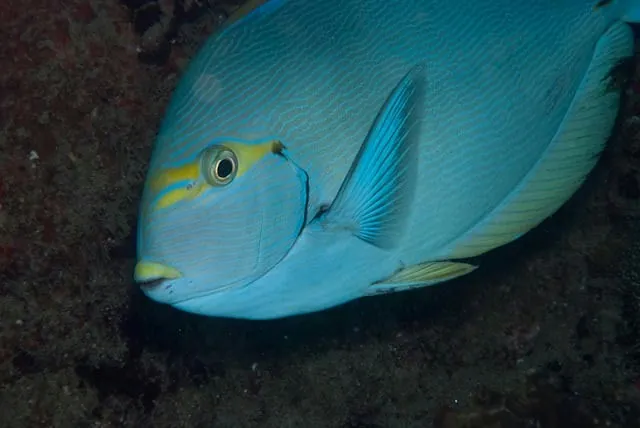
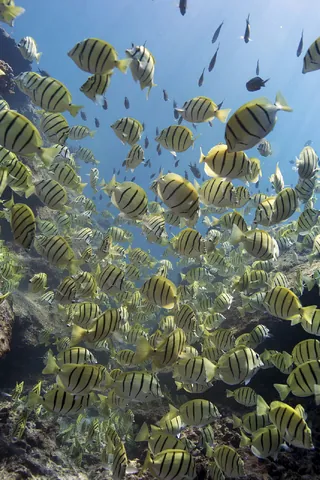
The elongate surgeonfish is a reef fish that can switch its look in an instant, turning from a striped brown fish into a plain grey-blue one. It grows to about 50 cm and often gathers with others in open water to feed.
Also known as: elongate surgeonfish, mata surgeonfish, surgeonfish, mata surgeonfish, bluelined surgeonfish, yellowmask surgeonfish, striped surgeonfish, white-tail lancet, tang, pale surgeon, yellowmask, blue-lined surgeonfish, elongate surgeon, lancet fish, elongate surgeonfish, yellowmask surgeonfish, pale surgeonfish, pale surgeon
Several surgeonfishes share similar blue lines and a common name involving 'blue-lined' or 'striped'. Look for the yellow stripe through this fish's eye splitting into two separate lines in front of the eye, paired with a yellow upper lip; that combination is the giveaway.
This fish has an oval, laterally flattened body reaching up to 50 cm. Its background colour is brown, streaked with horizontal bluish lines, though it can change to an overall grey-blue. A yellow stripe runs through the eye and splits into two lines in front of it, and the upper lip is also yellow. The dorsal and anal fins are bluish with a yellow sheen, and the anal fin has a thin black line along its base. The tail fin is crescent-shaped, and the mouth is small and pointed. Like other surgeonfishes, it carries a sharp, blade-like spine at the base of the tail that it can flick out to defend itself.
It lives on steep reef slopes, often over rocky bottoms or in slightly turbid water, across the tropical Indo-Pacific from the Red Sea to the islands of the central Pacific. Divers usually meet it in open water off the reef edge, where it gathers to feed on plankton.
This fish was first described in 1829 by the French zoologist Georges Cuvier, but not as a surgeonfish at all - he originally classified it as a butterflyfish, Chaetodon mata, before it was later moved into its current genus, Acanthurus.
Describe what you saw and we name it, then keep every species you find in your Oceandex.