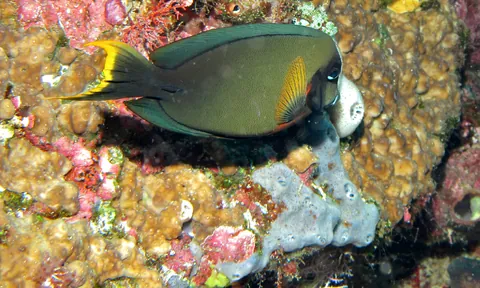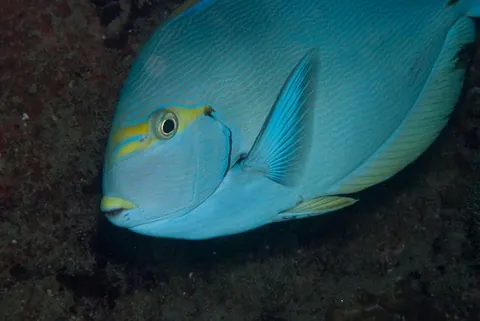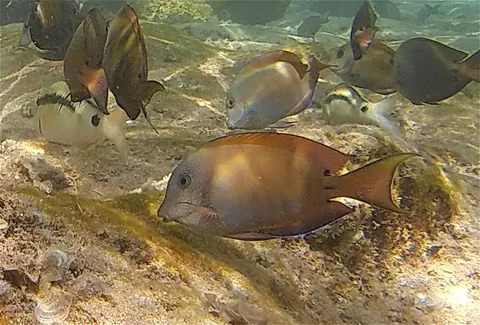
Brown surgeonfish
Acanthurus nigrofuscus
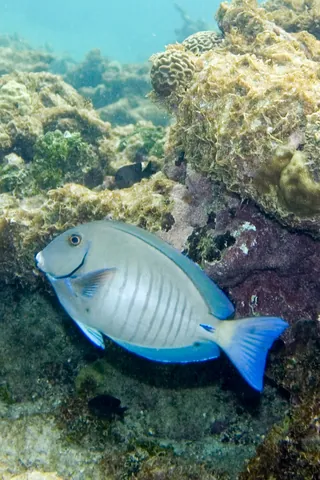
Acanthurus coeruleus
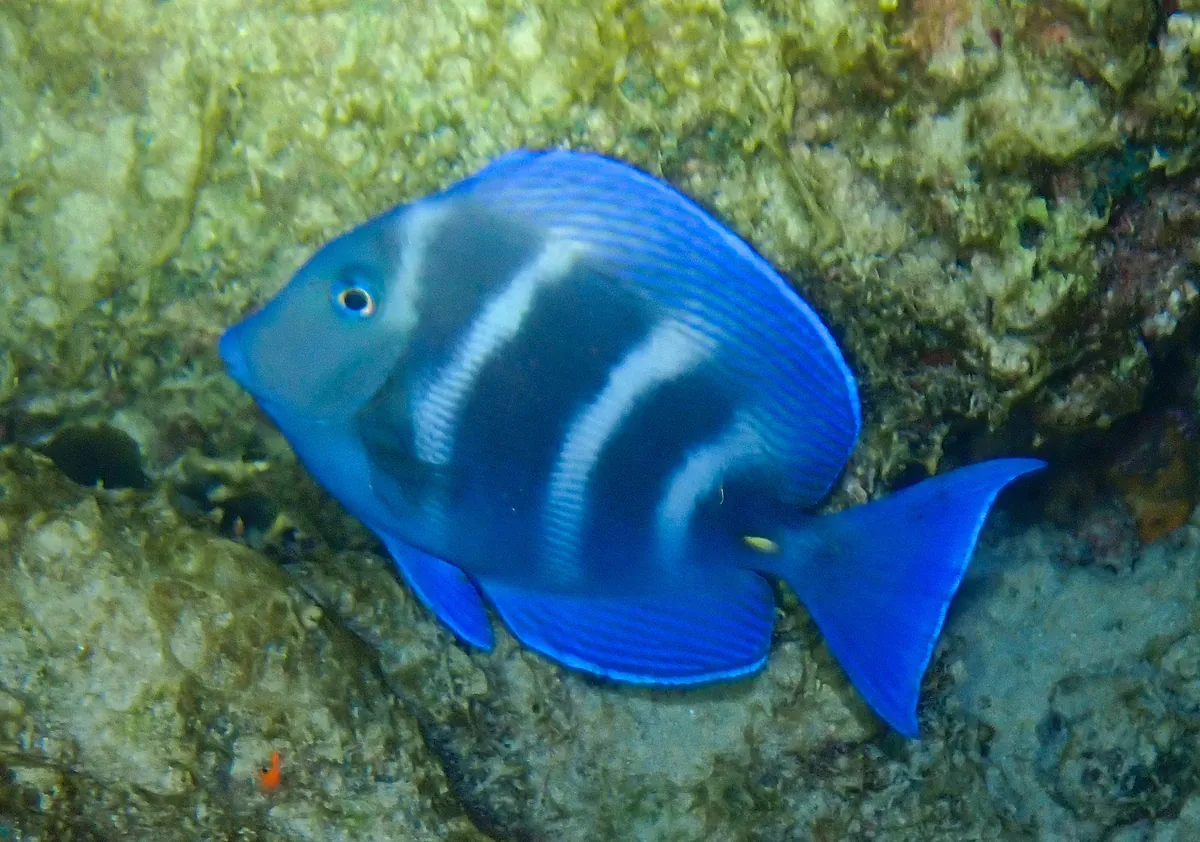
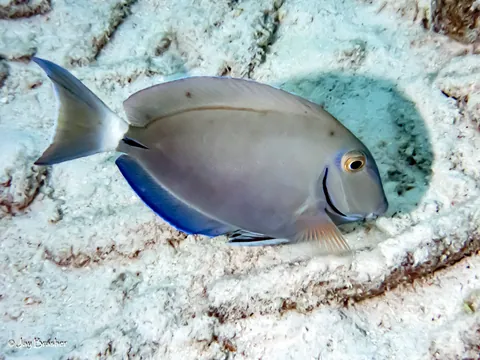
The Atlantic blue tang is one of the most recognisable fish on Caribbean reefs. Its colour changes a great deal as it grows, from a bright yellow youngster to a deep blue adult. It grows up to 39 cm long, though most are closer to 25 cm.
Also known as: blue tang, blue tang surgeonfish, caribbean blue tang, blue barber, blue doctor, blue doctorfish, blue surgeonfish, yellow barber, yellow doctorfish
This fish changes colour dramatically as it grows, from yellow to blue, which can make it hard to judge by body colour alone. Look instead for the golden edge along its fins, which stays present at every life stage.
Adults are light to dark blue all over, with a golden-blue edge along the fins on the back, belly, and tail. Young fish start out bright yellow, then pass through a yellow-and-blue stage before becoming fully blue as adults. Like other surgeonfish, it carries a sharp spine on each side near the base of the tail, which it can use in defence.
Atlantic blue tangs live on coral reefs and in nearby grassy or rocky shallows in the western Atlantic, from Florida south to Brazil. They have also been seen in the Mediterranean Sea since 2011. They are usually found from close to the surface down to about 18 m, though they can range down to about 40 m.
This fish can be territorial, live in schools, or wander alone, depending on local conditions. Territorial individuals stay in one spot and chase off other blue tangs. Schooling fish swim faster in mixed groups, often alongside other reef fish. Blue tangs also act as cleaners, picking parasites and dead skin off other fish, and even off green sea turtles, nipping gently at the head, limbs, and shell.
Blue tangs are herbivores. They mainly eat algae growing on the reef, along with some detritus and plankton. They also pick algae straight off the bodies of other fish, cleaning them as they feed.
When a blue tang visits a cleaning station to be cleaned itself, it often stands almost on its head, a strange pose that seems to signal to cleaner fish that it is ready.
Describe what you saw and we name it, then keep every species you find in your Oceandex.