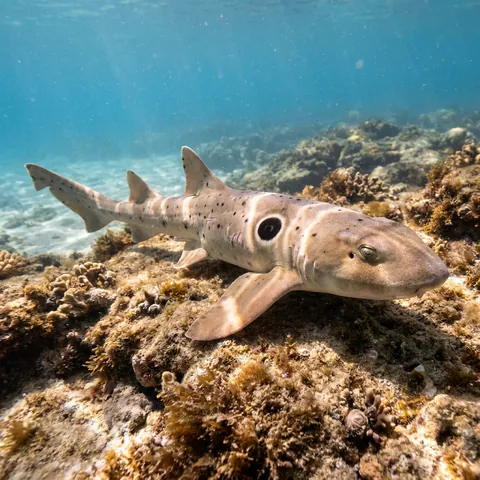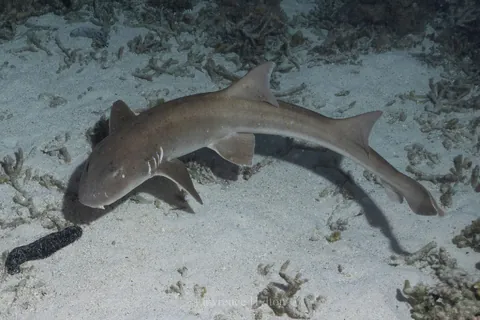
Brownbanded bamboo shark
Chiloscyllium punctatum
Stegostoma tigrinum
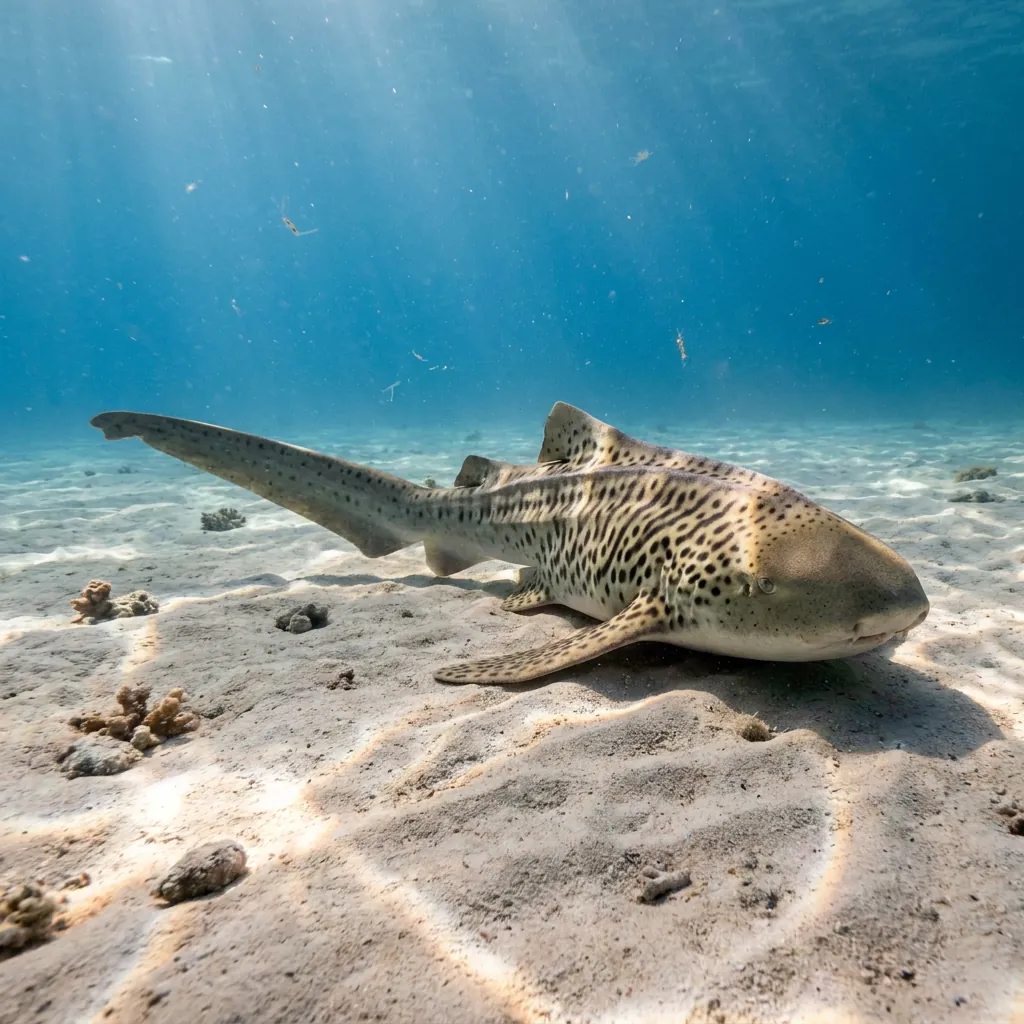
The zebra shark is a slow, gentle giant of the reef, growing up to 354 cm long. It spends its days lying still on the sand, looking almost lazy, but at night it becomes an active hunter.
Also known as: leopard shark, monkey-mouth, nurse shark, sea tiger, Stegostoma tigrinus, Stegostoma fasciatum, tiburón acebrado
A resting zebra shark on the sand can look like a nurse shark at first glance. Check the tail: the zebra shark's tail fin is nearly as long as the rest of its body, far longer than a nurse shark's short tail.
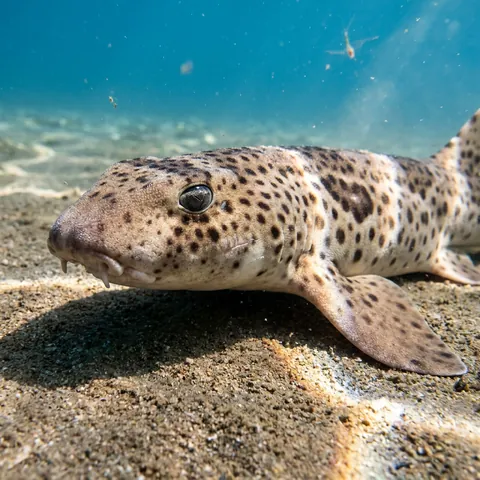
This shark has a long, cylindrical body with a broad, flat head and a short, blunt snout. Five ridges run along its back and sides like low ribs under the skin. Adults are pale with small dark spots all over the body and fins. Young zebra sharks look completely different: they are dark brown with pale vertical stripes, and they do not yet have the ridges. The tail fin is huge, almost as long as the rest of the shark's body, with a barely-there lower lobe.
Zebra sharks live on coral reefs, rubble patches, and sandy flats across the tropical Indo-Pacific. They are bottom-dwellers, resting on the seabed from shallow water down to about 90 m. Divers most often find them tucked into sandy gutters or reef channels, sometimes lying with their mouths open, facing into the current.
By day, zebra sharks are sluggish and rest motionless on the bottom, sometimes propping up the front of the body on their side fins. They become active at night, wriggling their flexible bodies into holes and crevices to hunt shelled molluscs, crustaceans, and small fish. They swim with strong, eel-like waves of the body and tail. Most of the year they are solitary, but in some places large groups gather in shallow water for part of the year. Females lay large egg capsules with hair-like fibres that anchor them to reef structures.
harmless to humans (gentle and slow-moving)
This shark is named for its striped juveniles, not its spotted adults. As it grows, the stripes break apart into spots, which is why fully grown zebra sharks are sometimes wrongly called 'leopard sharks', a name that actually belongs to a different, unrelated shark.
Describe what you saw and we name it, then keep every species you find in your Oceandex.