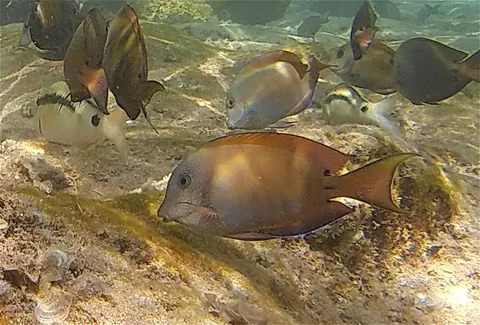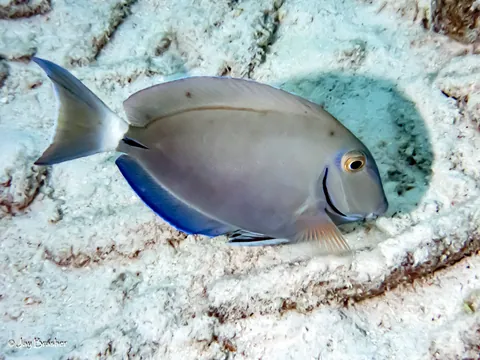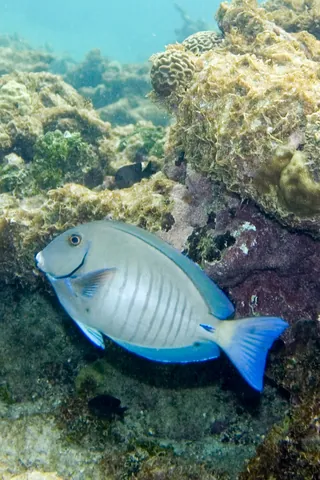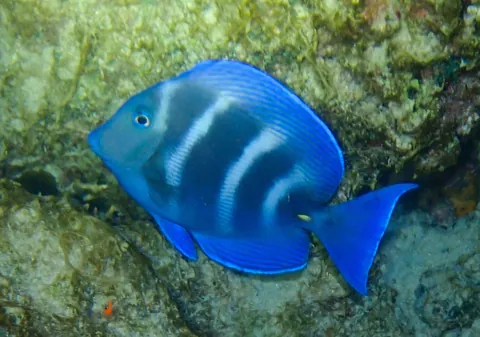
Atlantic Blue Tang
Acanthurus coeruleus
Acanthurus guttatus
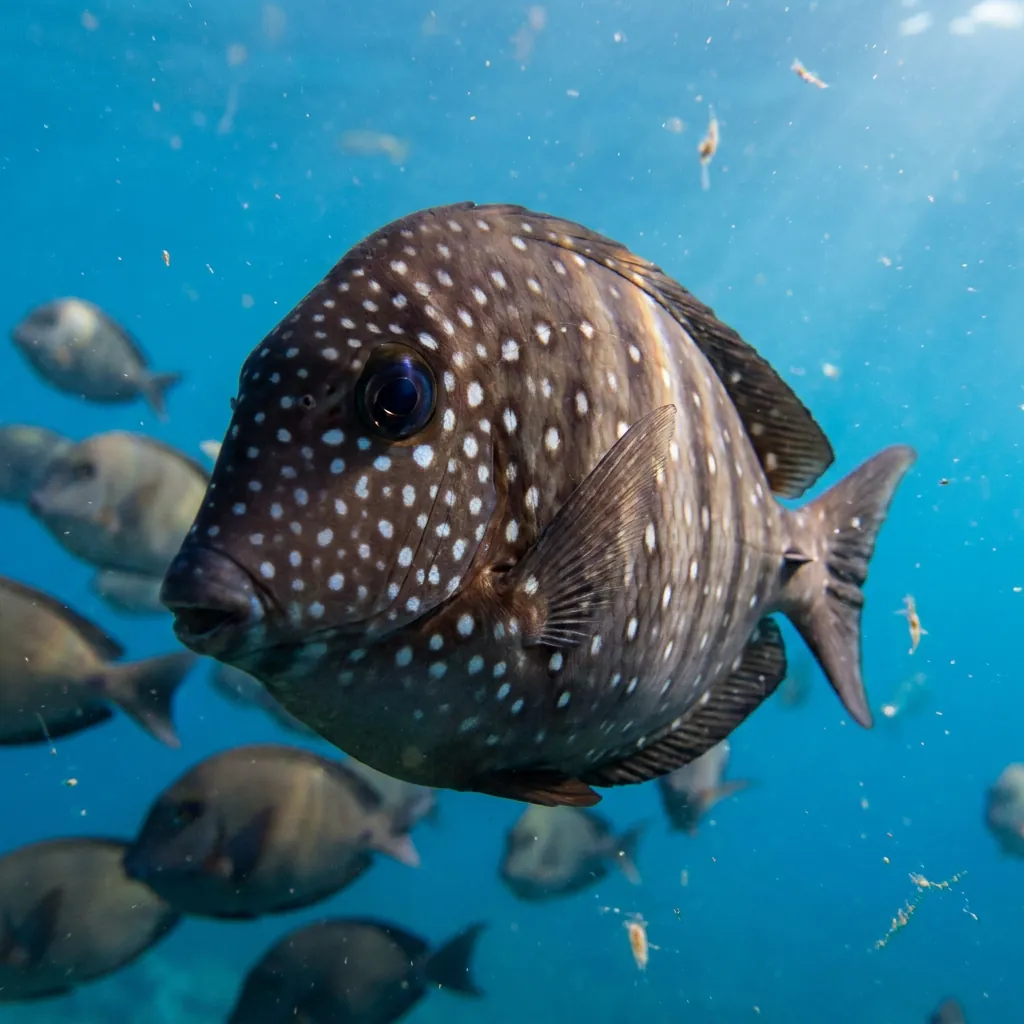
The whitespotted surgeonfish is a small, deep-bodied reef fish covered in white spots, built for life in rough, churning water. It grows to about 26 cm and is a common sight on wave-battered reef edges.
Also known as: mustard surgeonfish, white-spotted surgeonfish, spotband surgeonfish, white-spotted surgeon
It is easily confused with other spotted or banded surgeonfish. Check the tail fin: this species has one half pale yellow and one half black, a combination not shared by similar reef surgeonfish.
The body is deep and flattened side to side, grey and darkening toward the tail, and scattered all over with white spots. A white band runs behind the eye to the back of the head, and a second white band circles the body just behind the bright yellow pelvic fins. Most other fins are dark, but the small tail fin is split evenly into pale yellow and black halves. Like other surgeonfish, it carries a sharp, forward-pointing spine on each side of the tail base.
This fish lives on exposed reefs and rocky shores in shallow water, usually no deeper than about 8 m, in the surge zone where waves churn the water into froth and bubbles. It ranges across the Indo-Pacific and is usually seen in groups over reef flats.
Whitespotted surgeonfish graze on filamentous and calcareous algae, the low, encrusting kinds that coat reef rock, and play a key role in feeding that plant material into the wider reef food web. In some populations breeding happens all year, with eggs released into drainage channels on the reef at dusk.
Its scattering of white spots may work as camouflage by mimicking the bubbles that fill the churning surge water it prefers to live in.
Describe what you saw and we name it, then keep every species you find in your Oceandex.