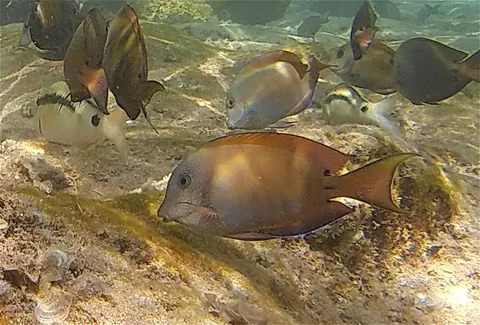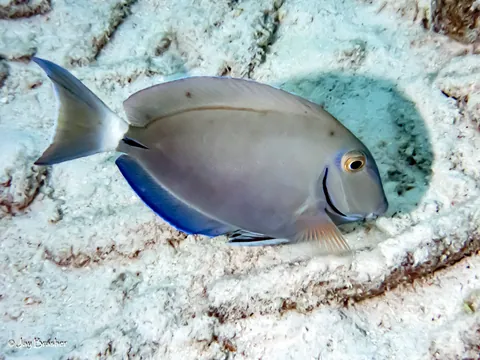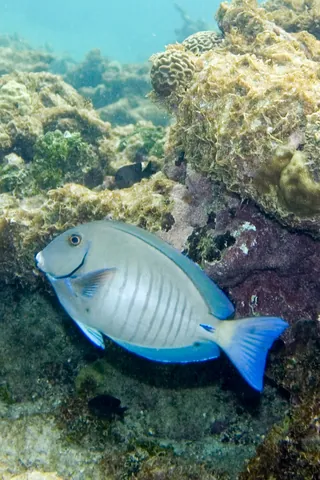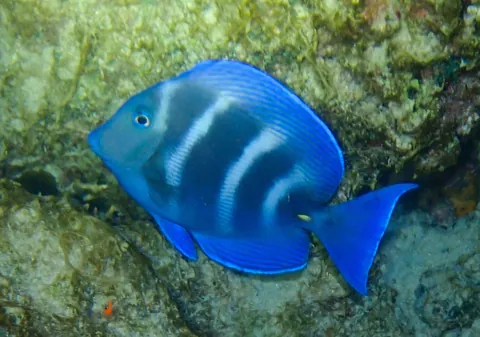
Atlantic Blue Tang
Acanthurus coeruleus
Acanthurus nigricans
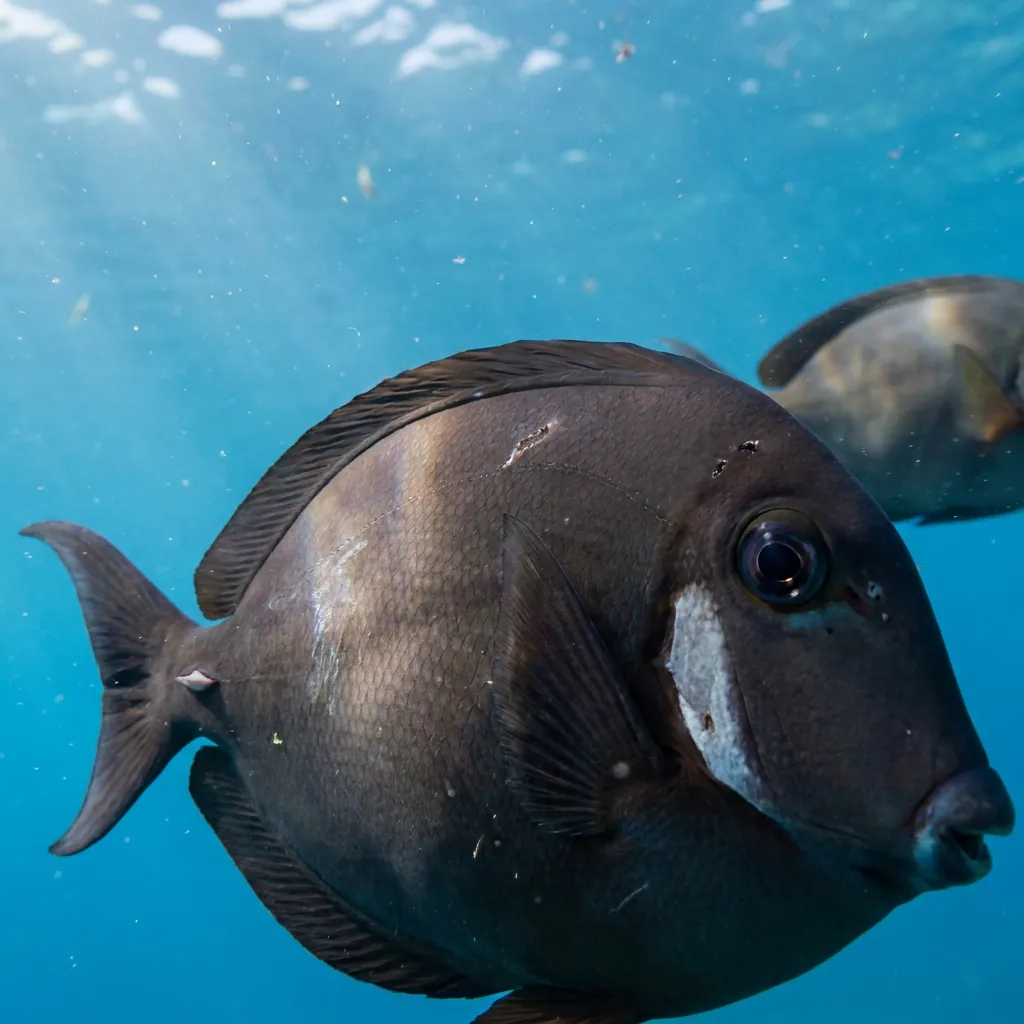
The whitecheek surgeonfish is a small, dark tang of clear tropical reefs. Like all surgeonfishes it carries a blade on each side of the tail base, the sharp spine that gives the family its name. It grazes fine, thread-like algae off hard surfaces. It grows to about 21 cm and is found from just under the surface down to about 67 m, though it is usually seen from about 2 m down.
Also known as: blackear surgeonfish, gold-rim tang, golden rim surgeonfish, goldrim surgeonfish, gray surgeonfish, blackear surgeonfish, surgeonfish, whitetail surgeonfish, gold-rimmed surgeonfish, gold-rim tang, white-cheeked surgeonfish, yellowfin tang, whiteface surgeonfish, golden rimmed surgeonfish, gray surgeonfish, whitecheek surgeonfish, yellowrimmed surgeonfish, yellow spotted surgeonfish, velvet surgeonfish, goldrim surgeonfish, whitecheek surgeonfish, whitetail surgeonfish, velvet surgeonfish, yellowrimmed surgeonfish, yellow-banded surgeonfish, white-cheeked surgeonfish, velvet surgeon
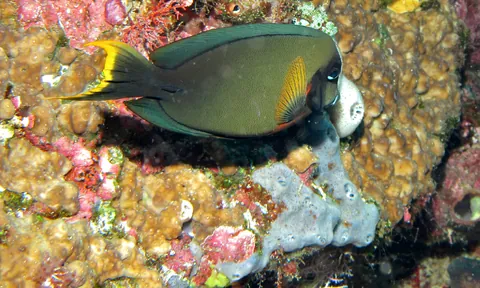
Look for the white cheek. On a nearly black fish, a bright white blotch lies flat directly under the eye, with a second white ring behind the mouth. Back it up with the yellow stripe along the base of the dorsal and anal fins, which widens as it runs towards the tail. All of these are fixed marks and are easy to read at normal viewing distance.
The body is a rounded, drawn-out oval, deep and flattened from side to side, with a steep forehead and the eye set high on the head. The mouth is small and can be pushed forward to graze. The overall colour is bluish-black to black, and the bright marks stand out sharply against it: a white patch below the eye, a white ring behind the mouth, and a yellow band along the base of the dorsal and anal fins that grows wider towards the tail. The tail base is black apart from a yellow edge around the blade and its sheath. The base of the pectoral fin is black.
It ranges from the central Indo-Pacific east across the Pacific to Hawaii and on to the coasts of Central and South America; in the Indian Ocean it reaches the Chagos Islands, Christmas Island and the Cocos (Keeling) Islands. It wants clear water and hard ground: lagoons and seaward reefs, from the lower surge zone, where the swell still pushes you around, down to at least 67 m. Young fish are shy and stay tucked in among large corals.
It interbreeds with the Achilles tang, Acanthurus achilles, a rare relative, and the two produce hybrid young where their ranges meet.
Describe what you saw and we name it, then keep every species you find in your Oceandex.