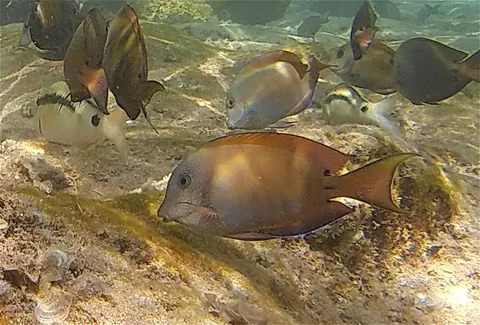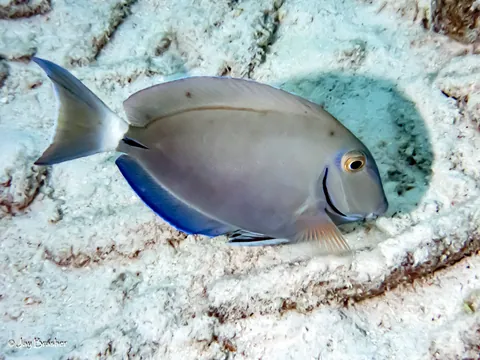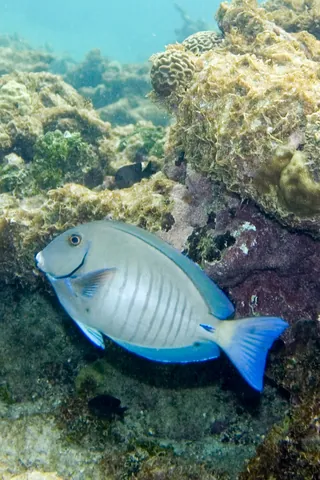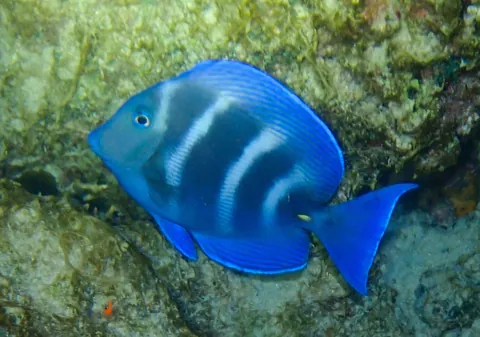
Atlantic Blue Tang
Acanthurus coeruleus
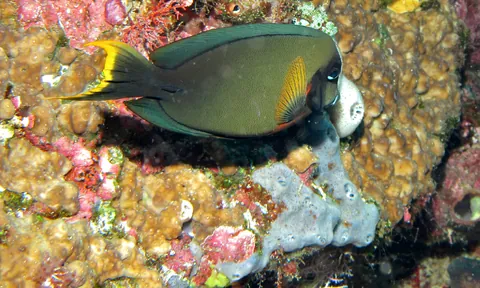
Zebrasoma scopas
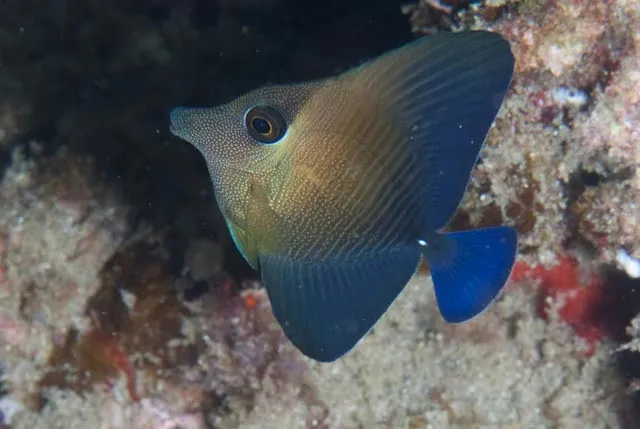
The twotone tang, also called the brown tang, is a surgeonfish. It has a deep body that is strongly flattened from side to side, a snout that sticks out for picking at the reef, and a large, sail-like back fin. It reaches about 40 cm. Like other surgeonfishes it carries a blade on the tail base, which in this species is white.
Also known as: bluelined sailfin tang, brown sailfin surgeonfish, brown sailfin tang, brown tang, brushtail surgeonfish, twotone tang, brushtail tang, yellow tang, bluelined sailfin tang, brown sailfin tang, brown sailfin surgeonfish, twotone tang, two-tone surgeonfish, brown saiffin tang, brushtail tang, brown sailing tang, brown sailfish surgeonfish, spotted tang, brown tang, yellow sailfin tang, twotone tang, two-tone surgeon, sombre surgeon-fish, scopas tang
Look for a plain, disc-shaped brown fish whose colour deepens from a pale, almost white head to a near-black tail, with a tall sail-like back fin and a matching fin below. Then look at the tail base for a small white blade set against the dark body. That head-to-tail dark gradient plus the white blade separates it from the many other brown reef fish.
The head is whitish and the body is pale brown, growing darker towards the rear until it is almost brown-black next to the black tail. Faint pale blue-green lines run lengthwise along the body; they start as dots near the head, become continuous lines along the middle, and break back into dots towards the tail. Young fish are paler, have yellowish bars towards the front and yellow specks, and their back fin looks even larger for their size.
It lives across the Indo-Pacific, from East Africa east into the central Pacific, in coral-rich areas of lagoons and on seaward reefs. It is usually on the exposed, outer side of the reef and in coral-rich lagoons, from just below the surface down to about 60 m.
It feeds mainly on fine, hair-like algae, which it crops from the reef, and it often grazes in groups. Adults are sociable and sometimes gather in schools, while young fish stay alone among the corals. Pairs and small groups both spawn: the fish rush up towards the surface, release eggs and sperm into open water, and the young then drift in the plankton for several weeks before settling on the reef.
Its scientific name scopas means 'broom'. It refers to the patch of stiff bristles on the tail base, next to the blade, which gives the fish its other common name, brush-tail tang.
Describe what you saw and we name it, then keep every species you find in your Oceandex.