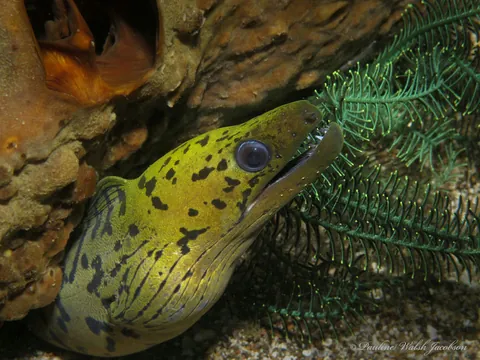
Fimbriated moray
Gymnothorax fimbriatus
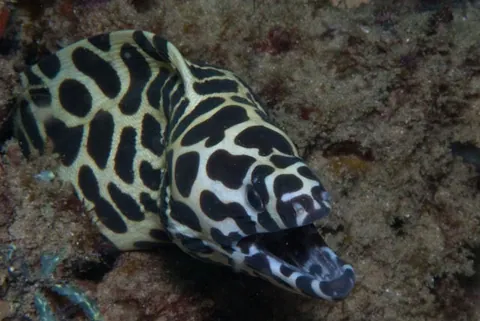
Echidna nebulosa
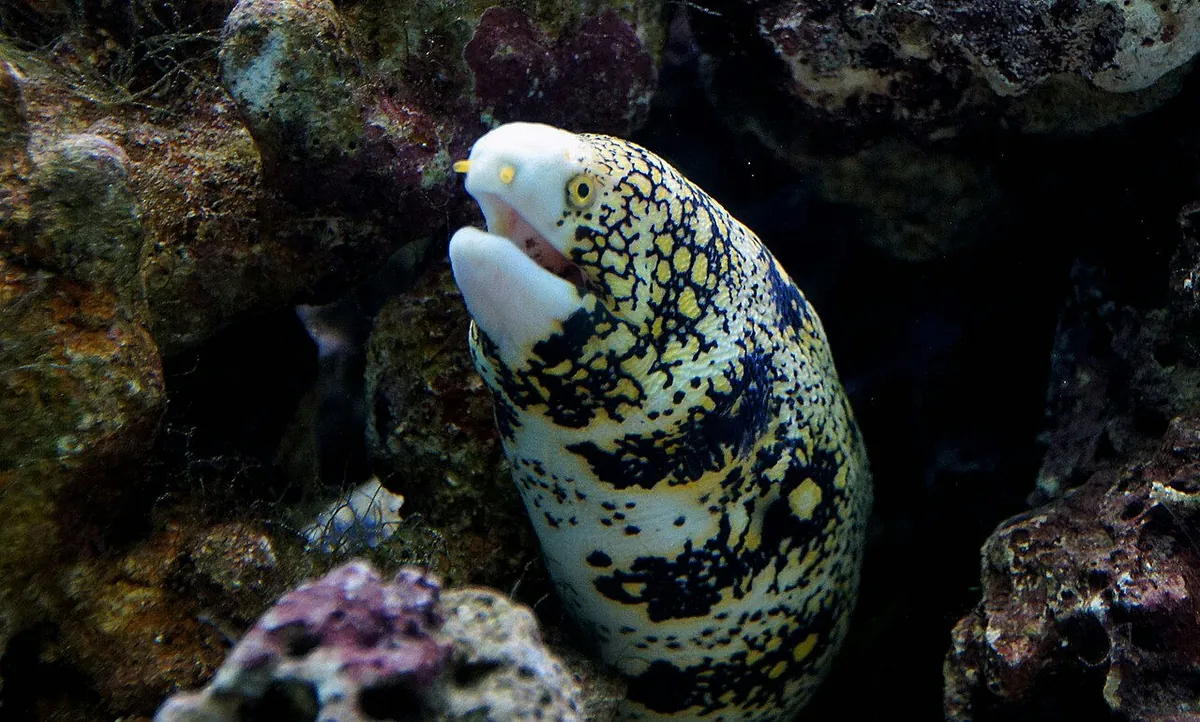
The starry moray, also known as the snowflake moray, is an eel of the moray family. It reaches about 100 cm, though a common size is nearer 50 cm. Unlike most morays it has small blunt teeth instead of sharp ones, and it feeds mainly on crustaceans such as crabs and shrimps. Morays see poorly and hunt largely by smell. This one is usually seen alone, either out in the open or with just its head showing from a hole.
Also known as: bosch's reef-eel, clouded moray, clouded reef eel, floral moray, nebulous moray eel, snowflake eel, snowflake moray, starry moray, starry eel, zebra moray, clouded moray, nebulous moray eel, clouded reef eel, bosch's reef-eel, snowflake moray, white moray, bosch's moray, floral moray, starry eel, snowflake eel, clouded eel, starry moray, zebra moray, snowflake moray
Two marks work at viewing distance. The snout is clearly white and blunt, in contrast to the patterned body behind it, and short yellow tubes stick out from the tip of that white snout and angle down. Combine those with the cloudy dark blotches along a pale body. You never need to see the teeth.
The snout is blunt and white, and behind it the body carries a speckled pattern of yellowish, brown and black that forms cloudy blotches along its length. A single fin runs like a ridge from behind the head all the way along the back. Two yellow tube-shaped nostrils stick out from the tip of the snout and point downwards, and a second pair sits closer to the eyes.
It is widespread across the Indo-Pacific, from the east coast of Africa and the Red Sea across to Hawaii, and it also occurs in the eastern Pacific from Baja California down to northern Colombia. It likes shallow, broken ground: intertidal reef flats, rocky shallows, seagrass beds with rock rubble, and tide pools, as well as shallow lagoon and seaward reefs. Records run from 1 m down to 48 m, but most sightings are in the top 10 m, so this is a shallow-dive and snorkel animal.
Its Hawaiian name is puhi-kapa, and it comes from a nickname of King Kamehameha I, the ruler who unified the Hawaiian islands.
Describe what you saw and we name it, then keep every species you find in your Oceandex.