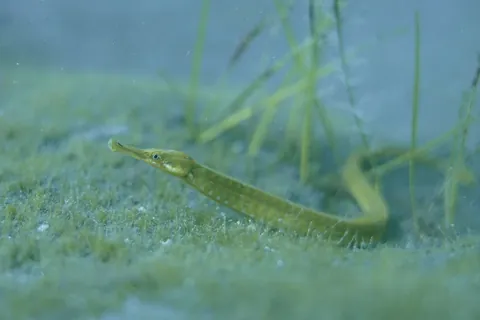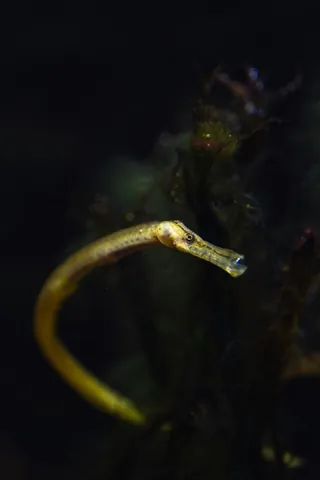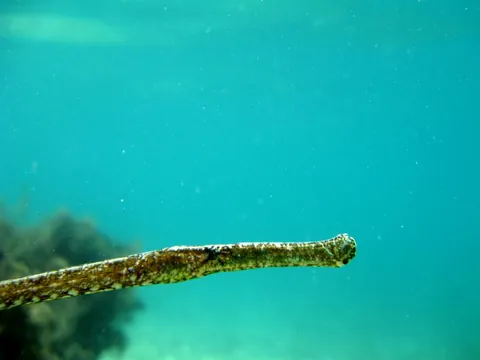
Broadnosed Pipefish
Syngnathus typhle
Hippocampus kuda
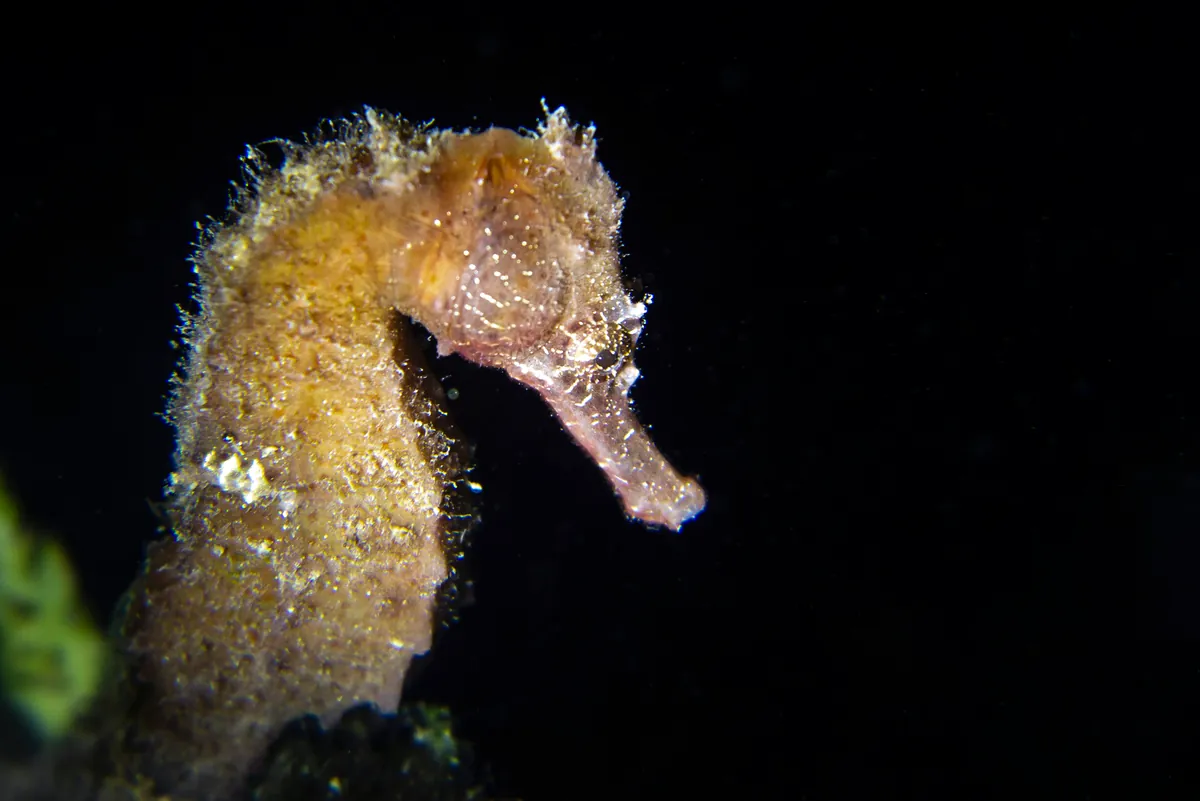
This small seahorse relies on staying hidden rather than staying still. Its colours can shift from near-black to yellow to reddish, always patterned with fine dark spots. It grows up to 30 cm.
Also known as: hippocampus kuda, common seahorse, estuarine seahorse, estuary seahorse, oceanic sea horse, oceanic sea horse red, sea horse, seahorse, yellow sea horse, yellow seahorse
Its smooth, spineless body is the key mark: seahorses covered in knobs or spines are a different kind. Colour is not a reliable guide, since it ranges from near-black to yellow to reddish in this species alone.
The body is long and slender, with a fairly large head and a short, thick snout. It has no spines - any bumps on the body are smooth and rounded rather than sharp. A small crown-like bump on the head, called a coronet, rises toward the back and can carry long, thread-like filaments. Some adults have a black line crossing the dorsal fin. Base colour varies from dark and grainy to yellow, cream, or reddish, always with many small dark spots. The tail has no fin; it is used instead for gripping onto objects.
It lives in estuaries, lagoons, harbours, and coastal seagrass beds, and also on steep mud slopes. It usually stays in shallow water down to about 8 m, though it has been recorded as deep as 68 m. It has also been found far offshore, clinging to rafts of drifting Sargassum seaweed.
This species is thought to pair up with a single partner, though this has not been confirmed in laboratory studies. During courtship, the male changes colour and dances around the female, and the pair's tails intertwine. The female then transfers her eggs into a brood pouch on the male's tail, using an egg-laying tube. The male carries the eggs through their development before giving birth.
harmless
This species is classified as Vulnerable. It is caught by accident in shrimp trawl nets, and on purpose for the aquarium trade and for traditional medicine. It also produces few young at a time, which makes it slow to recover from these pressures. Its international trade is controlled under CITES, a treaty that limits trade in animals at risk.
This species is among the most heavily traded seahorses for traditional medicine, with Vietnam, India, the Philippines, and Thailand named as its biggest exporters.
Describe what you saw and we name it, then keep every species you find in your Oceandex.