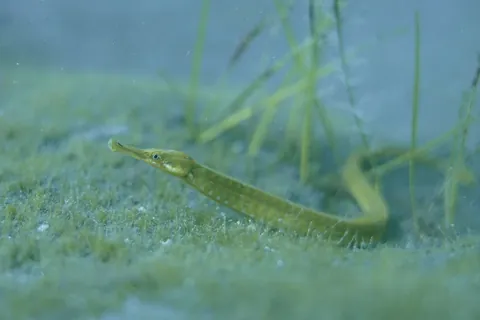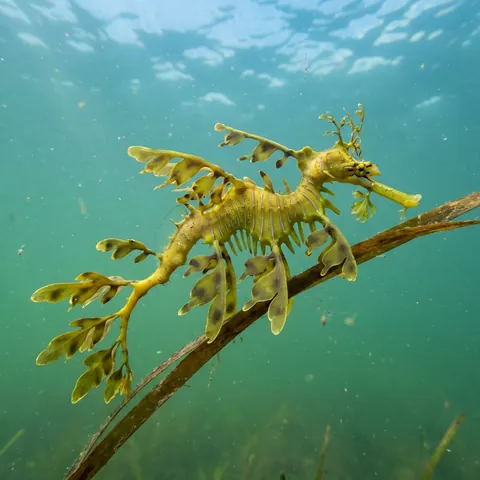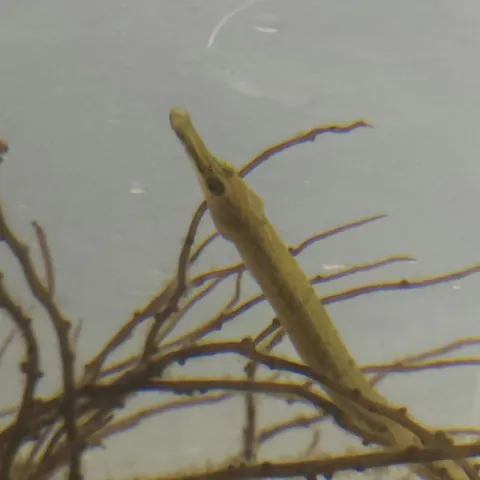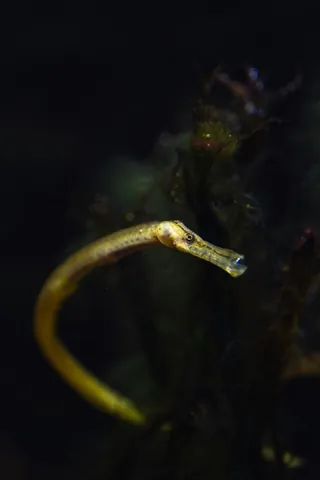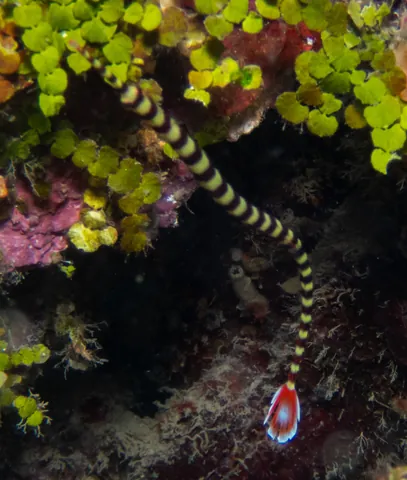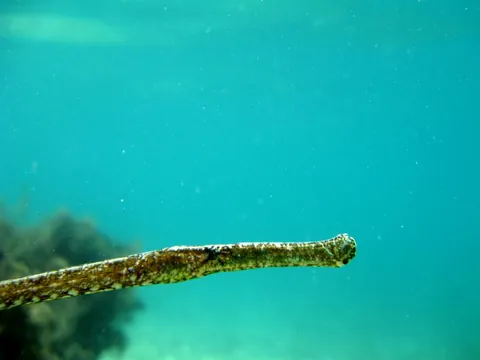
Broadnosed Pipefish
Syngnathus typhle
Solenostomus paradoxus
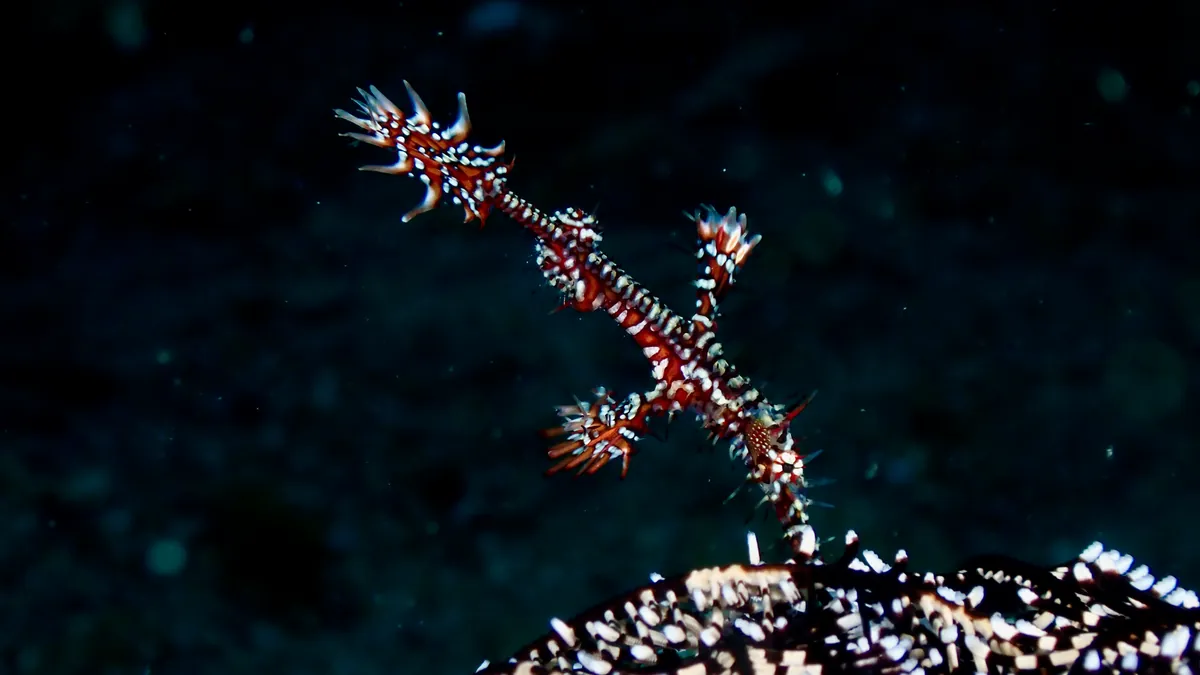
This slender fish is a master of disguise. It is an uncommon find on reefs with strong currents, and it is so well hidden against its host that divers rarely spot one. It grows to about 12 cm.
Also known as: harlequin ghost pipefish, ornate ghost pipefish, shortbodied pipefish, ornate ghost-pipefish, ornate ghostpipefish, harlequin ghost pipefish
Unlike true pipefish, which swim in the open over sand, this fish hangs almost motionless, head-down, pressed against a gorgonian, crinoid, or clump of weed whose color and texture it matches. That head-down posture glued to a matching host, rather than free swimming, is the giveaway.
The ghost pipefish has a long, thin body and highly variable coloring. Each individual settles into either a light color phase (yellow, orange, pink, white, or red) or a dark phase (deep brown, crimson, or black), and its skin is mottled and patterned rather than plain.
It lives along reef edges exposed to strong currents, from the Red Sea across the Indian Ocean and western Pacific to Tonga, at depths of 4 to 35 m. It is found alone or in pairs, sheltering among gorgonians (soft sea fans), corals, crinoids (feather stars), hydroids, algae, floating weed, or seagrass that matches its own coloring.
It hangs upside down near its host and sucks in small fish and mysid shrimp (tiny shrimp-like crustaceans) through a specialized snout. Its camouflage is so effective it is often mistaken for a drifting scrap of algae or dead plant matter, which lets it sit still and ambush passing prey. The female carries the eggs herself, in a brood pouch, rather than the male.
This species is rated Least Concern, but it depends entirely on fragile hosts like large gorgonian corals and black coral trees. These are easily damaged by careless diving, boat anchors, bottom trawling, and coral bleaching linked to climate change. That puts the ghost pipefish's habitat at risk, even though the fish itself is not directly threatened.
Describe what you saw and we name it, then keep every species you find in your Oceandex.