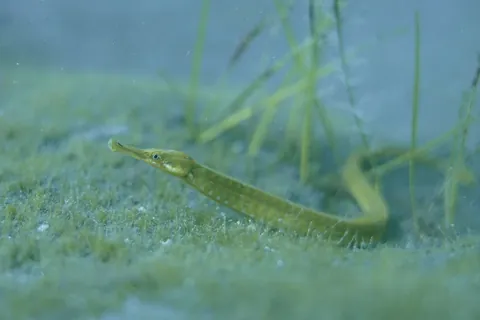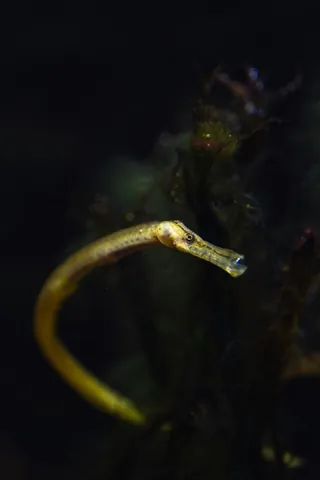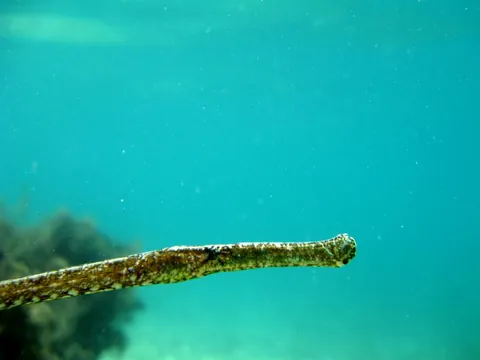
Broadnosed Pipefish
Syngnathus typhle
Solenostomus cyanopterus
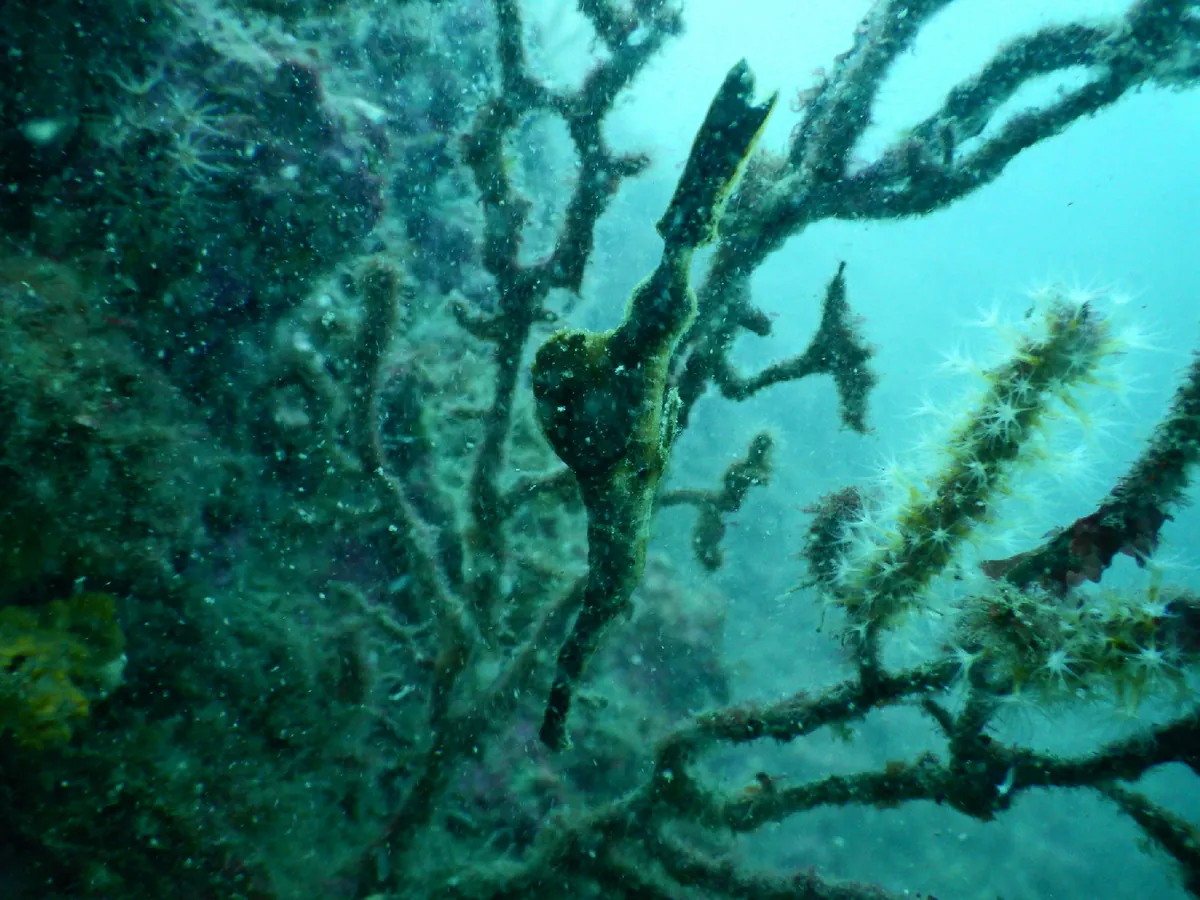
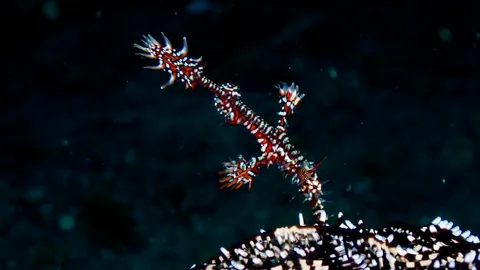
Drifting head-down like a torn strip of seagrass, the robust ghost pipefish is the largest of its family, reaching about 17 cm.
Also known as: robust ghost pipefish, hairy ghost pipefish, seagrass ghost pipefish, robust ghost-pipefish, squaretail ghost-pipefish, racek's ghost pipefish, ghost pipefish, rough-snout ghostpipefish, זרבובית רבגונית
Several ghost pipefish species share this seagrass-blade disguise and slow, head-down drift. This one is the largest of the group and carries a noticeably thicker, more robust snout than its relatives - the feature behind its common name.
The body and fins are shaped to mimic a blade of seagrass, and its colour can shift gradually over several hours to match its surroundings. The snout is long, with the toothless mouth at its tip. Instead of true scales, scattered bony plates protect the skin. Females carry a brood pouch, formed from their two pelvic fins - a feature the males lack.
Found on coastal reefs and in weedy areas or lagoon reefs, often over algal flats or seagrass beds with coral, vegetation or sand nearby, from shallow water down to about 25 m.
A slow-moving ambush hunter, it swims snout-down near the bottom and simply sucks up small crustaceans and plankton whole through its toothless, tube-shaped mouth, relying on camouflage rather than speed to get close.
The female alone cares for the eggs, holding them in a brood pouch formed by her two pelvic fins joined together. When the eggs are ready, she releases the well-developed larvae into the water column to drift with the current. Each individual reproduces only once in its life.
Its wide range and adaptable camouflage support a healthy population, and its short lifespan and poor survival in captivity mean it holds little appeal for the aquarium trade.
Robust ghost pipefish pair for life. Once a male and female find each other, they stay partners, and each one breeds only once in its lifetime.
Describe what you saw and we name it, then keep every species you find in your Oceandex.