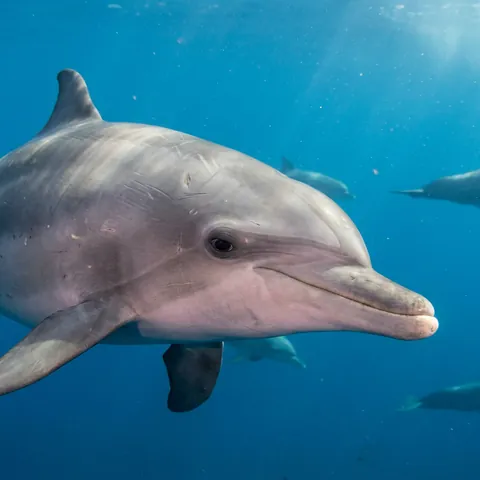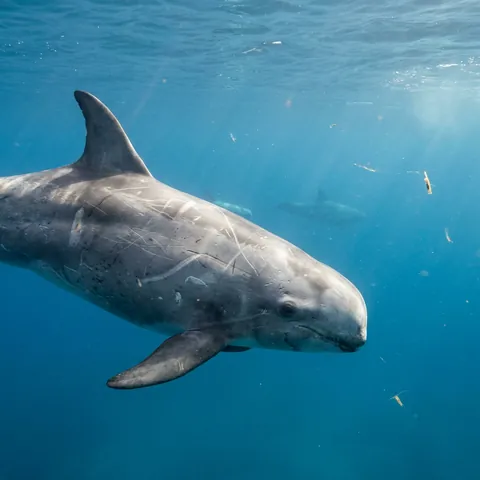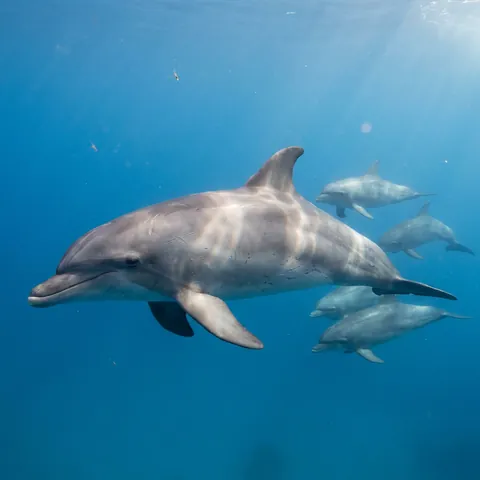
Bottlenose Dolphin
Tursiops truncatus
Inia geoffrensis
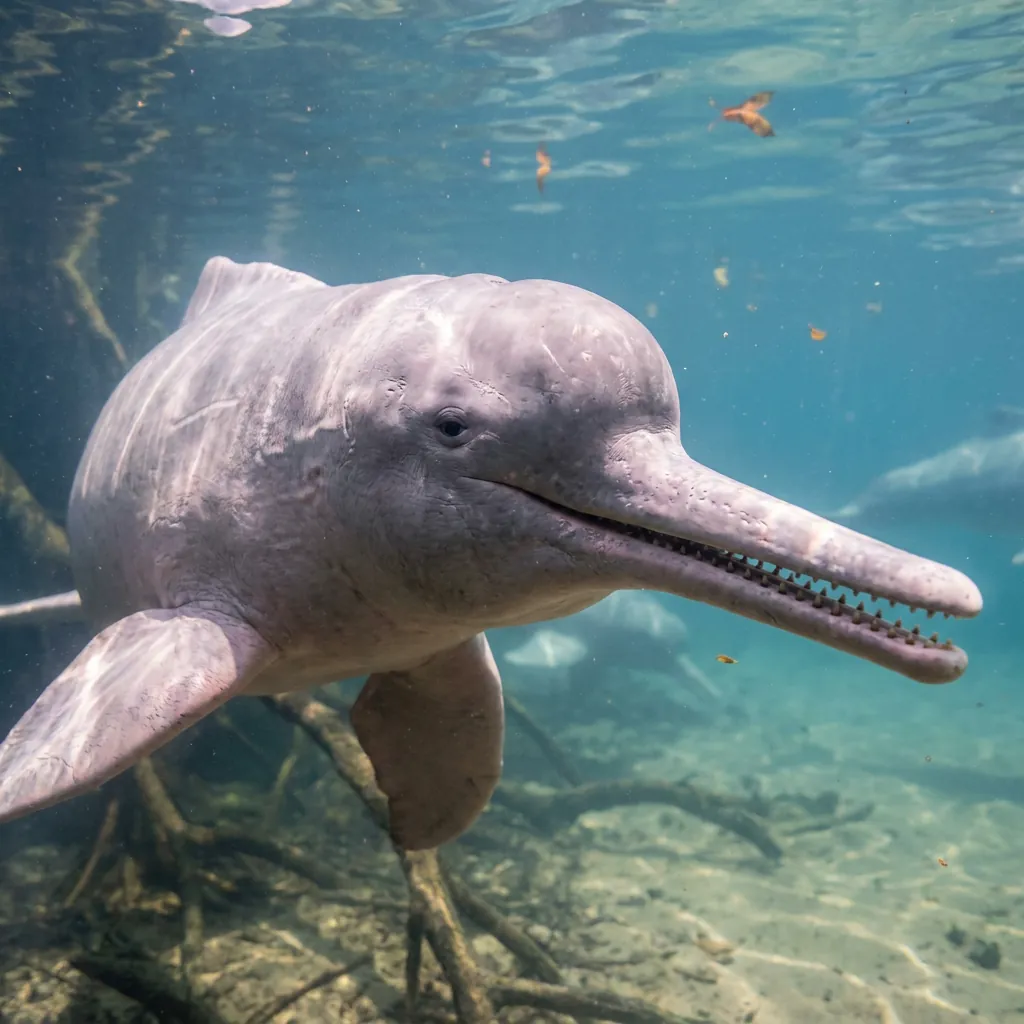
The Amazon river dolphin, or boto, is the largest of all river dolphins, growing up to 280 cm long and 160 kg in weight. Adults often turn a striking shade of pink, making it one of the most recognisable animals of the Amazon and Orinoco basins.
Also known as: amazon river dolphin, boto, bufeo, inia geoffrensis
It shares its rivers with the smaller tucuxi dolphin, which looks similar in the water. The clearest difference is the back fin: the tucuxi has a tall, curved dorsal fin, while the Amazon river dolphin has only a low ridge along its back.
It has a strong but flexible body, and its neck is not fused like an ocean dolphin's, so it can turn its head almost sideways. A long, low ridge runs along its back in place of a tall dorsal fin, and its pectoral fins are broad and paddle-shaped. Colour changes with age: calves are dark grey, young animals turn light grey, and adults become pink or mottled pink, with males usually pinker than females.
It lives across the Amazon and Orinoco river systems, spanning six South American countries. In the dry season it stays in the main riverbeds, and when the rivers flood it moves out into the flooded forest to feed among the trees.
Amazon river dolphins are usually seen alone or in pairs, though small groups form where food is plentiful. As the top predator in their rivers, they are curious and not especially shy of boats or divers, but they are less social with each other than ocean dolphins.
It eats a very wide range of river fish, along with river turtles and freshwater crabs that its strong teeth can crack open. It feeds through the day and night but is most active at dawn and dusk, sometimes hunting alongside tucuxi dolphins and giant otters.
Breeding is seasonal, with calves born as the rivers flood. Gestation is long, and calves stay close to their mothers and continue nursing well into their first year, a level of parental care unusual among river dolphins.
harmless to humans
The Amazon river dolphin is classed as endangered. It competes with local fishers for the same fish, and animals are sometimes killed or injured after becoming caught in nets and lines.
Because its neck bones are not fused together, the Amazon river dolphin can turn its head almost 90 degrees, something ocean dolphins cannot do.
Describe what you saw and we name it, then keep every species you find in your Oceandex.