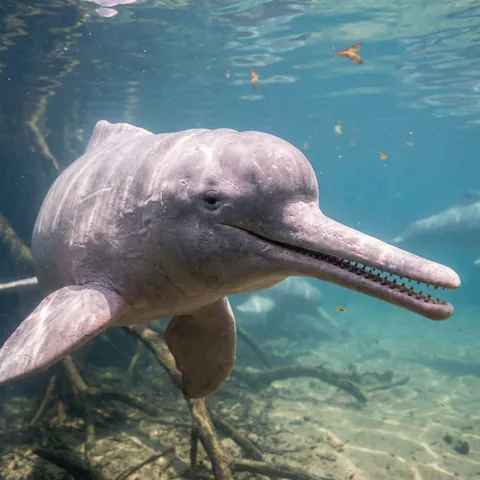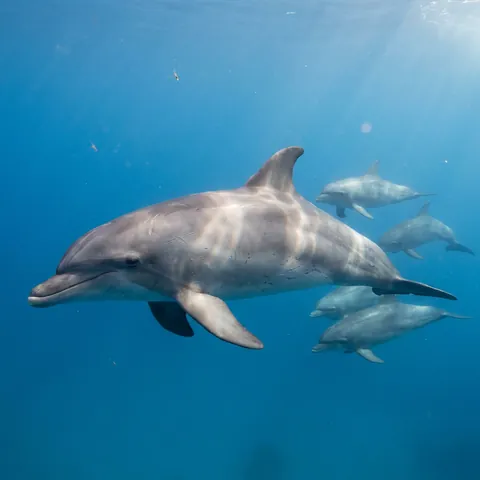
Bottlenose Dolphin
Tursiops truncatus
Delphinus delphis
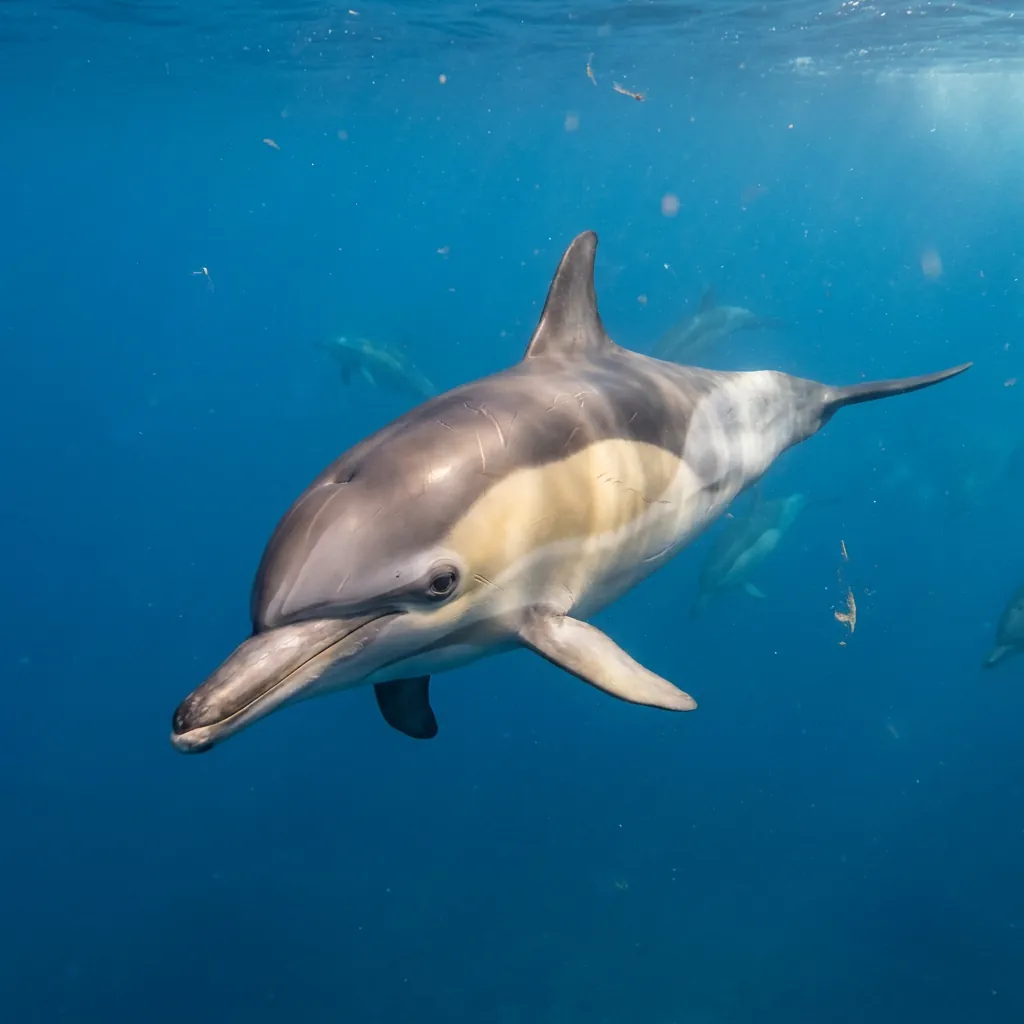
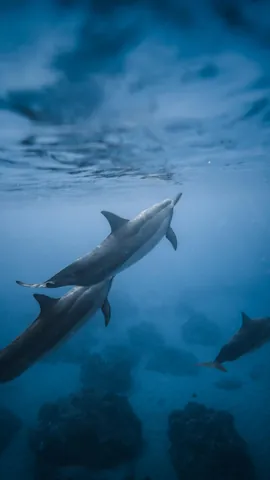
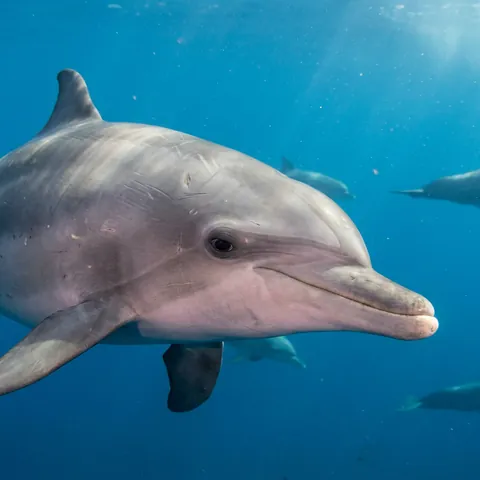
One of the most widespread dolphins in the ocean, this fast, social swimmer travels the open sea in large groups, often putting on a show as it rides bow waves and leaps clear of the surface. Adults can reach up to 260 cm long and weigh up to 135 kg.
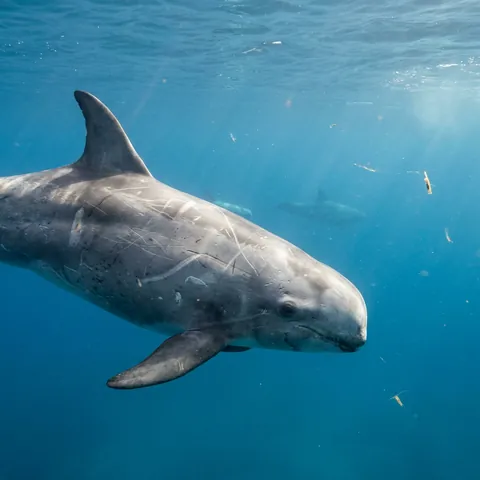
A medium-sized dolphin with the classic streamlined, torpedo-shaped body of its family. Adults grow to as much as 260 cm long and can weigh up to 135 kg.
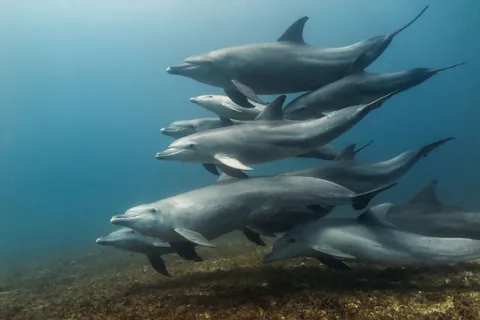
This is a highly social species, usually seen in large herds of 30 or more animals. It ranges widely through warm-temperate and tropical waters, living both close to shore and far out over open, deep water, often gathering near underwater canyons, ridges, and seamounts where currents stir up food. Great white sharks are among its natural predators.
It hunts small schooling fish and squid. At night, it follows the deep scattering layer, a band of small fish and other prey that rises toward the surface after dark, and feeds on it there.
Females give birth to a single calf after a long pregnancy. Calves nurse for a period that varies between populations before weaning. The age at which males and females reach sexual maturity, and how often females give birth again, also differs from one population to another. There is no evidence of major reproductive differences between the short-beaked and long-beaked forms.
harmless to humans
This is one of the most abundant cetaceans in the world and is listed as Least Concern. Even so, some populations carry measurable levels of metal pollutants, and dolphins have been hunted in some regions for food and shark bait. Mass strandings have also been recorded in some areas, in at least one case suspected to be linked to naval activity nearby.
Common dolphins were once split into short-beaked and long-beaked species, but long-beaked populations around the world turn out not to be closely related to each other. Many arose independently from short-beaked ancestors, so all long- and short-beaked forms are now classified as a single species.
Describe what you saw and we name it, then keep every species you find in your Oceandex.