Angelfish
angelfish
Pygoplites diacanthus
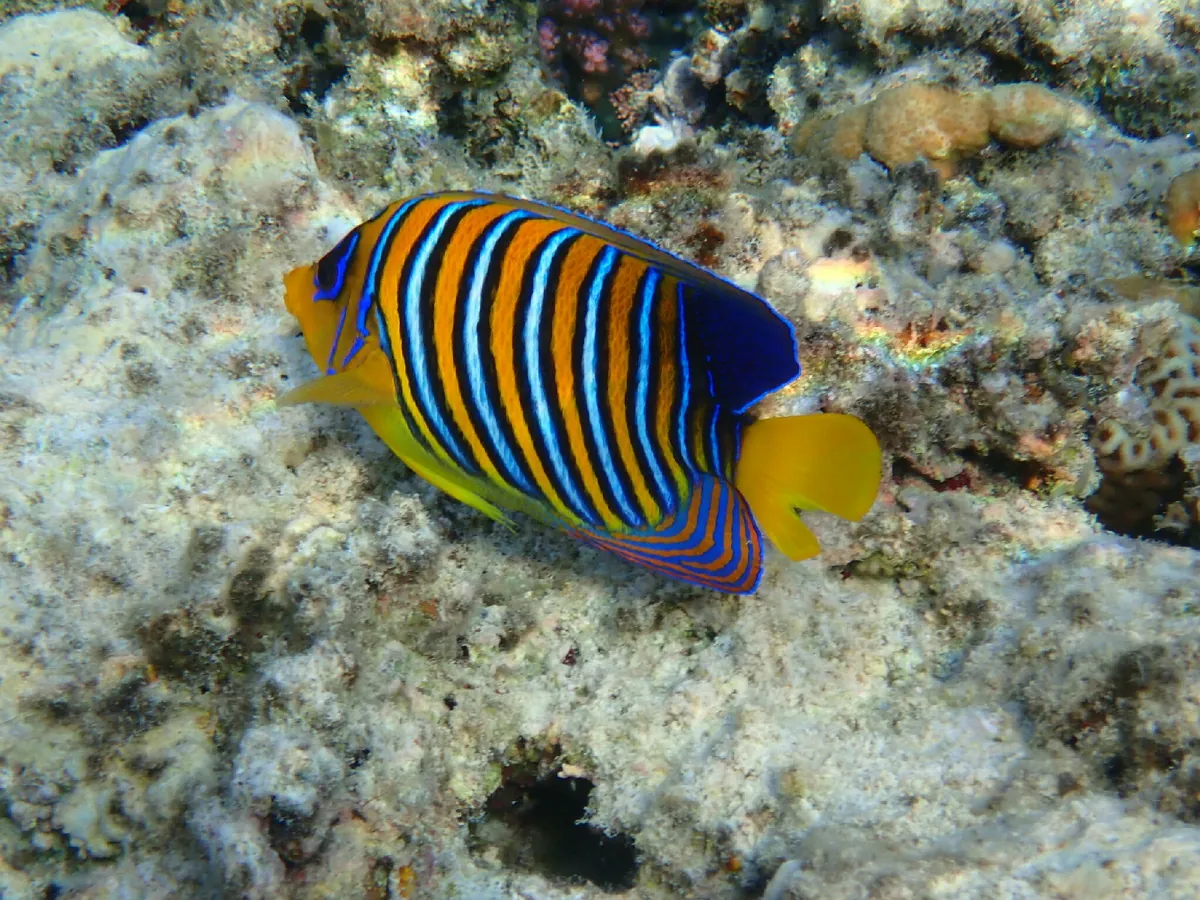
The regal angelfish, also called the royal angelfish, is a marine angelfish and the only member of its genus. It grows to about 25 cm. The body is fairly long for an angelfish and strongly flattened from side to side, with a small mouth that can be pushed forward to pick food off hard surfaces. It eats sponges and sea squirts, small filter-feeding animals fixed to the reef. It may be seen alone, in a pair or in a small group. It spawns at dusk or after dark, when a pair spiral upwards together and release eggs and sperm into the water above the reef.
Also known as: bluebanded angelfish, empress angelfish, regal angelfish pasific, regal angelfish, royal angelfish, royal angelfish, blue-banded angelfish, royal empress angelfish, regal angelfish pasific, royal empress angel, bluebanded angelfish, regal angelfish, empress angelfish, regal angelfish, royal angelfish, blue-banded angelfish
Look for bold orange and blue-white bars slanting backwards along the side, then check the back of the fish: the rear of the back fin is dark with tight blue dots, and the tail behind it is plain yellow with no pattern. That dark dotted fin against a clean yellow tail settles it even when the body colours look slightly different from the picture in the book.
The sides carry alternating stripes of orange and blue-white, each edged with a dark line. The stripes are narrow and slant backwards. The rear part of the back fin is black or blue and is covered with close-set blue dots, while the rear of the fin below the body has yellow and blue bands that follow the curve of the body. The tail is plain yellow and rounded. Young fish carry a large dark spot on the soft rear part of the back fin. Exact colours vary between regions.
It is found across the tropical Indo-Pacific, from the Red Sea and East Africa east into the central Pacific. Look for it in coral-rich parts of lagoons and seaward reefs, and especially around caves and overhangs, where its sponge and sea squirt food grows. It has been recorded from the surface down to about 80 m. Young fish keep to cracks and crevices.
It is one of the most frequently exported angelfish in the aquarium trade and one of the least likely to survive in a tank, which makes a healthy adult on the reef the only place most people will ever see one.
Describe what you saw and we name it, then keep every species you find in your Oceandex.