Angelfish
angelfish
Pomacanthus imperator
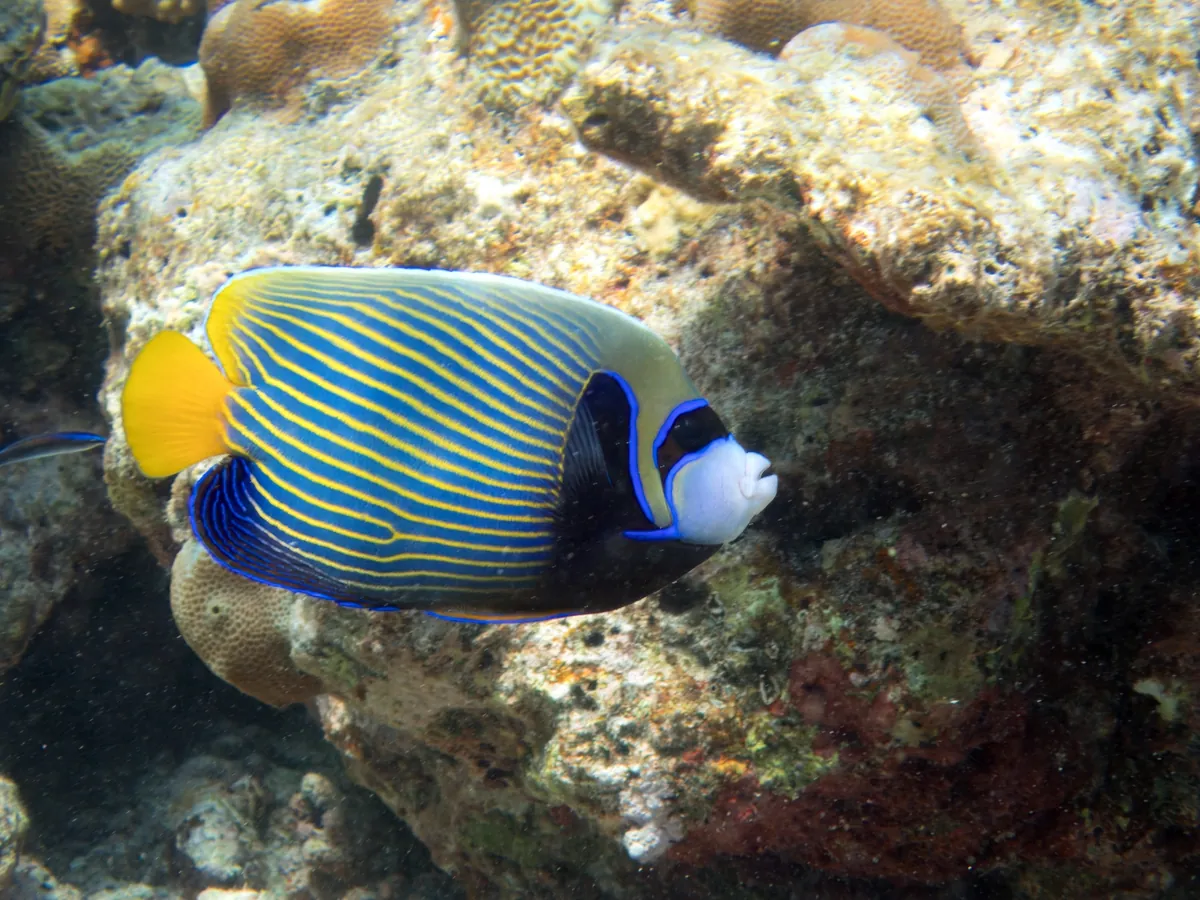
The emperor angelfish is one of the most recognisable fish on an Indo-Pacific reef, a tall, disc-shaped fish that cruises slowly along a wall and slips into a cave when approached. It reaches about 40 cm and undergoes one of the most dramatic colour changes of any reef fish as it grows.
Also known as: pomacanthus imperator, angel fish, angelfish, emperor, imperial angelfish
Several reef angelfish begin life with a similar blue-and-white ringed juvenile pattern, which can cause confusion. Check the dorsal fin: this species is the one with a clean white margin along the top fin. Once it reaches the adult striped colouring, there is little else it could be mistaken for.
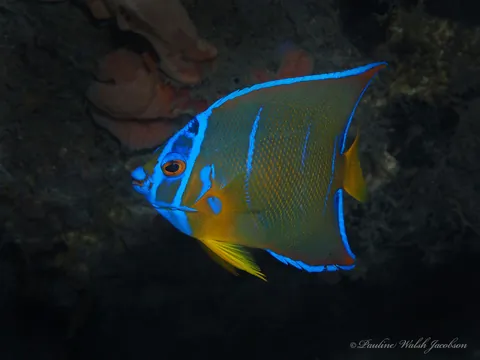
Juveniles are dark blue, ringed with curving lines of pale blue and white that wrap around the body and straighten into bars near the head; the tail fin is clear. As adults, the pattern changes completely: the body is blue with close-set horizontal yellow stripes, the face is light blue with a dark blue band over the eyes, and the tail is plain yellow. A blackish band, edged bright blue at the front and thin yellow at the back, runs above the pectoral fin, the fin just behind the gill cover.
This angelfish ranges right across the Indo-Pacific, from the Red Sea and East Africa to the central Pacific, north to southern Japan and south to the Great Barrier Reef; small numbers have also reached the eastern Mediterranean since 2009. It lives from 1 to 100 m. Adults favour clear lagoon, channel, and seaward reefs with rich coral growth, sheltering under ledges and in caves, while younger fish use holes on the reef front and in surge channels.
harmless
Adults from the Pacific carry a thin filament trailing off the rear of the dorsal fin, while adults from the Indian Ocean do not - the same species looks subtly different depending on which ocean it is in.
Describe what you saw and we name it, then keep every species you find in your Oceandex.