Angelfish
angelfish
Centropyge bicolor
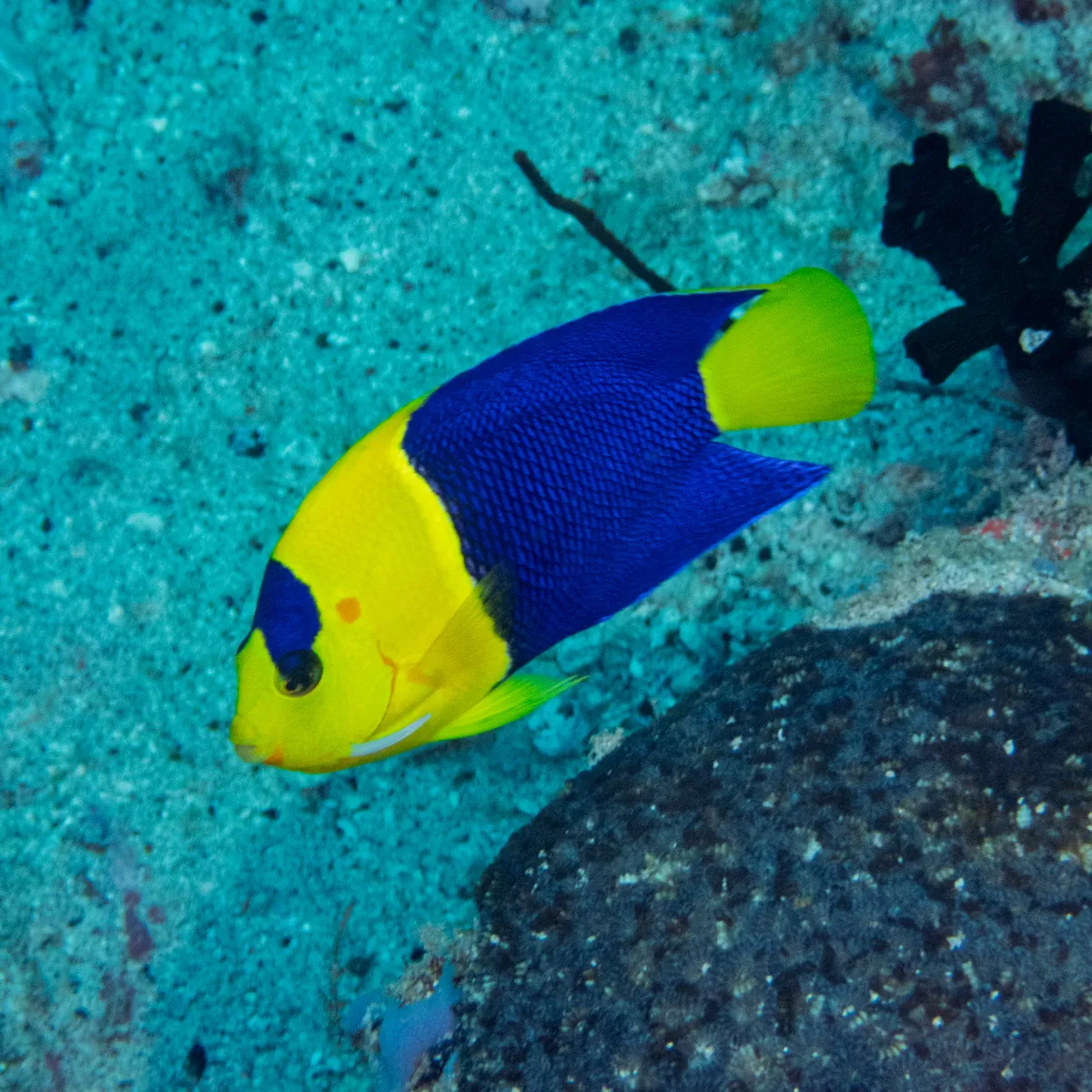
A small, sharply two-toned angelfish that darts between hiding spots on the reef, reaching about 15 cm.
Also known as: black and gold angelfish, blue & gold angelfish, two coluored angelfish, two-colored angelfish, black and gold angelfish, two-colored angelfish, black and gold angel-fish, blue and gold angelfish, blue & gold angelfish, angelfish, two coluored angelfish, blue and gold angelfish, bicoloured angelfish, black and gold angel-fish
Several small reef fish combine yellow and blue, but few show as sharp a two-tone split as this one: golden-yellow at the front, inky dark blue at the back, the boundary falling roughly through the middle of the body.
The head, front half of the body, and the pelvic and tail fins are bright yellow, with a blue blotch over the eye. The pectoral fins are almost see-through. Everywhere else - the back half of the body and tail region - is dark blue.
Lives on reef slopes, in coral-rich areas, lagoons and near drop-offs across the Indo-Pacific, from near the surface down to about 25 m.
Moderately aggressive toward both its own kind and other species, it lives in a harem led by one male, who defends a territory covering the ranges of all his females against predators, intruders and rival harems. When threatened, it darts quickly from one hiding place to the next.
All individuals start life as females; sex change to male only happens later, and only for the highest-ranking female if the harem's male is lost. Within an established harem, the male visits and courts different females at dusk, and each female scatters her eggs for him to fertilize at most once a night, with higher-ranking females spawning more often than those below them.
In captivity, bicolor angelfish have been seen acting as facultative cleaner fish, picking parasites off other fish - a habit thought unlikely to happen out on the reef.
Describe what you saw and we name it, then keep every species you find in your Oceandex.