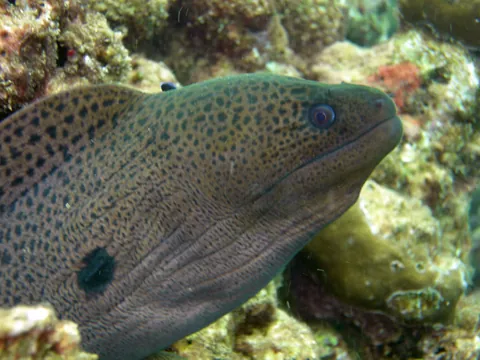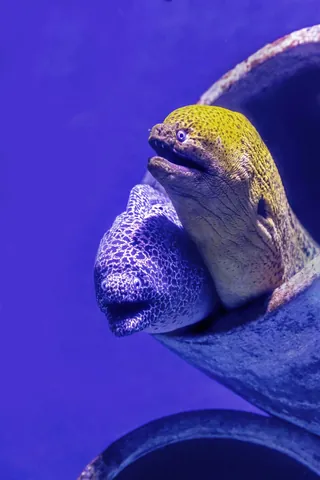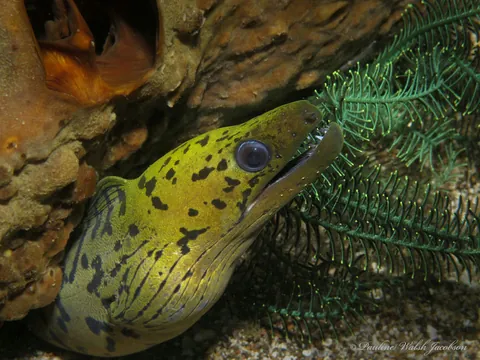
Fimbriated moray
Gymnothorax fimbriatus
Enchelycore pardalis
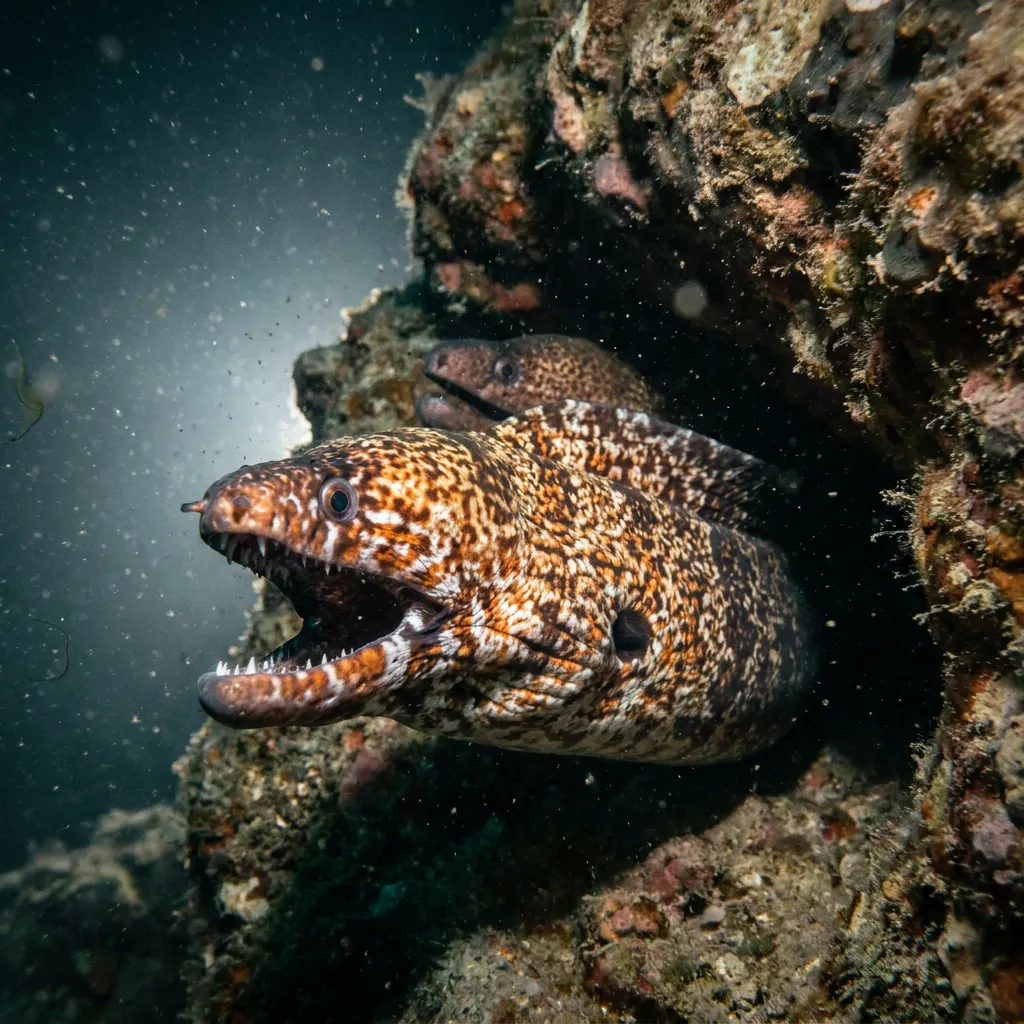
The panther moray, also called the dragon eel, is one of the most striking moray eels on the reef, with bold spots and red facial stripes that make it hard to miss. It grows up to 92 cm long.
Also known as: dragon eel, dragon moray, dragon moray eel, dragon moray eel, leopard moray eel, enchelycore pardalis, hawaiian dragon eel, leopard moray, leopard moray eel
Its colour is so bold that it is rarely mistaken for another eel. The vivid red stripes across its face are the clearest giveaway, set against the plainer, more muted patterns most reef morays show.
This eel has a long, slender, snake-like body with no pectoral or pelvic fins. Its jaws are narrow and curved, often leaving long canine teeth visible even with the mouth closed, and its nostrils form small upright tubes. The body is covered in white, reddish-brown, and dark brown spots of varying size and shape, and vivid red stripes run across and around the face.
It lives on coral and rocky reefs, from shallow water down to about 60 m. By day it hides in crevices in the reef, coming out at night to hunt.
The panther moray is nocturnal, sheltering in cracks in the reef during the day and hunting fish and small octopus or squid after dark. When feeding, it may spin its whole body along its length to tear chunks from prey, or loop its body and pass its tail through the loop to form a knot, which helps it grip, crush, or swallow larger prey.
harmless
To handle prey too big to swallow easily, it can tie its own body into a knot and slide its tail through it for extra grip.
Describe what you saw and we name it, then keep every species you find in your Oceandex.