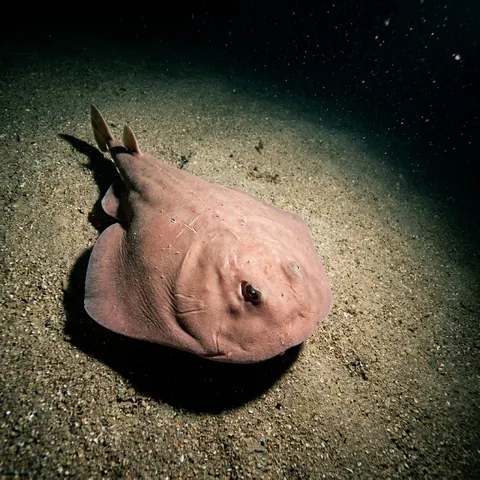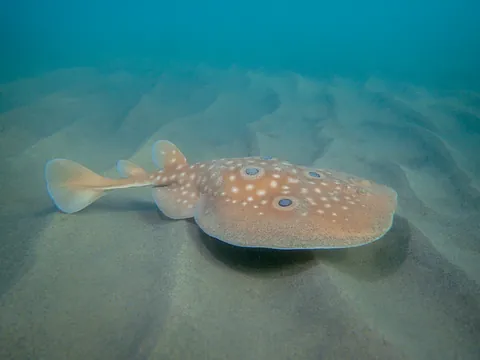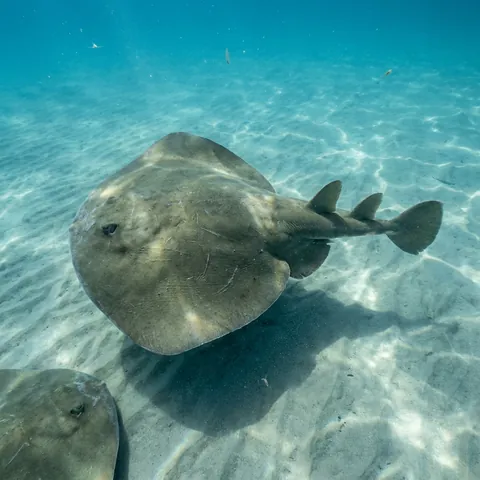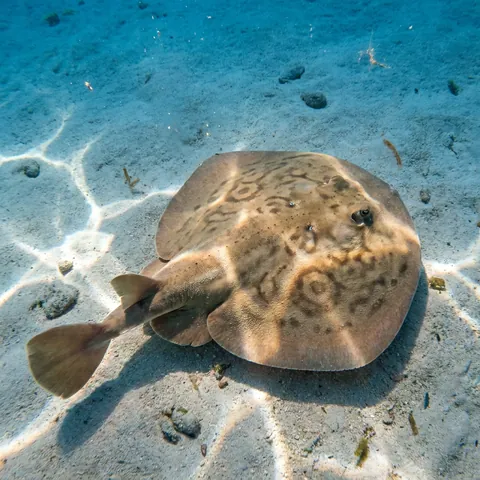
Caribbean Electric Ray
Narcine bancroftii
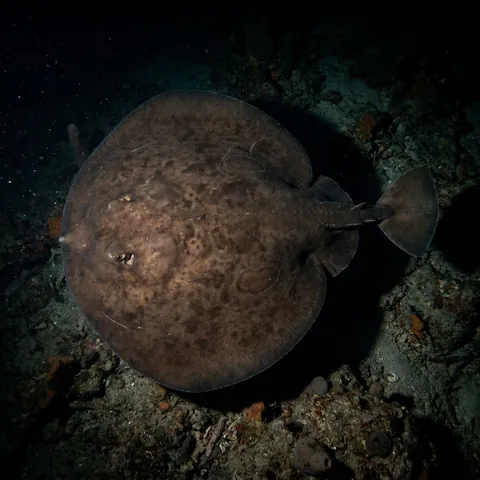
Torpedo marmorata
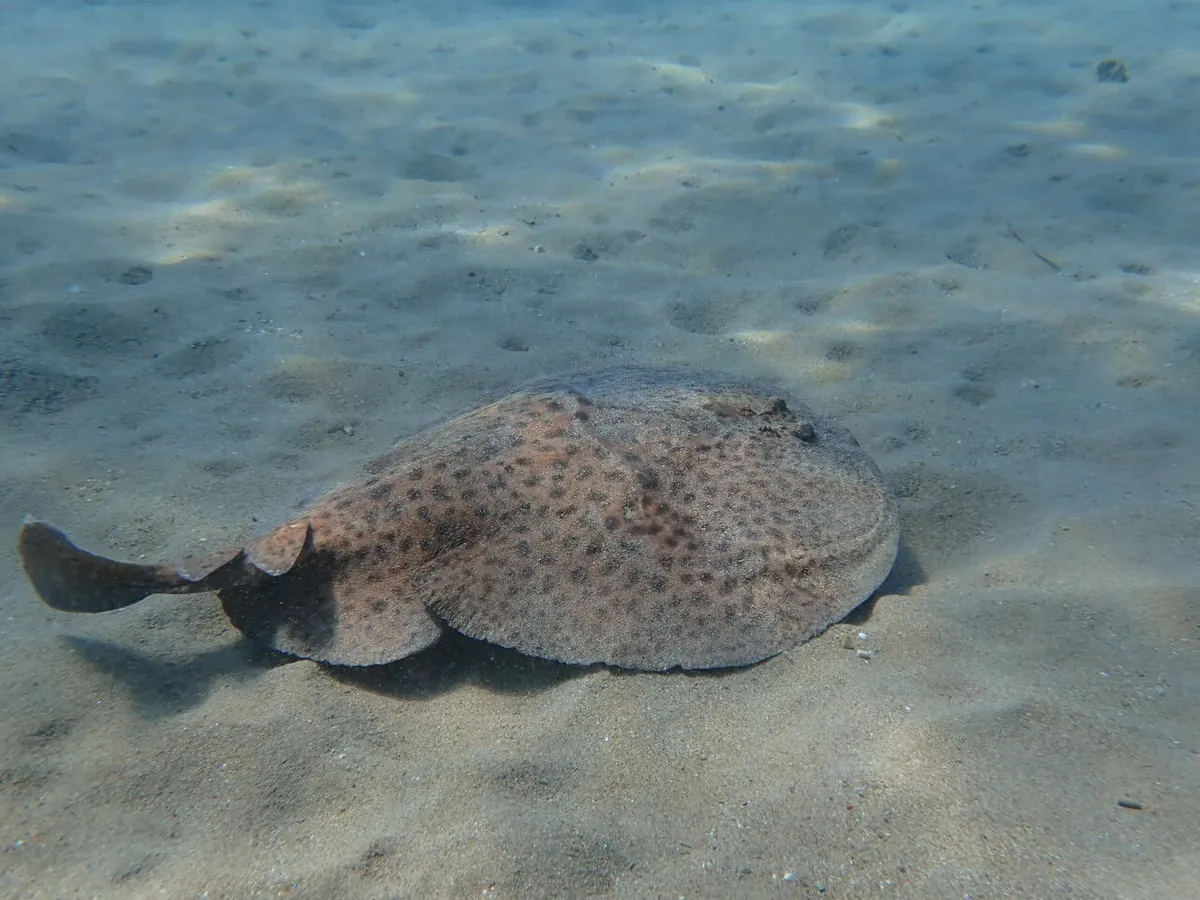
The marbled electric ray spends its days buried in sand, waiting motionless for a meal to swim past. Reaching up to 100 cm long, it can deliver a real electric shock to anything that disturbs it.
Also known as: torpedo marmorata, common crampfish, marbled torpedo, numbfish, spotted torpedo
It shares its range with the common torpedo ray, which looks similar at rest. Look for the dark, blotchy marbled pattern across the back, rather than the neat round spots a common torpedo shows.
This ray has a soft, flabby body and a nearly circular disc with no scales. Its small eyes sit close to a pair of kidney-shaped electric organs visible under the skin, and a large spiracle with finger-like rim projections sits just behind each eye. Two rounded dorsal fins sit close together on its back, and a short, thick tail ends in a triangular tail fin with blunt corners. The upper side shows a dark mottled or marbled pattern on a brown background, while the underside is plain off-white with darker fin edges.
It lives in the eastern Atlantic from Scotland and the North Sea south to the Cape of Good Hope, and in the Mediterranean Sea, favouring water cooler than 20 degrees C. It rests on the bottom over rocky reefs and seagrass beds, and on the sandy or muddy ground nearby, from shallow water down to 370 metres. In summer, pregnant females move into very shallow, muddy pools near oyster beds along the French coast.
This ray is solitary, slow-moving, and can stay motionless for days at a time. It is more active at night and spends daylight hours buried in sediment with only its eyes and spiracles showing. Its body runs on very little oxygen, letting it survive for hours in water too poor in oxygen for most other fish. When threatened or hunting, it can release a strong electric shock from a pair of organs built from stacked, battery-like tissue.
It is an ambush predator that relies on electricity and touch rather than sight to detect prey, since its eyes are often covered by sand. Small bottom-dwelling fish such as gobies, hake, sea bass, mullet, and wrasses make up most of its diet, with squid and cuttlefish taken occasionally. It swallows prey whole.
other
This ray has been seen using a hunting move called 'jumping': thrusting its disc upward to snatch small fish that swim close to its head.
Describe what you saw and we name it, then keep every species you find in your Oceandex.