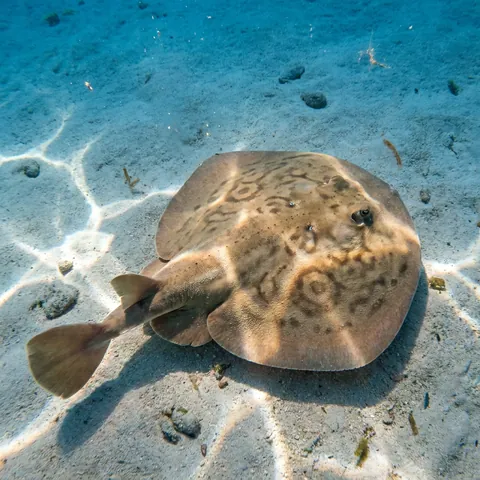
Caribbean Electric Ray
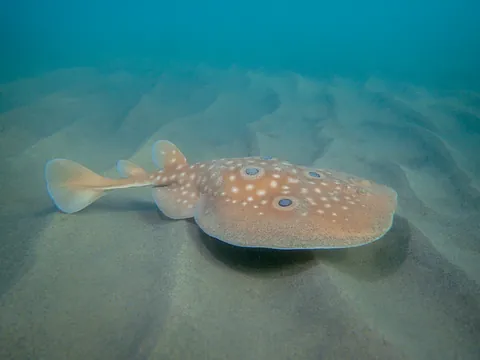
Narcine bancroftii
Tetronarce nobiliana
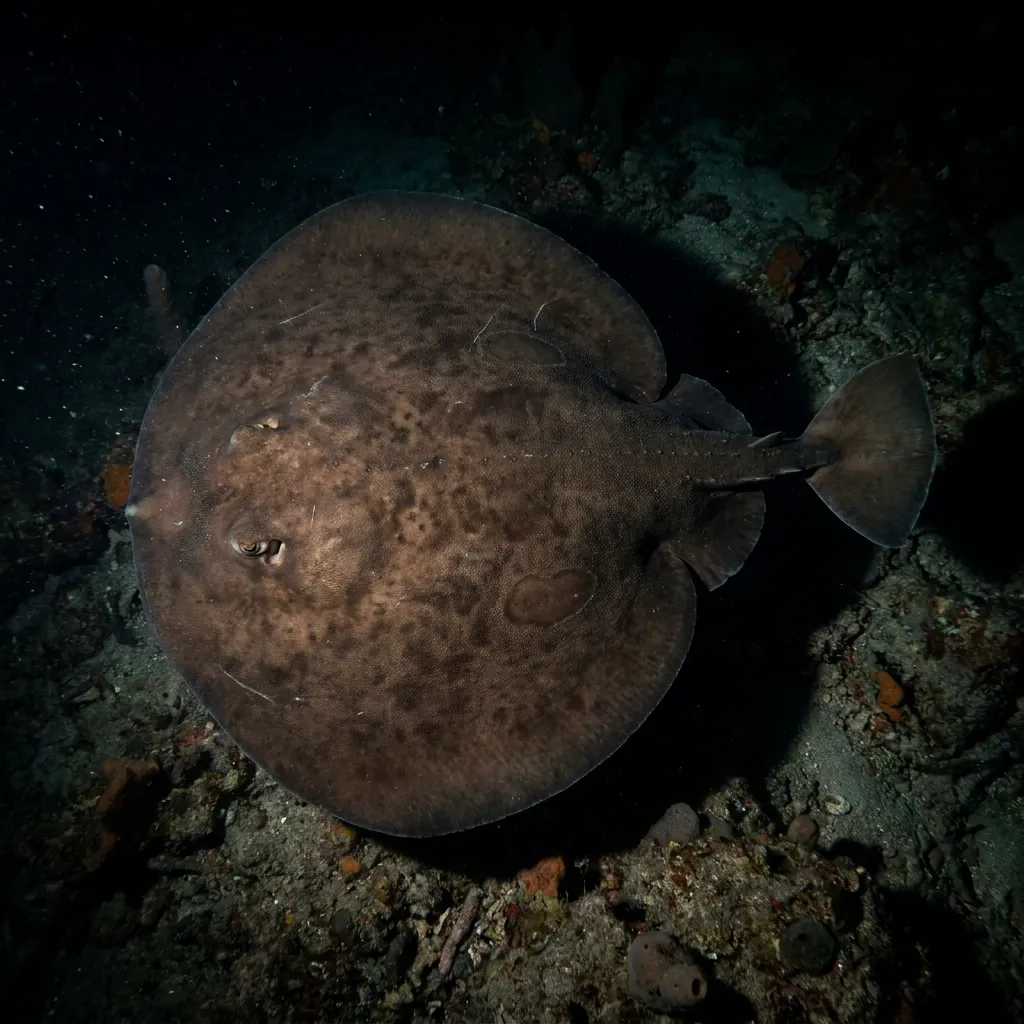
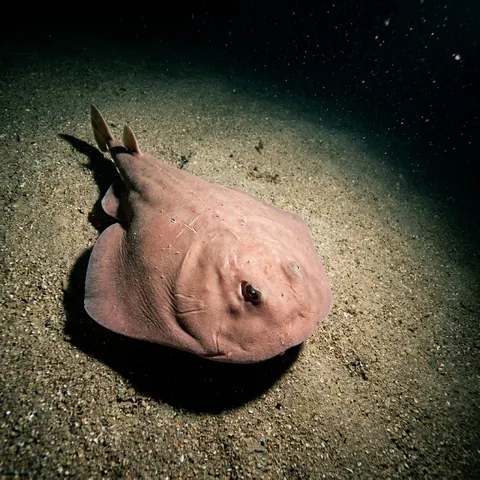
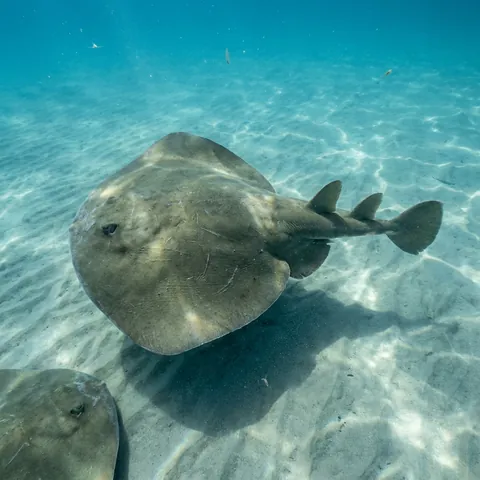
The Atlantic electric ray is the largest of the electric rays, a heavy-bodied ray that can knock down prey with its own built-in shock generator. It can grow to 180 cm and weigh up to 90 kg, though most seen are closer to 40 cm.
Also known as: tetronarce nobiliana, atlantic electric ray, atlantic new british torpedo, atlantic torpedo, black torpedo, crampfish, dark electric ray, electricfish, great torpedo, numbfish, torpedo
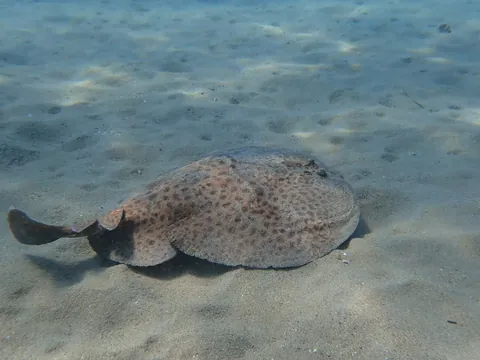
Other torpedo rays share its round disc shape, but this species is distinguished mainly by its larger size and plain, unspotted dark colouring rather than any single fixed marking.
This ray has a nearly circular disc with a thick, almost straight front edge, small eyes, and large spiracles just behind them. Its stout tail makes up roughly a third of its total length and ends in a broad, triangular tail fin. The skin is soft with no scales. It is plain dark brown to grey on top, sometimes with faint spots and darker fin edges, and white underneath.
Young rays live on the bottom over sand, mud, or near coral reefs, usually in the shallower part of their depth range, while adults spend more time swimming in open water. It is found in cool Atlantic waters on both sides of the ocean, from northern Scotland and the Mediterranean to West Africa in the east, and from Nova Scotia to Brazil in the west, at depths from 2 to 800 m.
It rests on or half-buried in the seabed by day and becomes more active at night. It is solitary and rarely falls prey to other animals, thanks to its size and its electric organs, which it can discharge even without an obvious threat nearby.
It feeds mainly on bony fish such as flatfish, salmon, eels, and mullet, and occasionally small sharks. It lies still and pounces on passing fish, trapping them against its body or the seabed while delivering shocks, then swallows the stunned prey whole.
can deliver a strong electric shock — do not touch
It can trap and swallow fish much bigger than its own mouth would suggest, thanks to jaws that stretch remarkably wide.
Describe what you saw and we name it, then keep every species you find in your Oceandex.