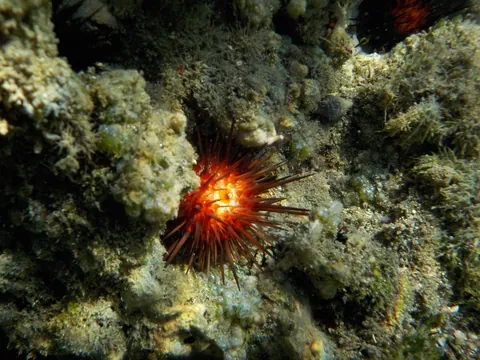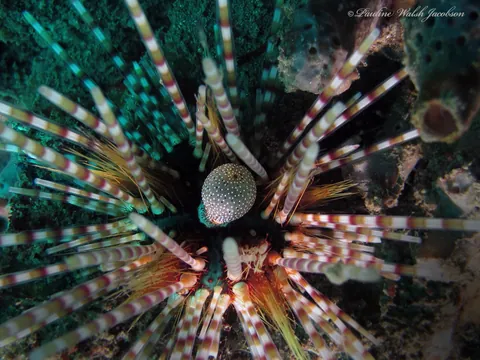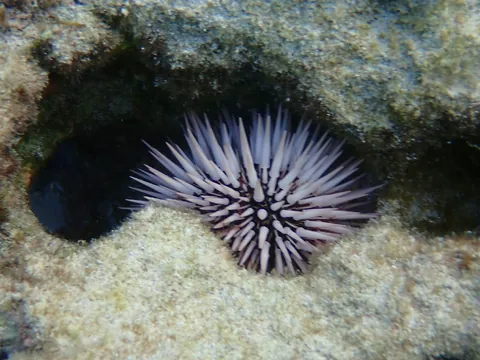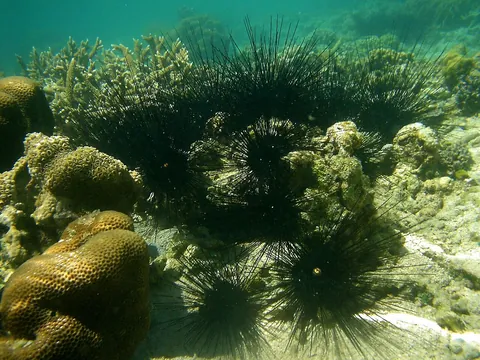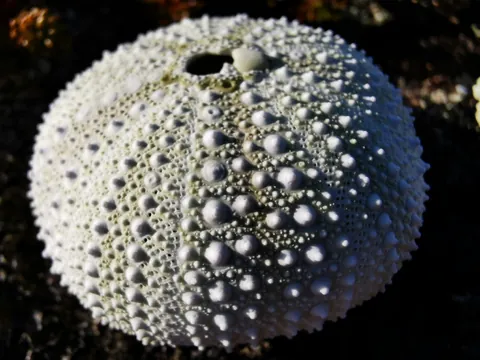
Arctic Green Sea Urchin
Strongylocentrotus droebachiensis
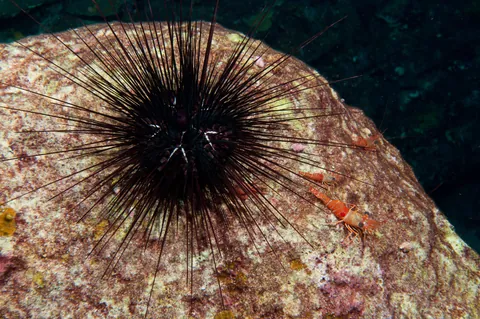
Diadema setosum
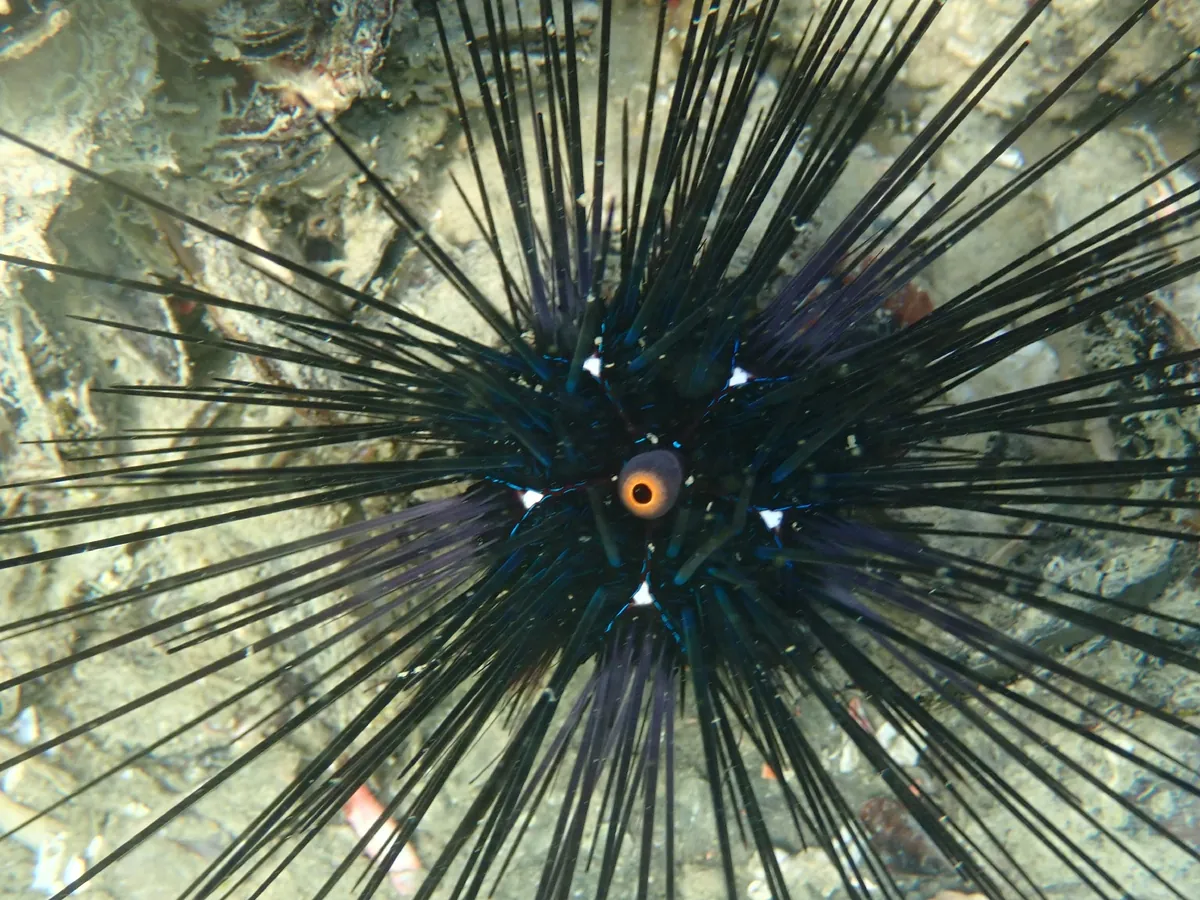
The long-spined sea urchin is a common, spiny reef dweller found across the Indo-Pacific. Its spines carry only a mild venom, but they are brittle and can break off painfully in skin.
Also known as: diadema setosum, diadema setosum (leske, 1778)
Look for a black, ball-shaped urchin covered in long, needle-thin spines, with five small white dots scattered across its body — a marking that sets it apart from its close relatives.
Its body, called a test, is a near-spherical black shell, very slightly flattened from top to bottom. Long, thin, hollow spines radiate outward from it and carry a mild venom. Five small white spots are scattered across the test, spaced out between the grooves that run along its surface. Around the top, where its anus sits, there is a bright orange ring, sometimes mistaken for an eye. Some individuals also show faint blue spots arranged in lines.
This urchin is found throughout the Indo-Pacific, from the Red Sea east to Australia and Japan, on coral reefs as well as sand flats and seagrass beds, down to about 70 m. It has also spread into the Mediterranean, likely arriving as larvae through the Suez Canal or on ships, and can reach very high densities on some rocky reefs, especially where its natural predators have been overfished.
Spawning can happen year-round near the equator, or seasonally further from it, often triggered by warmer water or timed to the full moon. Eggs and sperm are simply released into open water. If disturbed, the urchin can quickly flip itself over and scuttle away on the tips of its long spines.
At the top of its body, this urchin has a bright orange ring that is often mistaken for an eye — but it actually surrounds the animal's anus.
Describe what you saw and we name it, then keep every species you find in your Oceandex.