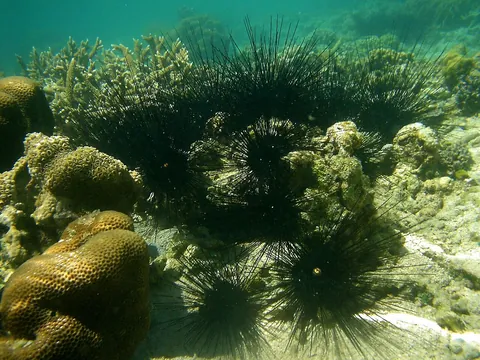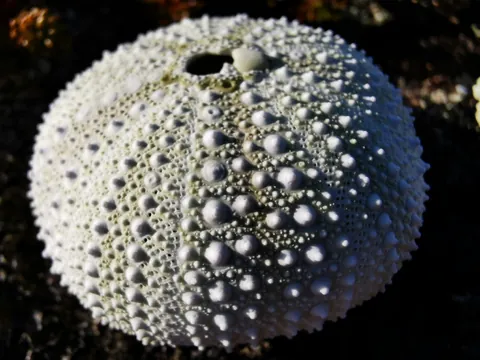
Arctic Green Sea Urchin
Strongylocentrotus droebachiensis
Echinothrix calamaris
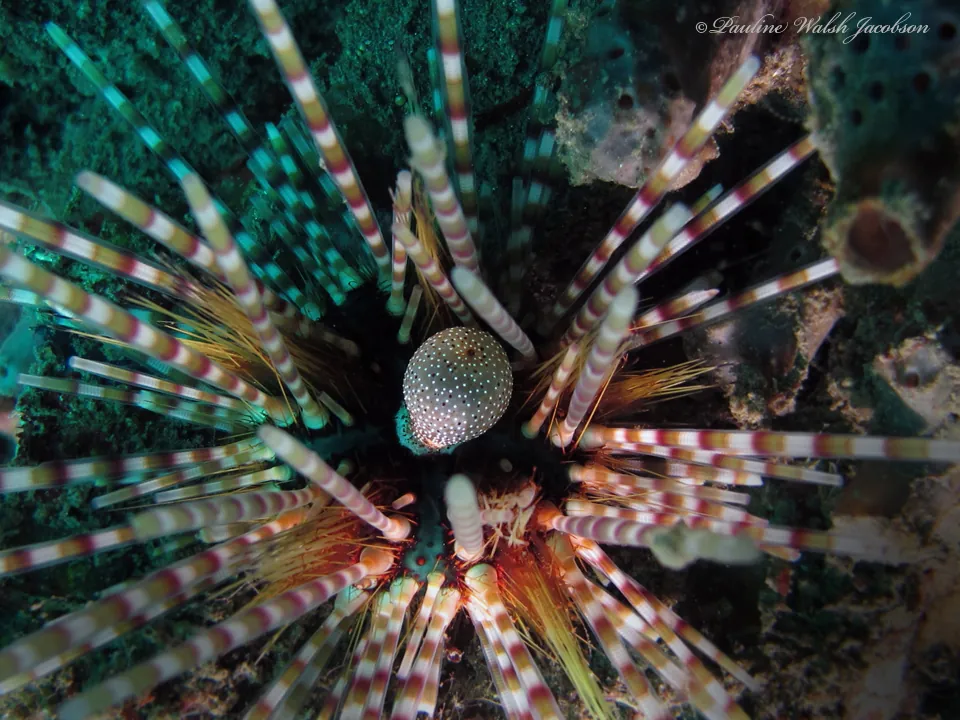
The banded sea urchin is a night animal. During the day it sits tucked into a crevice or under a rock, and it comes out to move around after dark. Its thin spines are venomous and can give a nasty sting, though they are not dangerous. Other animals make use of that defence: young cardinalfish often hover inside the spine canopy for protection, and in Hawaii the urchin frequently carries a small crab, Echinoecus pentagonus, that lives on it.
Also known as: double spined urchin, double-spined sea urchin, banded urchin
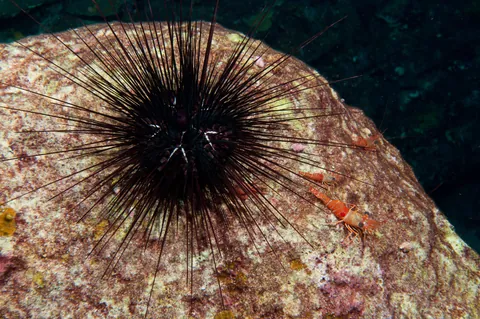
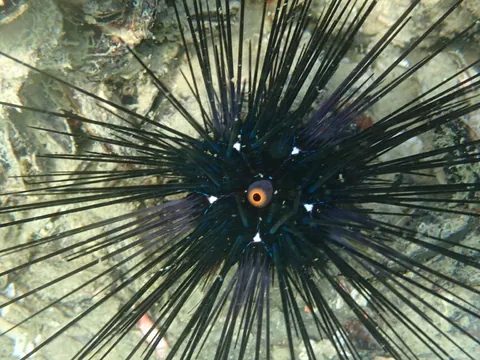
Look at the top of the animal, in the middle of the spines, for a large pale sac speckled with black and white. It is obvious at viewing distance and it is the feature to trust, because the spines vary: banded in most animals, but plain dark or plain white in others. Next look at the spines themselves. This urchin shows two sets at once, a dense mat of short thin spines under a spread of long thick ones. Between them, five bare star-shaped patches show on the shell, often blue. Never test the spines by hand.
The test, the round shell under the spines, is slightly oval. The urchin carries two clearly different sets of spines, and in this species the difference is easier to see than in its relatives. The short, slender spines are closed and range from yellow through brown to almost black; these are the stinging ones. The long spines are thicker, hollow and often blunt at the tip, and they are usually banded light and dark, though some animals have them all dark or all white. The spines are arranged so that five bare patches show on the top of the test in a star pattern, and these patches are often coloured blue. On top of the animal sits a large, more or less see-through anal papilla, a soft sac that is usually whitish and speckled with black and white. In the Indian Ocean many animals are much darker, with unbanded spines that shine green and a reddish test.
This urchin lives across the tropical Indo-Pacific, from the coast of East Africa to French Polynesia, taking in the Red Sea and Hawaii. It is found in lagoons, in channels and on outer reef slopes, on shallow coral and coral rubble, and it is recorded down to 90 m. Most divers meet it in shallow water, and in daylight you will normally see only the spines sticking out of a hole.
The pale sac on its back is ringed by light receptors, so this urchin has a simple kind of eyesight in a place where you would not look for eyes.
Describe what you saw and we name it, then keep every species you find in your Oceandex.