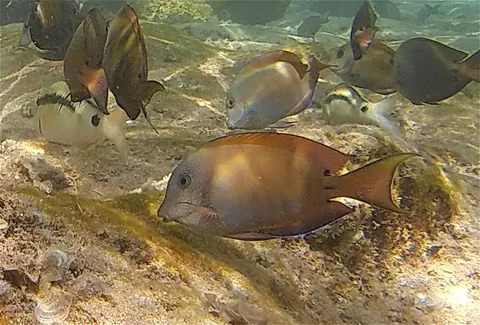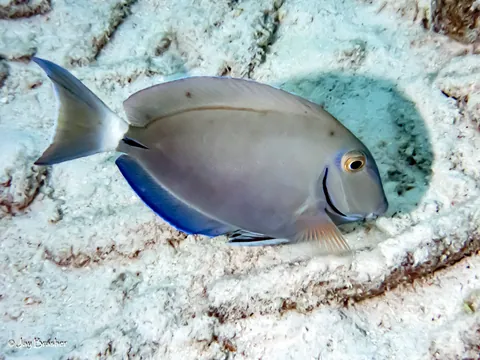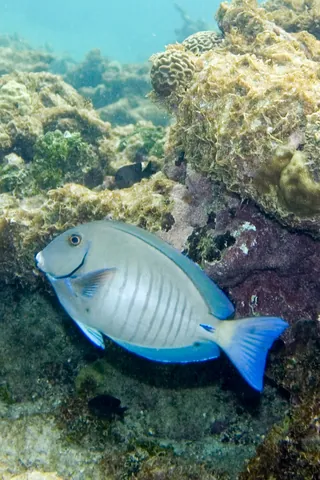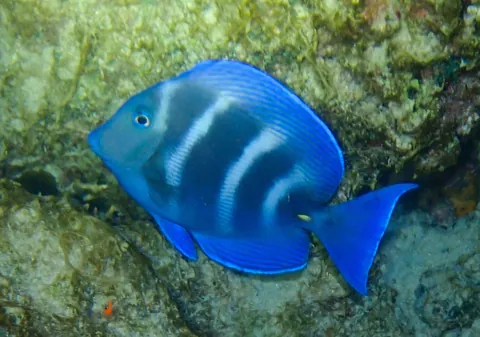
Atlantic Blue Tang
Acanthurus coeruleus
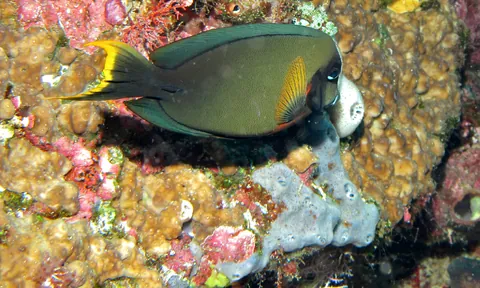
Ctenochaetus striatus
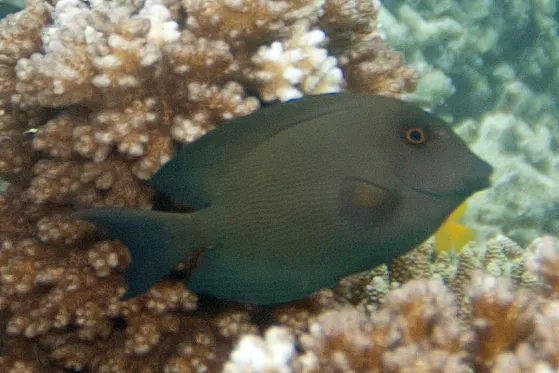
The lined bristletooth is a common Indo-Pacific surgeonfish. It is a grazer that works the reef surface all day, scraping up the thin film of algae that coats coral rock. Divers see it alone or in loose groups, often mixed in with other surgeonfishes. It reaches about 26 cm, and most are around 18 cm.
Also known as: striped bristletooth, fine-lined bristletooth, striped bristle-tooth, striated surgeonfish
Several other bristletooths share this reef and a similar body colour. The mark to check for is the dusting of small orange spots across the head.
The body is deep and flattened from side to side, like a plate held on edge. The colour is dark olive to yellowish brown. Along the flanks run slender, slightly wavy blue-grey lines, and these lines carry on into the dorsal fin on the back and the anal fin underneath. The head and nape are dotted with many small orange spots. The tail is crescent-shaped. Like other surgeonfishes, it has a blade-like spine on each side of the tail base that folds down into a groove.
This fish lives right across the Indian and Pacific Oceans, from the Red Sea and the East African coast east to the far islands of French Polynesia. It is a reef fish of shallow water: reef flats, lagoons and seaward reef slopes, over hard coral, bare rock pavement and rubble. Records run from 1 m down to 35 m, and it is most often seen between about 6 m and 30 m.
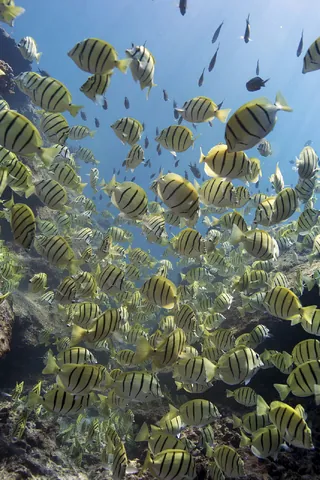
You may find a single fish, a small group, or a very large school, often mixed with other surgeonfish species. It feeds by combing the surface film of blue-green algae and diatoms (single-celled algae) off hard surfaces, and it takes small invertebrates as well. Spawning is tied to the full moon. The fish gather in large numbers and hang almost motionless in the water, turning grey, before small groups rise towards the surface and circle each other while releasing eggs and sperm.
Reef fish larvae usually either avoid reef noise or listen for particular sounds. The larvae of this surgeonfish stand out: they are drawn to noisy places without being fussy about which sound it is.
Describe what you saw and we name it, then keep every species you find in your Oceandex.