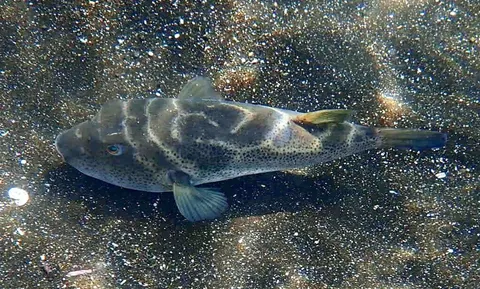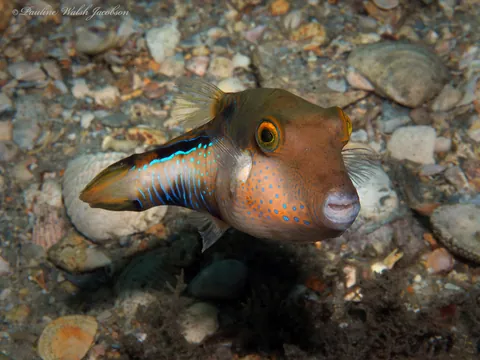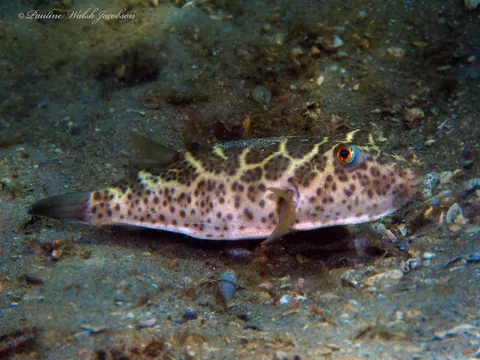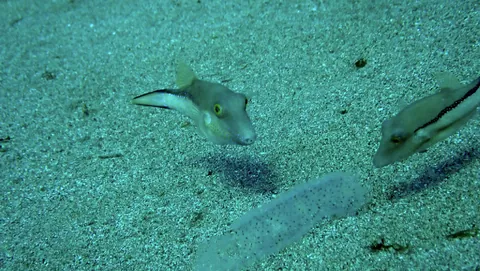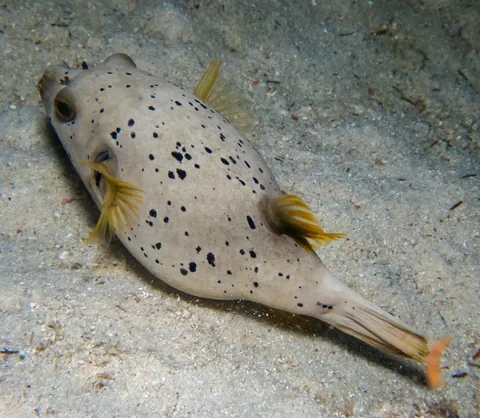
Blackspotted puffer
Arothron nigropunctatus
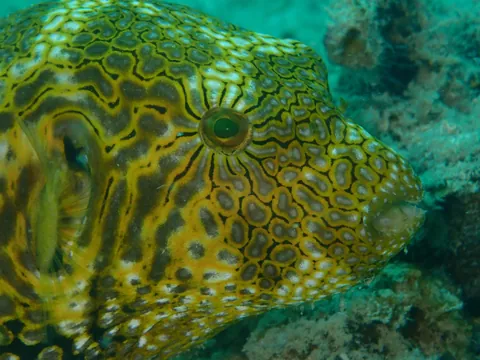
Arothron meleagris
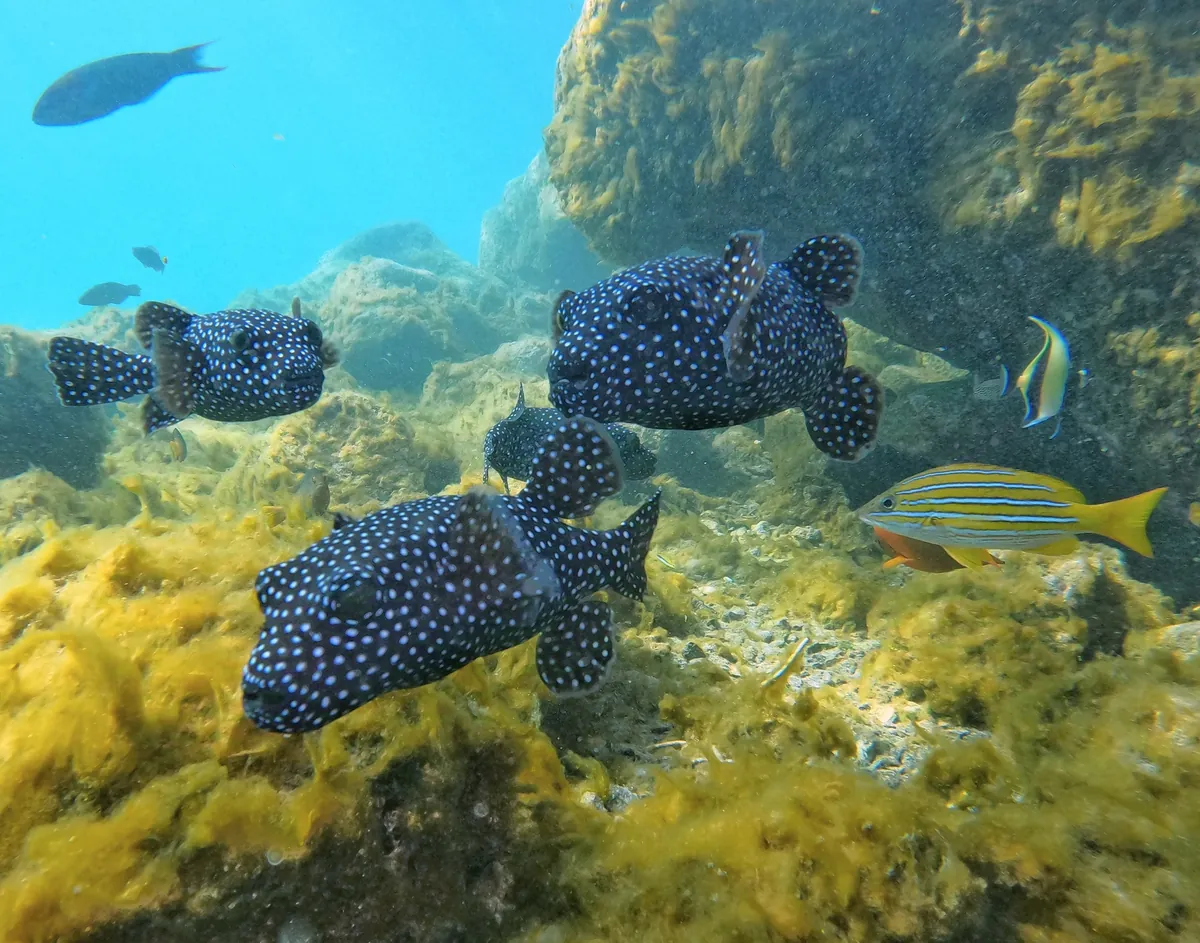
The guineafowl puffer, also called the golden puffer, is a heavy, rounded reef fish that grows to about 50 cm. It wears one of three bold, speckled colour schemes, and can inflate itself into a spiky ball at the first sign of danger.
Also known as: spotted puffer, guineafowl puffer, whitespotted pufferfish, white-spotted puffer, spotted puffer, white-spotted balloon, guinea-fowl pufferfish, velcro-fish, guineafowl blaasop, whitespotted pufferfish, white-spotted pufferfish
This puffer's whole body is covered evenly in bold spots from head to tail, in black-on-white, yellow-on-black or a mixed pattern, unlike reef puffers with patchier, uneven blotching. That even, all-over speckling is the quickest check.
The body is heavy and rounded, with a large blunt head, a short snout and a set of massive teeth. The dorsal and anal fins are small and set well back on the body, and the caudal fin base is long and deep with a rounded tip. Small denticles cover the skin like coarse sandpaper, and stand out when the fish puffs up. Colouration comes in three forms: black with many small white spots, bright yellow with black spots, or a mix of yellow with black patches. Spots on the rear of the body tend to be smaller than those on the sides.
It lives among Indo-Pacific and eastern Pacific reefs, favouring coral-rich areas over open rocky reef, at depths from about 1 to 73 m.
Coral reef destruction has reduced the habitat and food supply this species depends on, and it is also targeted by the marine aquarium trade because of its striking colours. Its population has been reported to decline in some regions as a result.
The yellow colour form of this species has fetched up to US$500 in the aquarium trade, far more than its black-and-white form.
Describe what you saw and we name it, then keep every species you find in your Oceandex.