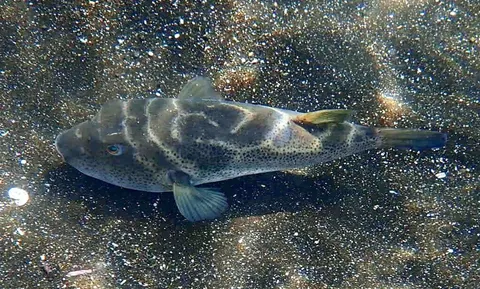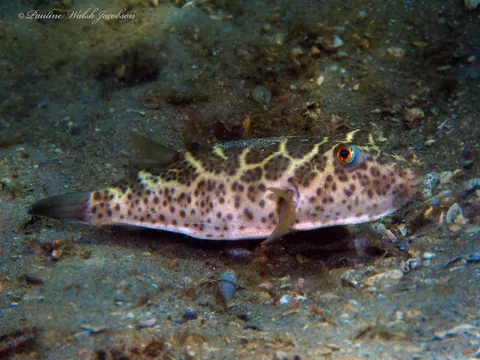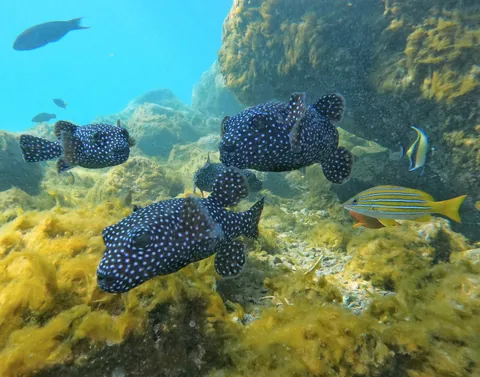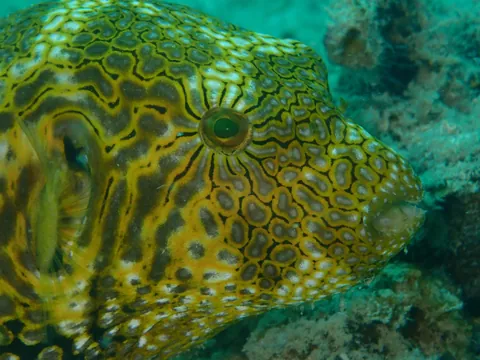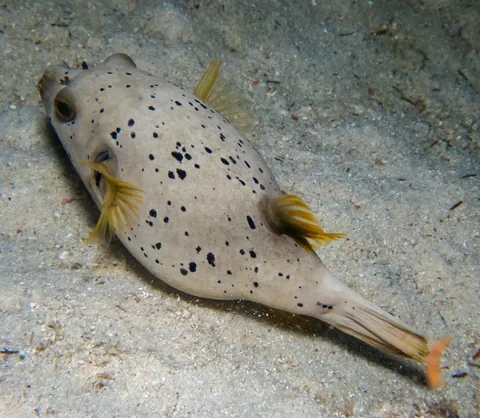
Blackspotted puffer
Arothron nigropunctatus
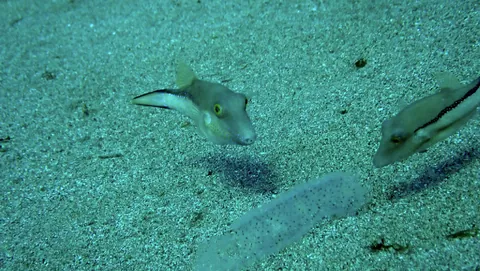
Canthigaster rostrata
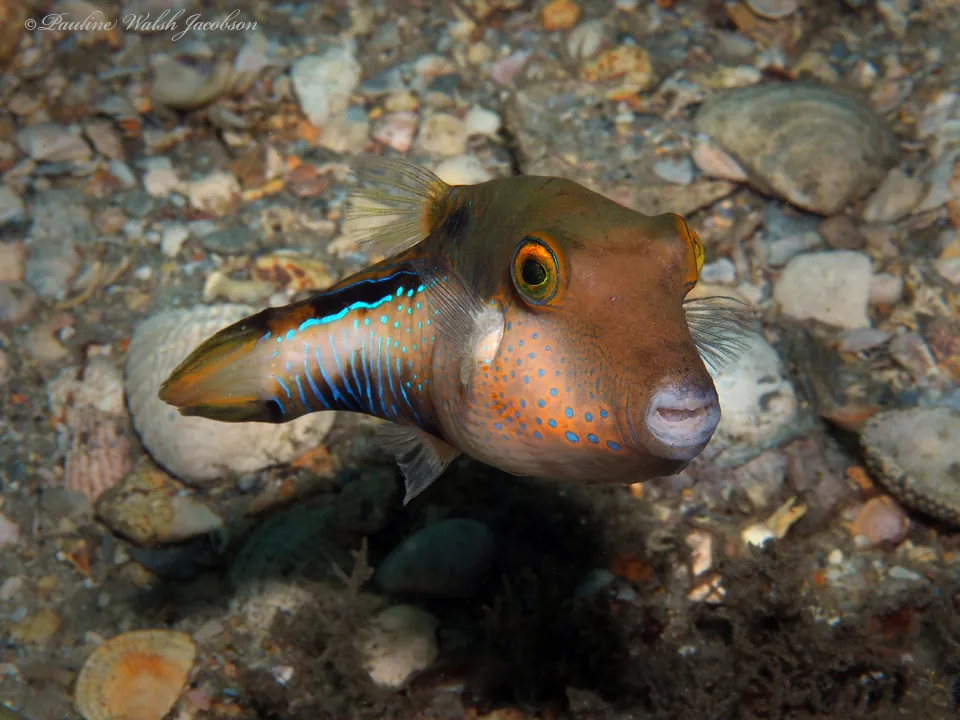
The Caribbean sharpnose puffer is a small, boldly marked reef fish that catches a diver's eye with a scatter of bright blue spots. It grows to about 12 cm, yet its colour and its slow, hovering swim make it easy to spot on a reef.
Also known as: sharpnose puffer, sharpnose pufferfish, caribbean toby
Other small Caribbean pufferfish can look similar at a glance. Look for a short dark stripe along the upper back, running from the tail toward the dorsal fin, plus pale bars on the snout; other local species instead show a large spot on the back or bars across the tail fin.
This puffer has a boxy, non-streamlined body built for slow swimming rather than speed. Its back is dark brown, fading to white below, with blue spots across its sides and head. A dark line borders the base of its bright yellow tail fin. Fine spines cover its skin instead of scales.
It lives from South Carolina down through the Caribbean, mostly on coral reefs but also over seagrass beds and other shallow marine ground. It stays in water no deeper than 40 metres, close to reef structure and open sand.
Its clumsy swimming style would make it easy prey, but strong defences keep most predators away. When threatened, it gulps water to inflate its body to several times its normal size. Few animals manage to eat it; the great barracuda, red lionfish, and green sea turtle are among the rare ones that do.
It is an omnivore that grazes on seagrass, sponges, and algae. It also eats polychaete worms, shrimp, crabs, snails, sea stars, sea cucumbers, and urchins.
Spawning peaks in spring, usually at dawn. A male spreads his fins to court a female living in his territory, and she signals interest with a mottled colour pattern. She then releases a cluster of eggs onto sand or into an algae nest in a seagrass bed, which the male fertilises externally. One male mates with several females in his territory, and neither parent cares for the eggs after they hatch.
In Mexico this puffer is called tamborin narizon, or 'big-nosed tambourine', a nod to its pointed snout and rounded body.
Describe what you saw and we name it, then keep every species you find in your Oceandex.