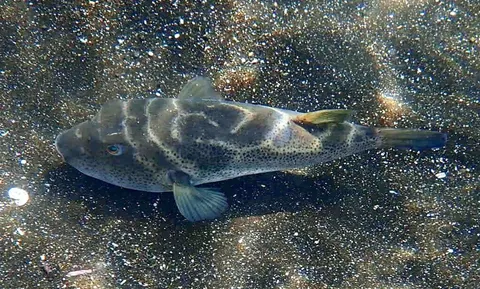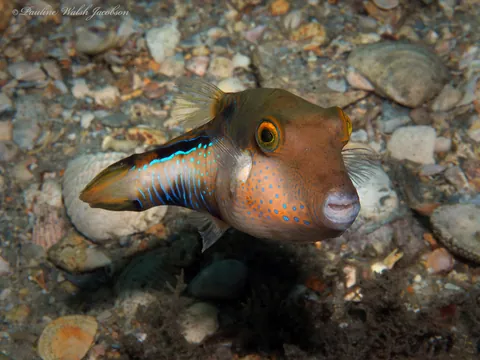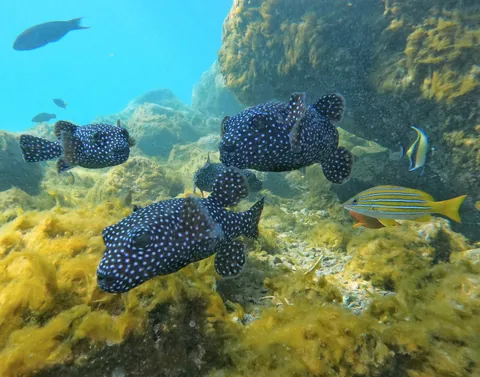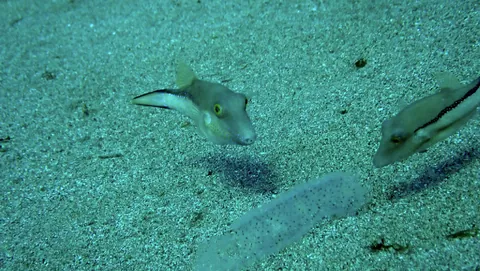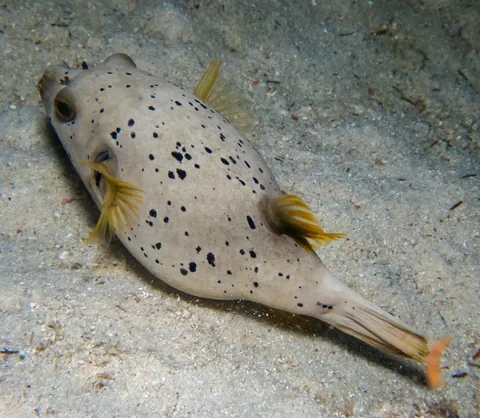
Blackspotted puffer
Arothron nigropunctatus
Arothron mappa
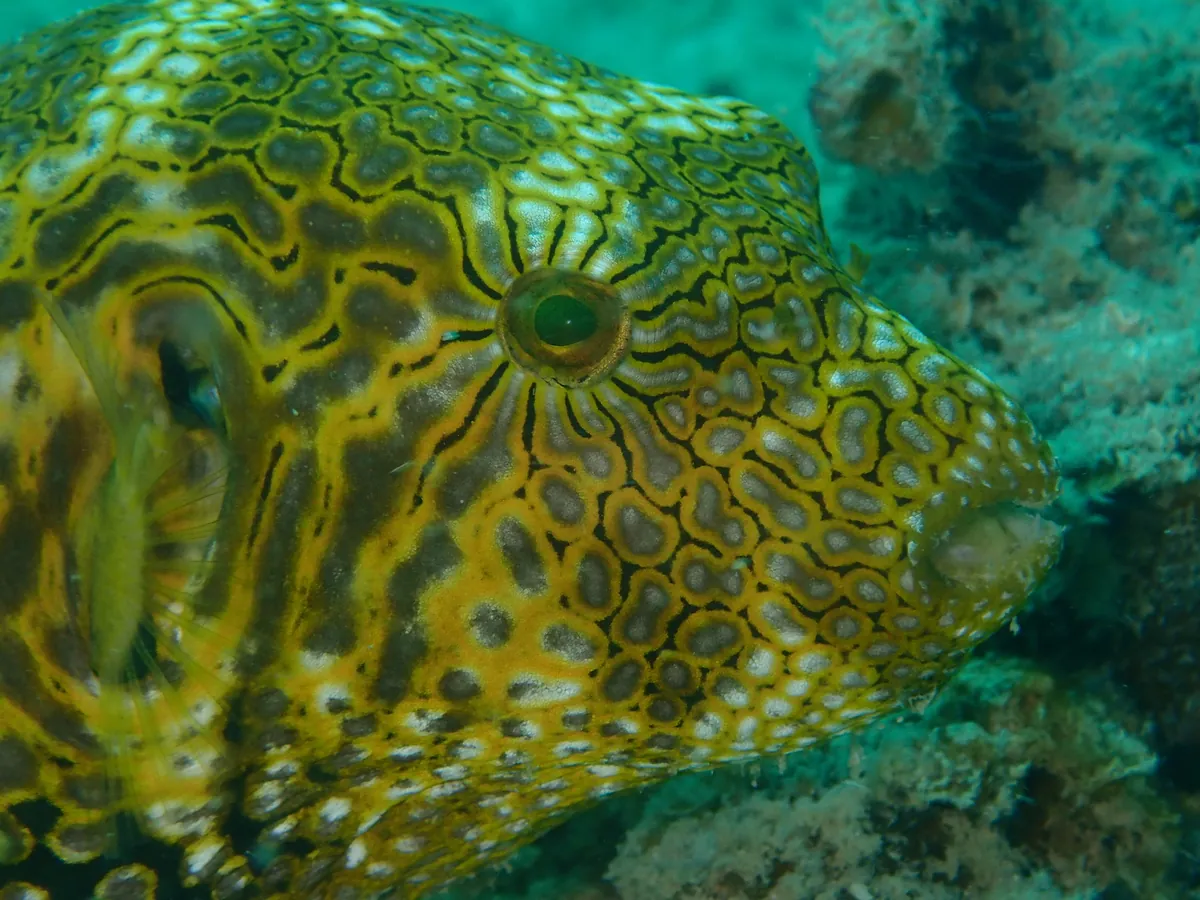
The map puffer is a large, slow-moving pufferfish found from the Indian Ocean to the western Pacific. Like other puffers, it carries a deadly toxin, though it is a popular sight for divers and also appears in aquariums and, in some places, on the menu.
Also known as: scribbled pufferfish, scribbled toadfish, map blaasop, scribbled pufferfish, scribbled toadfish, map blaasop, scribbled puffer, map toado, map pufferfish, map blaasop
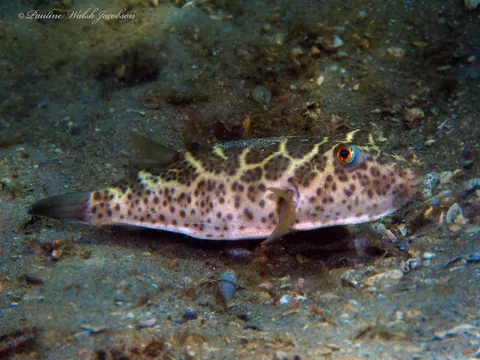
Look for a whitish, oval-bodied puffer covered in a dense network of dark, squiggly, maze-like lines — the pattern that gives this species its 'map' name.
Its body is oval and somewhat elongated rather than fully round. Instead of scales, most of its skin is covered in tiny dermal spines, except around the mouth and the base of the fins. It has no pelvic fins and no lateral line — the sensory stripe some fish use to detect movement in the water. Its four teeth are fused into a hard beak that keeps growing throughout its life and must be worn down by crunching hard-shelled prey. The background colour is whitish, covered in a dense, maze-like network of black, brown, or greenish squiggly lines, with a line radiating out from each eye. It can reach up to 65 cm long.
This species lives in tropical and subtropical waters from the Indian Ocean to the western Pacific. Adults are found along deep drop-offs and in clear, sheltered lagoon and seaward reefs down to about 30 m, while juveniles stay in seagrass beds.
The male digs a large, flattened circular nest in the sand using his fins, carving geometric ridges and valleys into a maze-like pattern. This display attracts a female; if she is drawn in, she releases her eggs into the nest and the male fertilises them. The eggs stay in the nest until they hatch into free-swimming larvae.
A parasitic worm called Psettarium yoshidai is found only inside map pufferfish, and nowhere else.
Describe what you saw and we name it, then keep every species you find in your Oceandex.