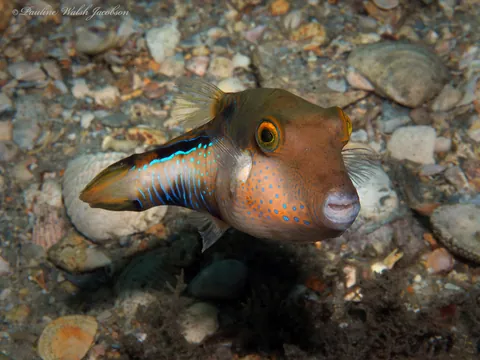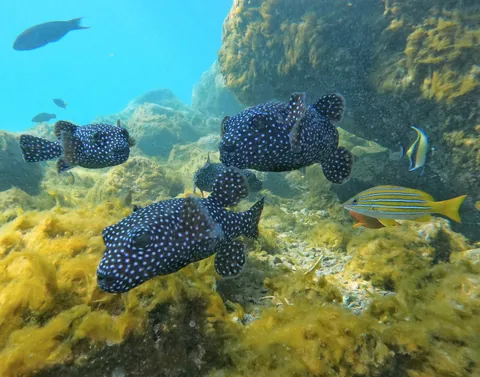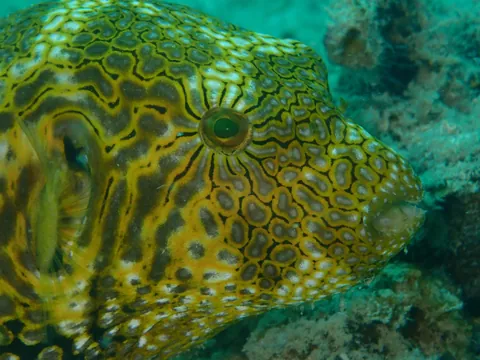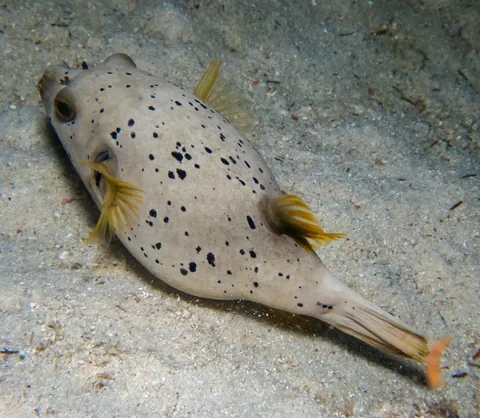
Blackspotted puffer
Arothron nigropunctatus
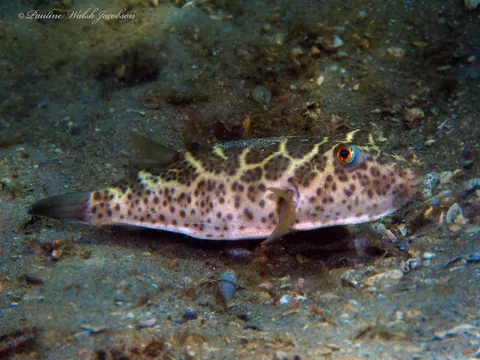
Sphoeroides annulatus
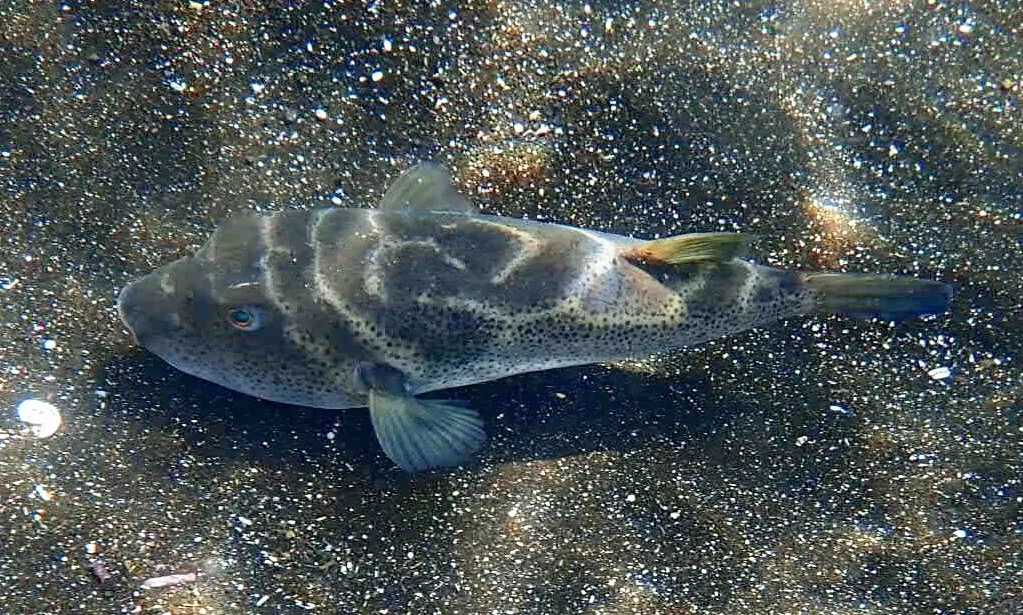
The Bullseye Puffer is a chunky, sand-coloured fish of the eastern Pacific, named for the double ring pattern on its back. It can grow up to 44 cm, though most divers see one closer to 18 cm.
Also known as: bullseye pufferfish
Several similar puffers share this coastline. Look for the double-ring, bullseye-like pattern on the back that gives this species its name, though it can fade and become hard to see in large adults.
Its back is olive-brown with narrow yellowish lines and bars, while its flat belly is white. Small dark spots cover the head, sides, and upper back, and the eye has a yellow iris. The head is large, blunt, and projecting, with a wide gap between the eyes and strong teeth built for crushing shellfish. Fins are small and set well back on the body, the tail is bluntly rounded, and there are no pelvic fins. The skin has no scales but is covered in tiny spines.
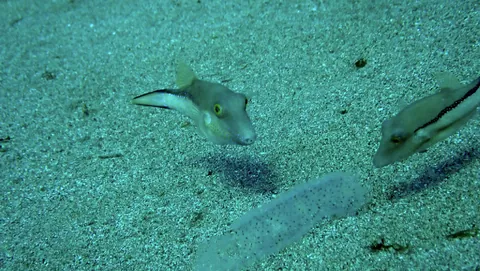
It lives along the eastern Pacific coast, from southern California down to Peru, including the Gulf of California and the Galapagos. Adults sit over sandy bottoms and sand patches near rocky reefs, in 10 to 60 m of water, using the sand to help hide from predators. Juveniles grow up in estuaries and mangroves before moving offshore.
Juveniles start out in fresh water and move into brackish, then fully salt water, as they grow into adults. This species relies mainly on camouflage against the sandy bottom rather than fast escapes, and it is known to make a loud grating noise. Its skin, organs, and gonads carry potent toxins that make it highly poisonous to eat; sharks appear immune and are among its main predators, along with other large fish and sea snakes.
The Bullseye Puffer feeds on insects, crustaceans, and small fish, using its strong, beak-like mouth to pull shellfish out of their shells.
It takes roughly two to three years to reach full size, and this species lives for about ten years on average.
The Bullseye Puffer is listed as least concern, with a stable population across a wide range. It is caught by subsistence fishermen using hook and line off Baja California Sur, and divers often encounter it in mid-water. Habitat loss is considered its biggest threat.
Despite being a puffer, the Bullseye Puffer may not be able to inflate itself to scare off predators, unlike most of its relatives.
Describe what you saw and we name it, then keep every species you find in your Oceandex.