Angelfish
angelfish
Pomacanthus arcuatus
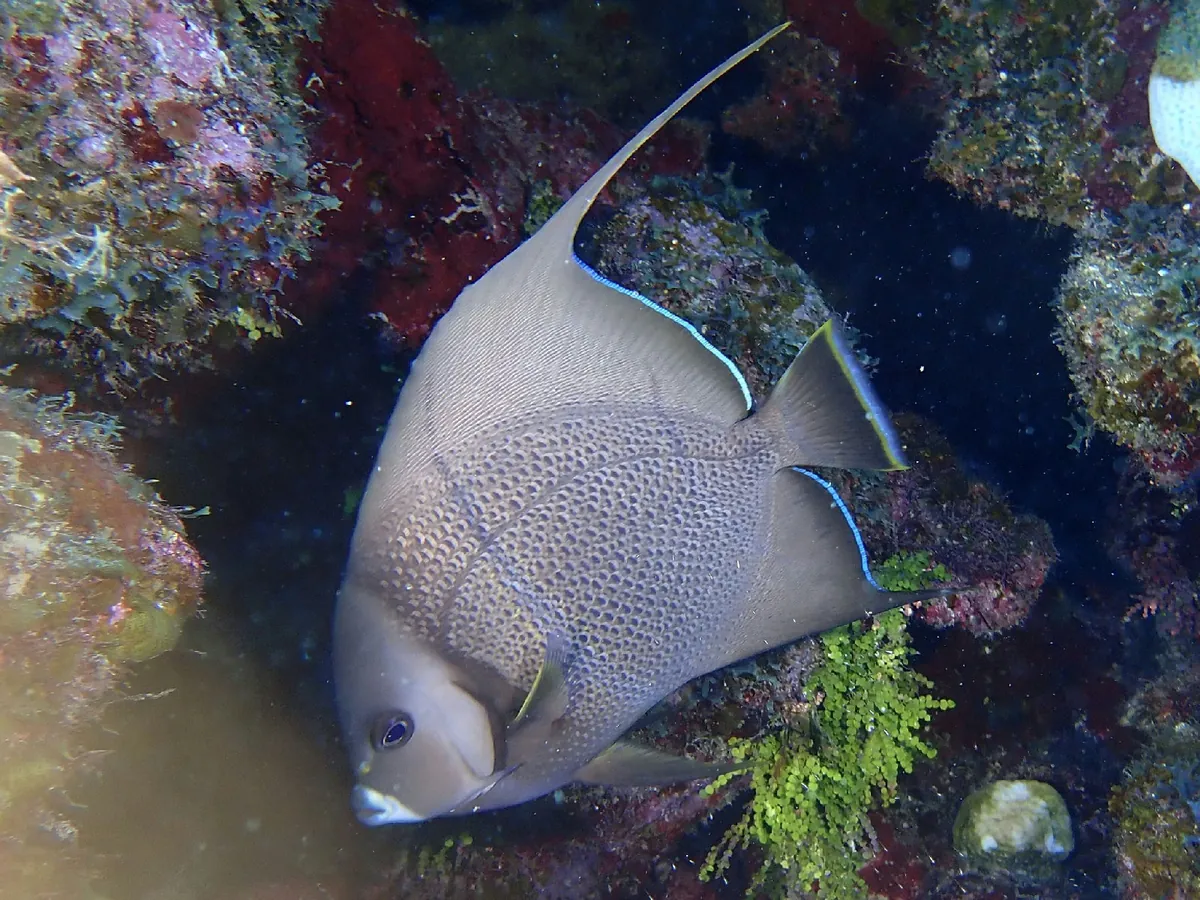
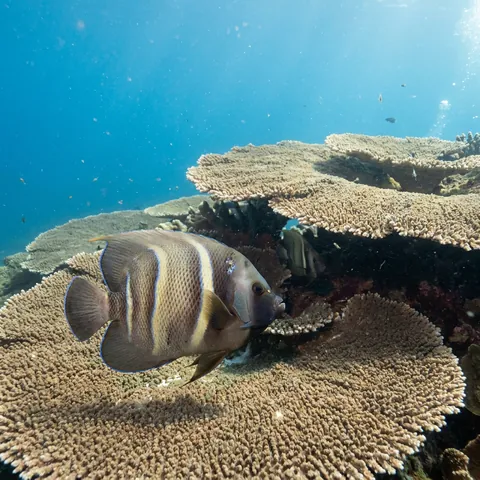
The grey angelfish is a bold reef local that grows up to 60 cm long. Divers often meet it hovering alone over a reef, unbothered by close company, its disc-shaped body catching the light as it turns.
Also known as: gray angelfish
Adult grey angelfish can look like other large grey-and-black reef angelfish. Check the tail: a pale grey margin runs along its edge, a mark that stays fixed even though the body's spotting can vary.
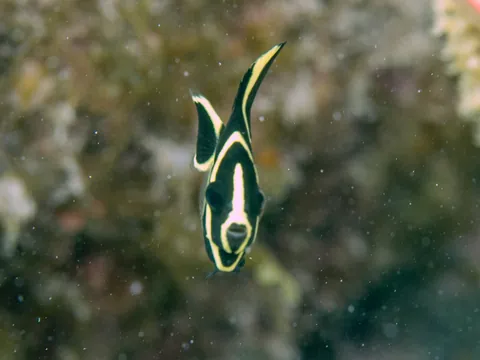
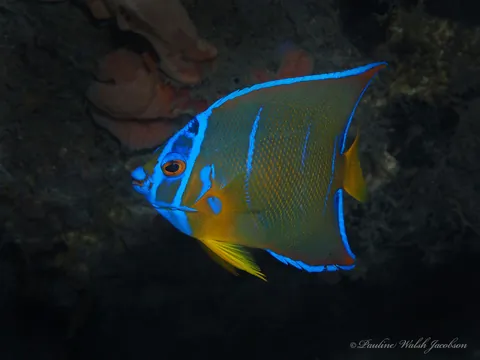
Adults have a flat, disc-shaped body in pale grey, covered in fine black spots. The mouth is white, and the inside of the pectoral fin is yellow. Long streamers trail from the dorsal and anal fins. Young fish look completely different: a black body crossed by five narrow yellow bars, three on the head and two on the body, with a black patch in the middle of the yellow tail.
Lives over coral and rocky reefs at depths from 2 to 30 m. Young fish stay in shallower water, sheltering on patch reefs and in seagrass beds before moving out to deeper reef as they grow.
Feeds mainly on sponges, but also eats algae, sea squirts, gorgonian sea fans, hydroids, and small colonial animals called bryozoans. It is active by day and hides in the reef at night. Young grey angelfish also work as cleaners, picking parasites off larger fish that visit their cleaning station.
Pairs spawn over deep reef in the early morning. They swim up together, bellies touching, to release eggs and milt into open water, and may repeat this several times. The eggs drift with the plankton, and the larvae settle onto the reef once they grow large enough.
This species gets its scientific name, arcuatus, meaning "bowed", from the curved lines on its body - the name Carl Linnaeus gave it back in 1758.
Describe what you saw and we name it, then keep every species you find in your Oceandex.