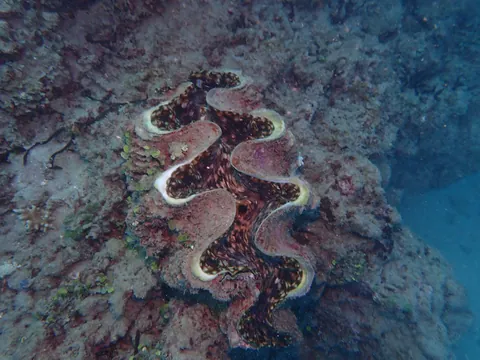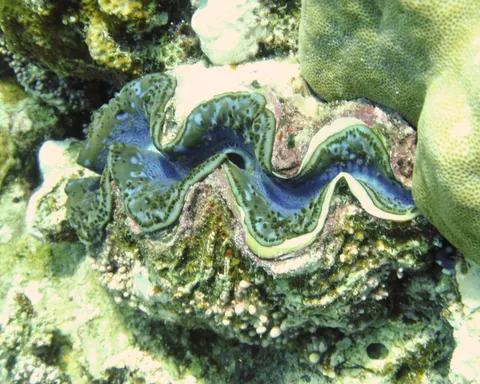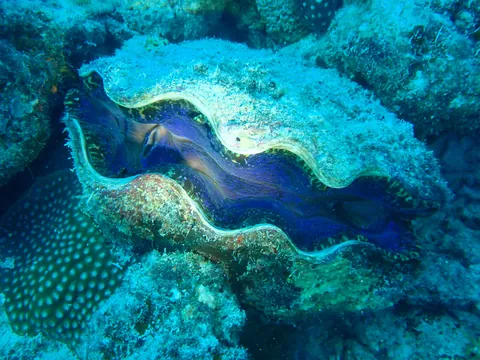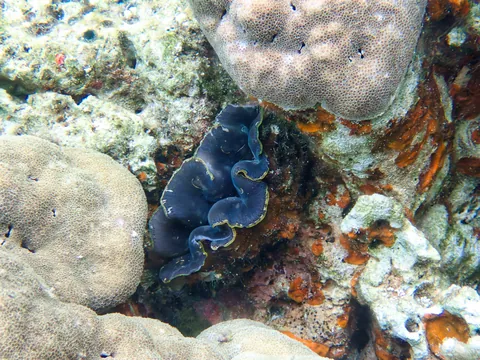
Boring Giant Clam
Tridacna crocea
Tridacna gigas
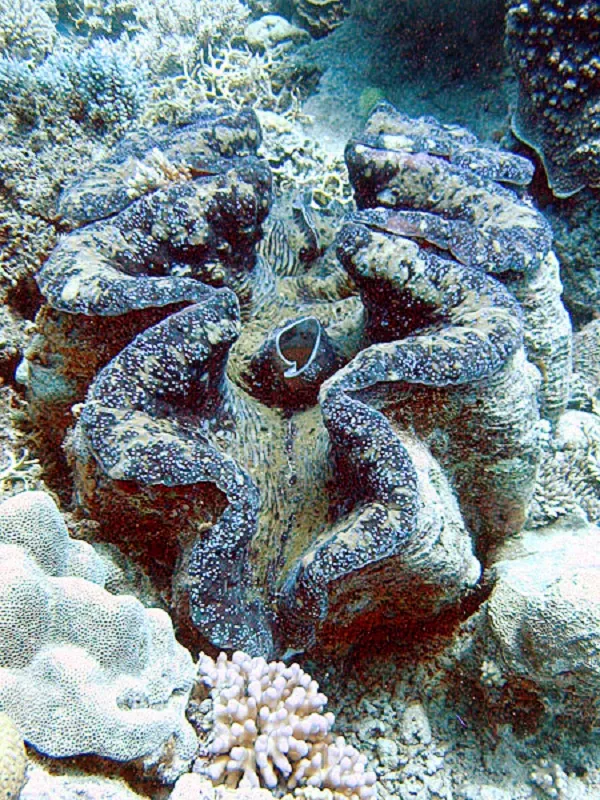
The giant clam is the largest shelled mollusc on the reef, a slow-growing giant that can live for decades wedged into the coral. It can reach 137 cm across and weigh up to 500 kg, though most seen on a reef are smaller, around 80 cm.
Also known as: killer clam, tridacna gigas, tridacna gigas (linnaeus, 1758)
Other giant clam species can look similar, but none reach this size: any clam approaching or passing a metre across on a reef is almost certainly this species.
Its shell is heavy and ridged, with four or five broad vertical folds running across it. Unlike other giant clams, it cannot fully close its shell, so a strip of its brownish-yellow mantle always stays visible. That mantle edge is dotted with hundreds of tiny pinhole eyespots, each one sensitive to changes in light.
It filter-feeds on plankton from the water, but most of its energy comes from algae living inside its mantle tissue. These algae use sunlight to produce food, which lets the clam grow to a huge size even in waters low in nutrients.
The mantle is lined with hundreds of simple eyespots that sense passing shadows and changes in light, letting the clam react to a diver's movement even though it has no proper eyes.
Describe what you saw and we name it, then keep every species you find in your Oceandex.