Fluted Giant Clam
Tridacna squamosa
Tridacna crocea
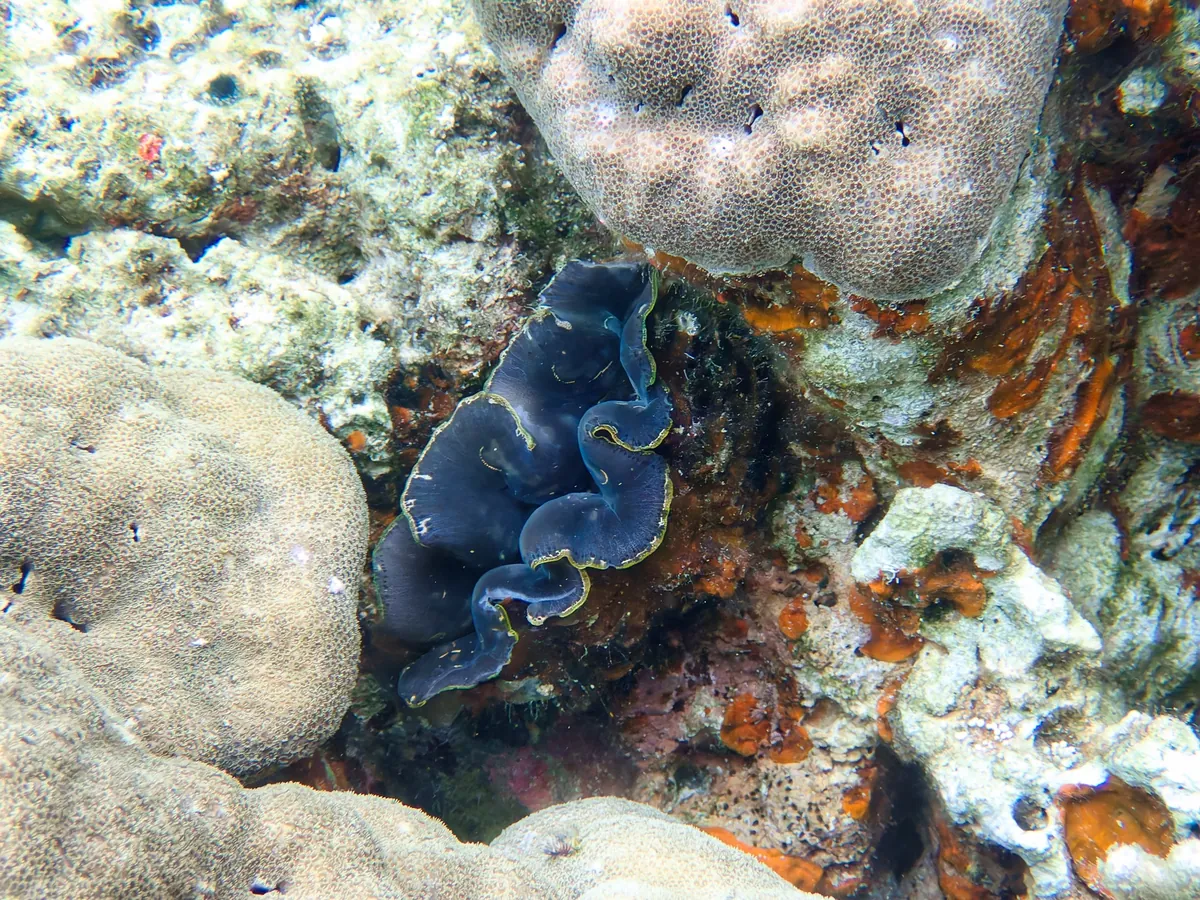
The boring giant clam gets its name from what it does, not from being dull: it bores into solid coral and sits sunk inside it. It is the smallest member of the giant clam group, reaching about 15 cm of shell, with 11 cm more usual. It holds itself in place with byssal threads, tough fibres that pass out through slits in the lower half of the shell and grip the rock. Grinding its way into the coral wears the outside of the shell smooth, and a clam that bores into rock of uneven hardness can end up with a lopsided shell. It is sometimes taken for the aquarium trade. The IUCN lists it as Least Concern.
Also known as: boring clam, crocus giant clam
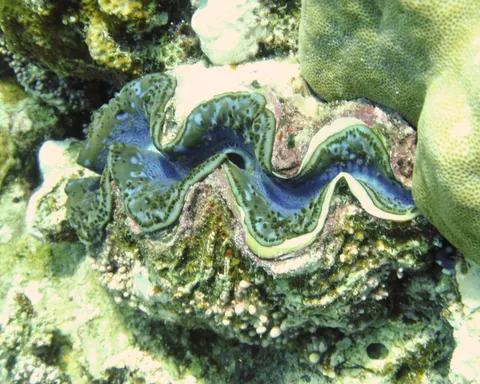
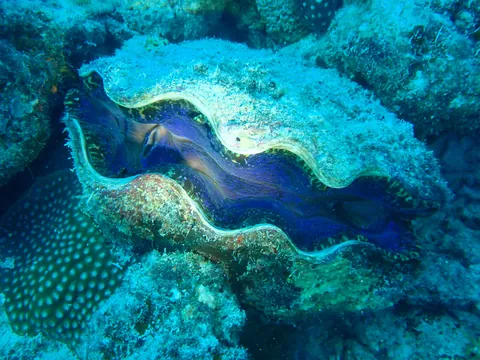
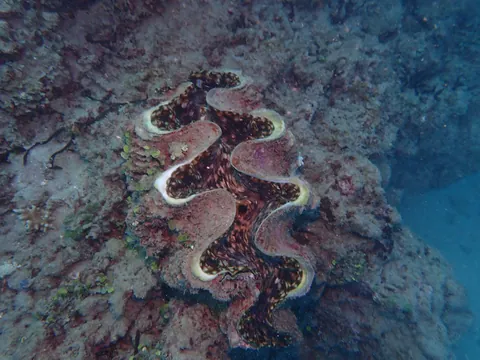
Do not go by mantle colour, which varies from clam to clam. Go by how it sits. This one is buried in the coral head, with the shell almost invisible and only the bright, bumpy mantle showing more or less flush with the coral surface, filling a slot the clam has ground for itself. It is small, hand-sized at most. The shell edge, where you can see it, closes as a zigzag of six to ten interlocking folds. If a clam of this size is standing on the reef rather than sunk into it, it is not this species.
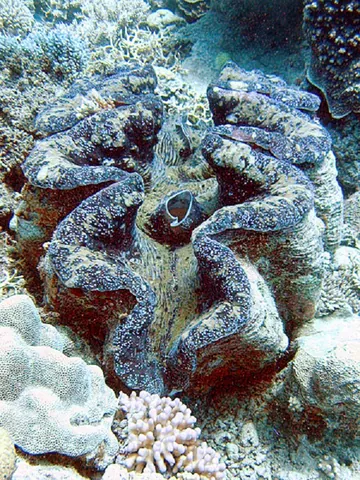
The shell has two thick halves joined by a hinge, and the animal is strongly swollen, most of all near that hinge. The upper half carries six to ten low, flat folds that lock into matching folds on the lower half, so the shell shuts tight along a zigzag edge. The shell itself is plain: greyish-white, sometimes with a hint of pink-orange, yellow or orange near the top edge. The colour is in the mantle, the soft body wall that covers the organs and spreads out between the open shell halves. It can be blue, green, purple, gold, orange or brown, usually marked with spots, stripes or squiggles, and its surface is covered in small bumps. Along the mantle edge sits a row of simple eyes. Water is drawn in through one opening ringed with small tentacles and pushed out through a second, often long and tube-shaped.
This clam lives in the tropical Indo-Pacific, from Southeast Asia and Japan south and east to Australia and the island groups of the western Pacific. It has disappeared from parts of its former range around Guam and the Northern Marianas. Look for it embedded in massive, solid corals, the boulder-like heads rather than branching coral, from the intertidal zone down to about 20 m.
It is the smallest of all the giant clams, at most about 15 cm across, and it is the one that carves its own socket into living coral rock.
Describe what you saw and we name it, then keep every species you find in your Oceandex.