Angelfish
angelfish
Pomacanthus paru
A dark, mesh-scaled angelfish usually met in pairs over the reef, the French angelfish grows to a common length of about 28 cm, with the largest reaching 41 cm.
Also known as: french angel
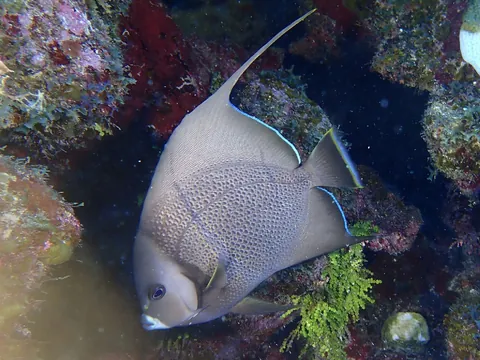
The French angelfish's closest lookalike is the grey angelfish. Check the eye: a yellow ring circles it on the French angelfish, while the grey angelfish's eye has none.
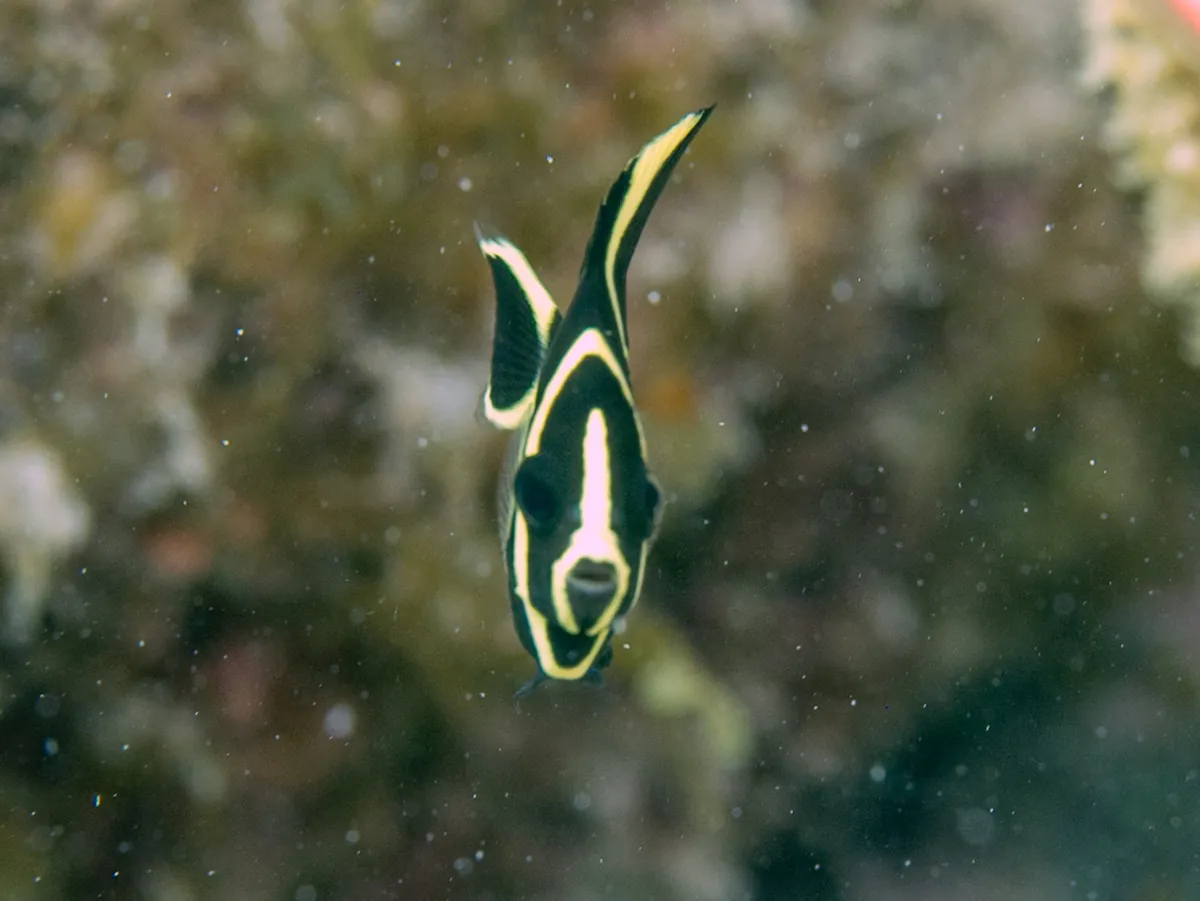
The body is deep but flattened side to side, giving it a tall, narrow profile head-on, with a short snout and a small mouth full of bristle-like teeth. Adults are black to dark grey, with each scale rimmed in bright yellow, giving a mesh-like sheen over the whole body. The mouth is white and a yellow ring circles the eye. A broad orange-yellow band crosses the pectoral fins, and a long yellow filament trails from the rear of the dorsal fin. Juveniles look completely different: they are almost solid black, crossed by five vertical yellow bands running the full height of the body.
It lives on rocky and coral reefs, often near sea fans, from 3 down to 100 metres.
This fish is usually seen in territorial pairs that defend their patch of reef together, often close to sea fans. It is active by day and returns to the same hiding spot every night. When alarmed, it can make a knocking sound. Juveniles behave very differently from adults: they set up fixed cleaning stations and pick parasites off larger fish that come to be serviced.
Adults feed mainly on sponges, using their comb-like teeth to grind up pieces. Juveniles instead feed on the parasites, mucus and dead tissue they clean from other fish, gradually shifting toward a more sponge-heavy diet as they grow.
French angelfish form lasting, monogamous pairs rather than mating in groups. Courtship is rarely witnessed, but on the occasions it has been seen, a paired male and female rise together from the reef near dusk, swimming close together with their bodies angled toward one another before separating again.
Currently listed as Least Concern, though the species is under growing pressure from the marine aquarium trade and from being caught as bycatch. Because these angelfish grow slowly and mature late, their populations are slow to recover from heavy fishing.
Scientists can work out how old a French angelfish is by counting the growth rings in its ear stones (otoliths), much like counting rings in a tree trunk.
Describe what you saw and we name it, then keep every species you find in your Oceandex.