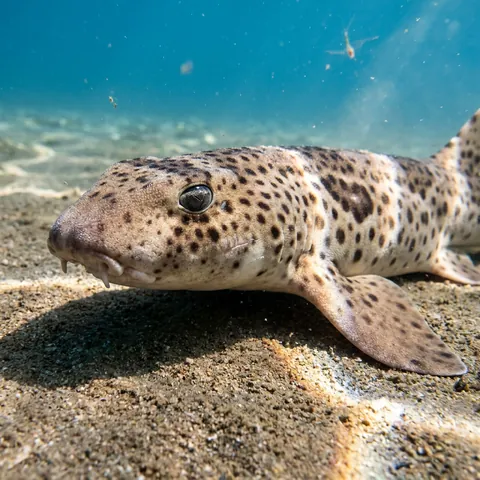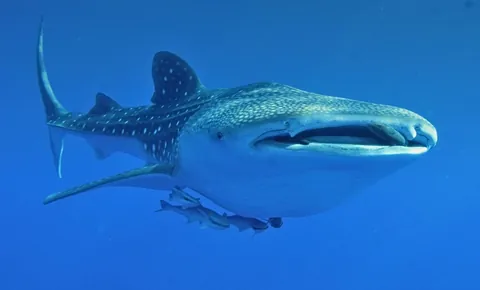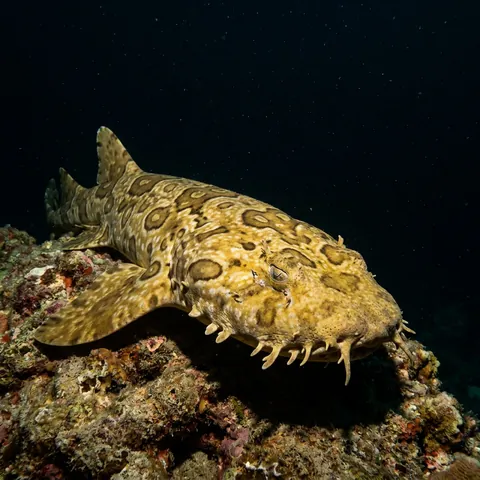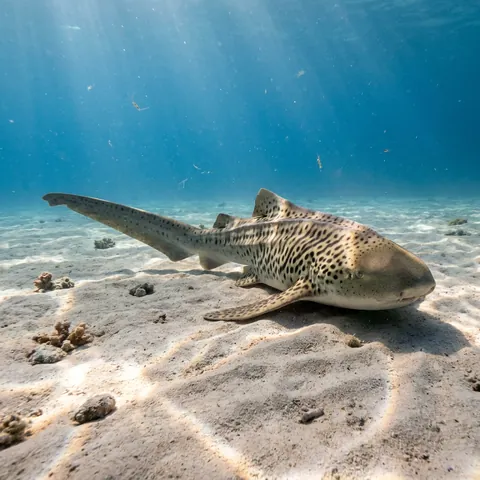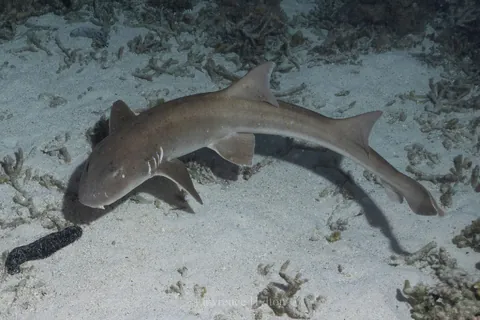
Brownbanded bamboo shark
Chiloscyllium punctatum
Hemiscyllium ocellatum
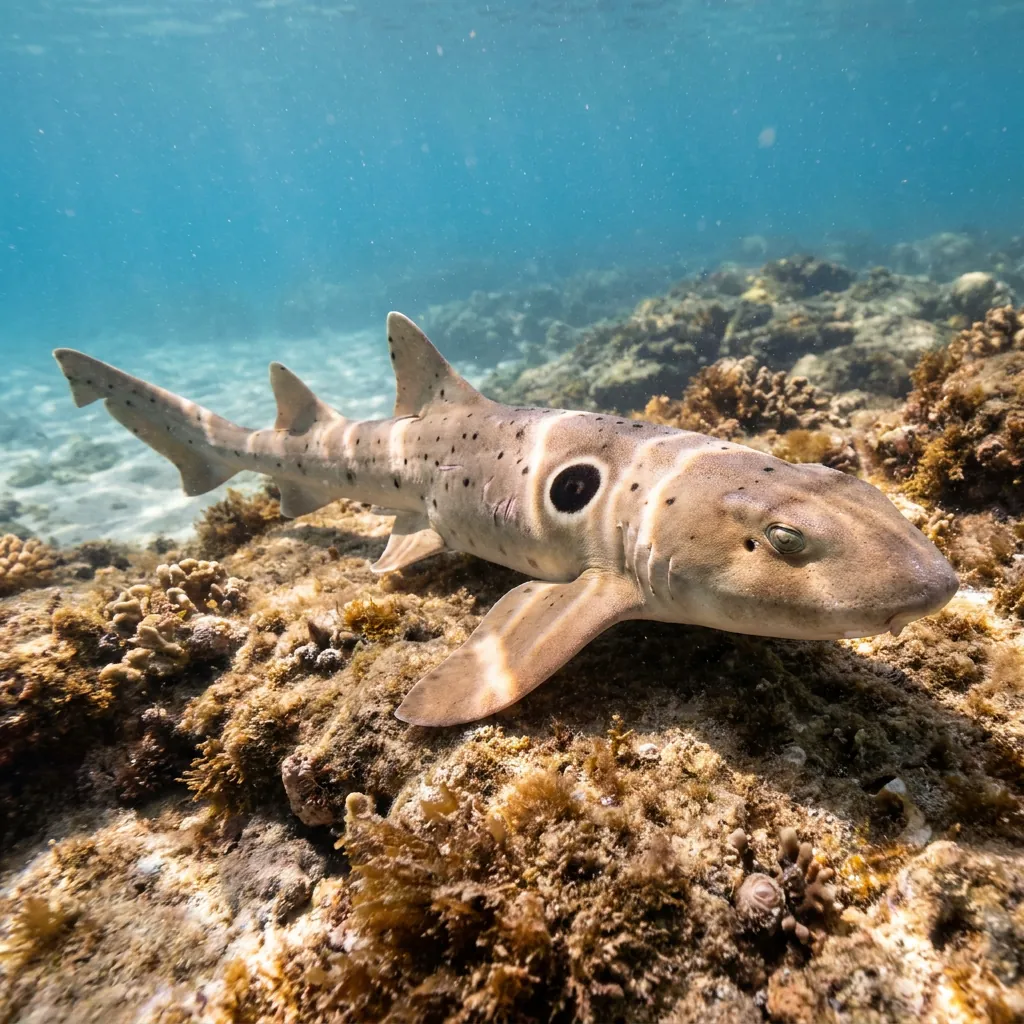
The epaulette shark is a small, harmless reef shark best known for walking across the seabed on its fins. It gets its name from a large, ringed spot behind each pectoral fin that looks like a military shoulder badge.
Similar carpet sharks share a spotted look, but this species' pectoral eyespot is not ringed by other large spots, and it has smaller spots on the head in front of and below the eyes, a useful pattern to check against lookalikes.
This shark has a long, slender body, more than half of it made up by the tail section. Its snout is short and rounded, with tiny barbels near the nostrils. The broad, rounded pectoral and pelvic fins are thickly muscled, built for pushing off the bottom. Colouring is beige to brownish with scattered brown spots and faint darker bands, and a large black spot ringed in white sits behind each pectoral fin. Young sharks show bold light and dark bands that fade as they grow. It can reach up to 107 cm long.
It lives in shallow, tropical water off northern Australia and southern New Guinea, with a particularly large population around the Great Barrier Reef's Capricorn-Bunker Group. It is found down to about 50 m, though it is often seen in water barely deep enough to cover its body, favouring tide pools, coral flats, and stands of staghorn coral.
This shark is famous for appearing to walk, bending its body side to side and pushing off the bottom with its paired fins like a pair of limbs, a gait similar to a salamander's. It can even use this to crawl between isolated tide pools. Mostly active at night and in shallow water, it hides under or beside coral by day and sometimes perches in the open, facing into the current.
It hunts crabs, worms, and small bony fish hiding on the seabed, relying on smell and its ability to sense weak electric fields rather than sight. It sucks prey into its mouth, and will dig its snout into sand or turn over debris to find hidden food, blowing sand back out through its gill slits. Flattened teeth let it crush hard-shelled prey.
The epaulette shark can survive in low-oxygen tide pools by shutting down non-essential brain activity, letting it keep functioning where most fish would struggle to breathe.
Describe what you saw and we name it, then keep every species you find in your Oceandex.